Galápagos Islands / Ecuador Things to do
What are the most worthwhile things to do in Galápagos Islands on a first visit?
The short answer
Walk the tortoise breeding center at the Charles Darwin Research Station, climb to the Bartolomé viewpoint over Pinnacle Rock, snorkel with sea lions at a park visitor site, and take one boat to a remote island — Genovesa or Española — that the land-based trips cannot reach.
The answer, with local context
The archipelago is a managed site before it is a destination, and its mechanics shape the pleasures. Only four islands have towns — Santa Cruz, San Cristóbal, Isabela and Floreana — and everything beyond them is reached by boat, on itineraries the National Park approves: tour vessels are capped at 100 passengers, every landing inside the protected area is led by a licensed naturalist guide, and the park's rules hold visitors on marked trails, at least 2 meters (6.5 feet) from the animals, with no touching, feeding or flash-lit close-ups. Within that frame, a first visit has a clear skeleton.
On Santa Cruz, the Charles Darwin Research Station in Puerto Ayora is the islands' interpretive heart: the research station of the Charles Darwin Foundation, a ten-minute walk from the town center, where the Fausto Llerena breeding center raises giant tortoises for repatriation. Its founding story is the archipelago in miniature — the program began by rescuing Española's last surviving tortoises, 14 animals, and their descendants repatriated to the island now number over 1,000; Lonesome George, the last Pinta Island tortoise, lived out his final years here before his death in 2012. The same island gives the wilder version in its highlands: wild tortoises grazing the reserves, the twin pit craters of Los Gemelos in their Scalesia forest, and lava tunnels you can walk through. Across on the coast, Dragon Hill tells the other recovery: in 1975 feral dogs nearly wiped out the land iguanas of northeastern Santa Cruz, and the emergency breeding program that followed rebuilt the colony you now step around. Tortuga Bay, reached by a paved path of about 1.6 miles (2.5 km) from Puerto Ayora, is the town's own beach — white sand, marine iguanas, and a sheltered cove at its far end.
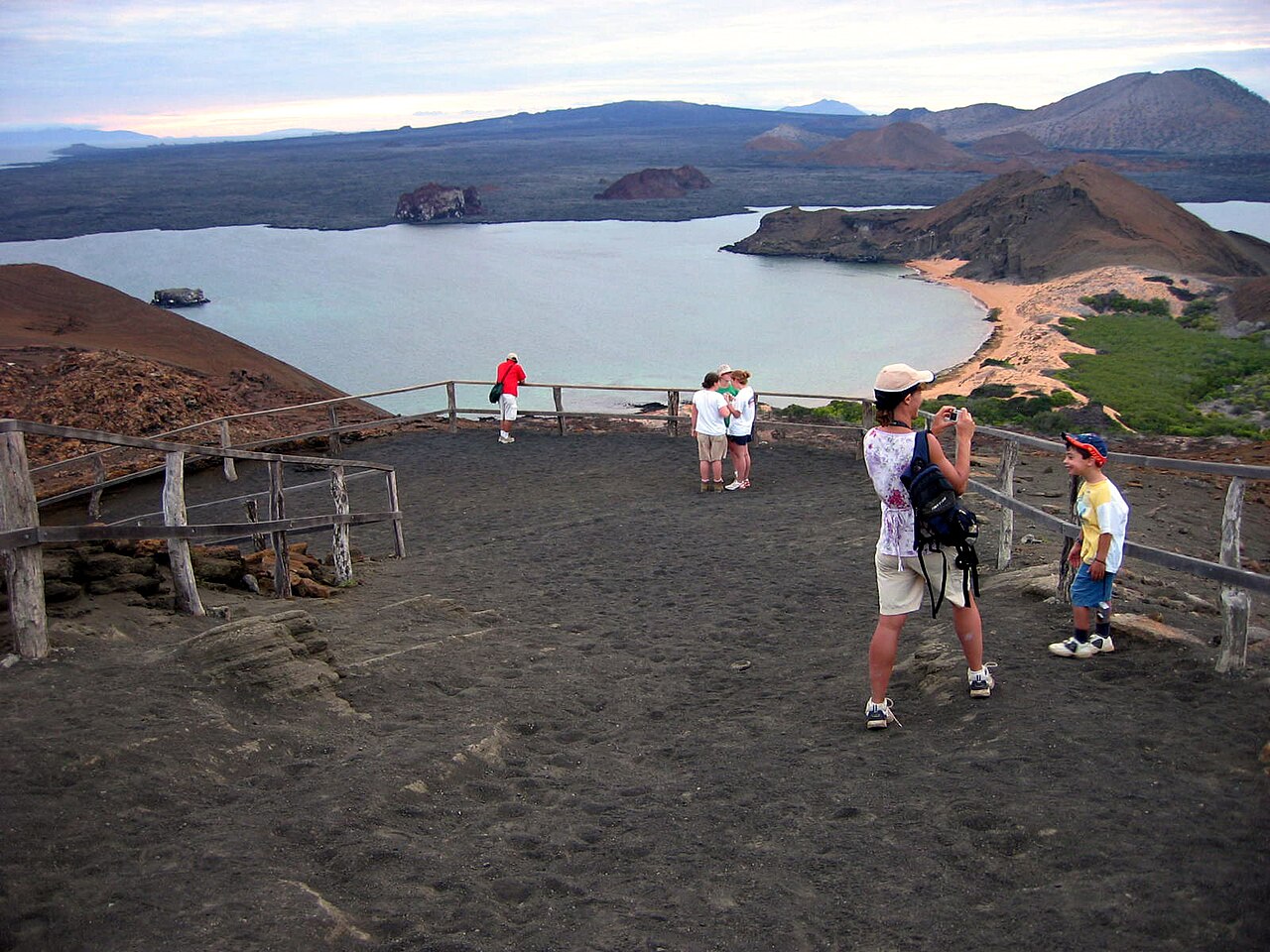
The day boats and cruises supply the set pieces. Bartolomé's boardwalk viewpoint — the islands' postcard — looks down on Pinnacle Rock and two crescent bays, with penguins on the rocks below. San Cristóbal's Kicker Rock rises 499 feet (152 m) straight from the sea, a tuff cone split in two, snorkeled through the channel between its walls. And the far islands justify one proper cruise segment: Genovesa, the bird island, where red-footed boobies nest in the palo santo trees above Darwin Bay, and Española, where the waved albatross colony occupies the southern cliffs from spring to December.
Picture the place
From the Bartolomé summit the view organizes the whole archipelago into one frame: the black lava flows of Santiago across the water, the twin bays curving away below in pale crescents, and Pinnacle Rock standing in the shallows like a sail — with the green of the highlands nowhere in sight, only tuff, ash and sea.
The easily missed detail
At the Research Station, look for the saddleback shells: the dome and saddleback tortoise shapes in the corrals are the visible machinery of evolution — saddlebacks, with their flared, raised shells, evolved on dry islands where a tortoise must stretch upward to browse, and the breeding pens are arranged by island of origin, so a slow walk along them is a tour of the archipelago's climates rendered in shell.
A practical rhythm
- Morning — Take the guided landing first: visitor sites run to the park's schedule, the wildlife is most active early, and the equatorial sun makes unshaded lava trails a midday punishment.
- Midday — Snorkel the midday session and spend the heat on the move between sites, or in Puerto Ayora: the Research Station's shaded paths and the fish market on the waterfront, where pelicans and a resident sea lion supervise the day's catch being sold.
- Evening — Land-based evenings belong to the towns: dinner in Puerto Ayora as the boats come in, and an early night, because the next landing is at dawn whether you are rested or not.
What could complicate the plan
The itinerary rotation is the first-timer's trap: cruise routes are fixed and approved in advance, and a boat that skips Española in albatross season or Fernandina altogether is not a defect — it is that week's rotation — so the island list must be checked before booking, not after. Access has its own formalities beyond the fees covered in the Ecuador answers: since January 31, 2026, the goods declaration for Galápagos-bound travelers is digital only, completed online up to 72 hours before the flight, and luggage is inspected on arrival for the seeds, plants and foods the park's rules bar from the islands. Day-trip boats to the nearer islands are the budget route, but they cannot reach Genovesa, Española or Fernandina — for those, the cruise is not a luxury but the only vehicle.
What to do next
Choose the cruise rotation by its island list, base the land days on Santa Cruz, and give the Research Station the first morning — it teaches you how to read everything you will see afterward.
Sources
- Galápagos National Park Directorate, visitor rules — licensed naturalist guide required inside the protected area; 2-meter minimum distance from wildlife; visitors keep to marked trails; tour vessels capped at 100 passengers on park-approved itineraries
- Charles Darwin Foundation / Charles Darwin Research Station — the Fausto Llerena breeding center in Puerto Ayora; the Española program that began with the island's last 14 tortoises and has repatriated over 1,000 descendants; the Dragon Hill land iguana recovery after the 1975 feral-dog collapse
- Agencia de Regulación y Control de la Bioseguridad y Cuarentena para Galápagos — the digital-only goods declaration in force since January 31, 2026, completed online up to 72 hours before departure, and arrival inspection of luggage