Galápagos Islands / Ecuador Food and drink
Where should I eat in Galápagos Islands, and which local food or drink is worth trying?
The short answer
Eat where the fleet lands: the kiosk grills of Calle Charles Binford in Puerto Ayora for whole fried brujo, canchalagua ceviche on San Cristóbal, spiny lobster only inside the park's open season — and finish with Café de Galápagos, the islands' own protected-origin coffee.
The answer, with local context
There is no separate Galápagos cuisine, and understanding why is the key to eating well here: the islands cook Ecuadorian coastal food with a supply chain of one cargo route. Almost everything that is not seafood arrives by ship from Guayaquil, three days out, while the fish was swimming that morning — so the menu's logic is to order from the sea and treat everything else as ballast. The towns are the table: Puerto Ayora on Santa Cruz, Puerto Baquerizo Moreno on San Cristóbal and Puerto Villamil on Isabela, the ports where the catch is landed and checked.
Order the brujo. The local scorpionfish — red, spiny and unlovely on the slab — has dense, white, faintly sweet flesh and is almost never exported, which is why it appears on no mainland menu; fried whole at a kiosk table with rice, patacones and lime, it is the most Galápagos lunch there is. The canchalagua is stranger and more exclusive: an armored intertidal mollusk, a chiton about 2 inches (5 cm) long with a black shell, found only in these islands and served as a ceviche with red onion and lime — most typical of San Cristóbal, firm as octopus and tasting of clams. The ceviche generally is Ecuadorian, not Peruvian: the fish or shrimp sits in its own citrus-and-tomato broth, and the popcorn and plantain chips that arrive with it are meant to be tipped straight in.
The lobster carries a law. The Galápagos National Park sets the spiny lobster calendar each year for the artisanal fleet: in 2026 the season for red and green spiny lobster runs from August 1 to December 31, minimum sizes apply — 26 cm whole, 15 cm as a tail — egg-bearing females are off-limits, and rangers check the catch at the authorized docks. Eating a species in its closed season, its veda, has legal consequences for buyer as well as seller, and the park has run restaurant inspections on Puerto Ayora's kiosk street with the police; the paper to ask for is the certificado de monitoreo, the monitoring certificate proving legal origin. The slipper lobster, the langostino, runs the calendar in reverse — its season occupies the spiny lobster's closed months, so some legal lobster-shaped thing is nearly always available to those who ask the right question.
Picture the place
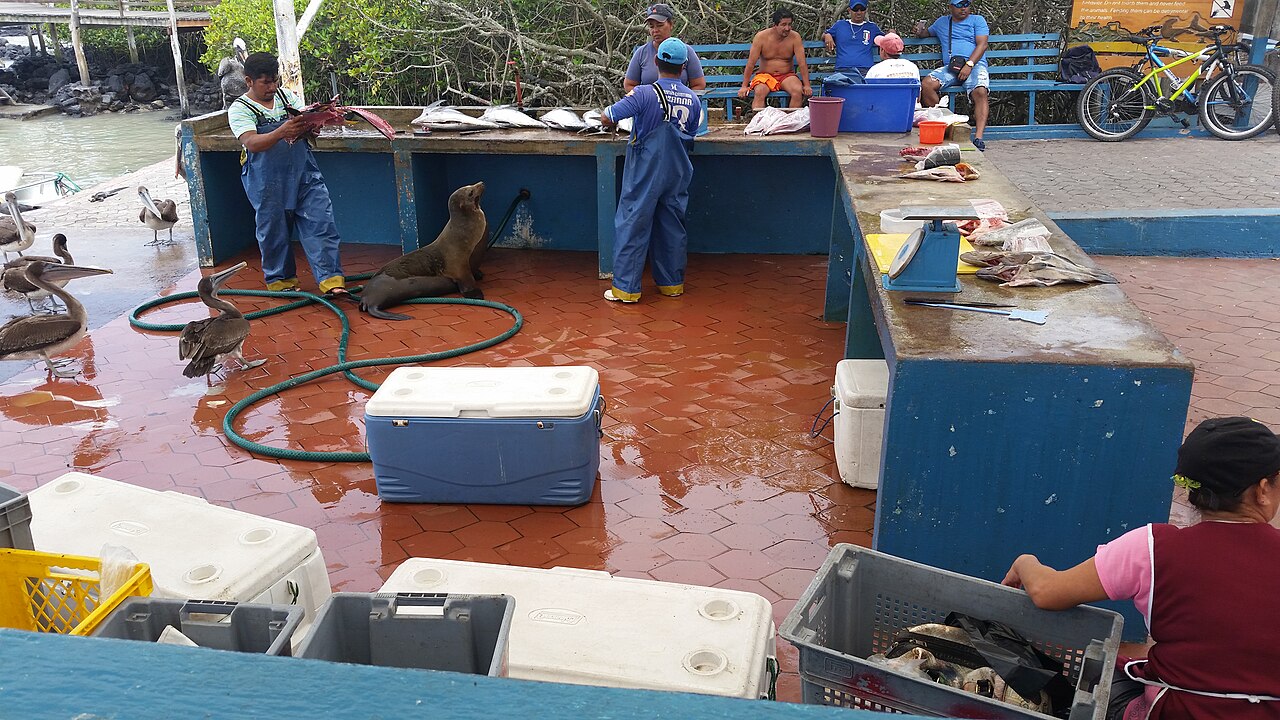
At Puerto Ayora's fish market the morning's catch is filleted on outdoor counters while brown pelicans stand at elbow height hoping for scraps and a sea lion sprawls across the floor in the best spot, entirely in the way — the fishermen working around all of them with the patience of men sharing a small kitchen with relatives.
The easily missed detail
The drink is grown, not imported: coffee reached the islands in 1866 from the French Caribbean colonies, and Café de Galápagos is now a protected Denomination of Origin, cultivated in the humid highlands of Santa Cruz, San Cristóbal and Isabela. In 2024 the agriculture ministry counted 30 producers with 142 hectares (about 350 acres) in certification — a tiny, volcanic-soil coffee industry hiding inside a national park, whose plantations double as bird habitat. A bag of it is the souvenir that clears the biosecurity rules with room to spare.
A practical rhythm
- Morning — Start at the fish market as the fleet unloads: encebollado and bolón de verde are the islands' working breakfasts, and the market tells you what the day's menus will be built from.
- Midday — Take the almuerzo, the set lunch of soup, a main and juice, which runs about $5–8 at simple places — the best value in the islands and the hour when the kiosk grills serve the town itself.
- Evening — Calle Charles Binford — Los Kioscos — wakes up around seven: whole brujo off the grill, lobster in season, the day's ceviche, at plastic tables at half the waterfront's prices.
What could complicate the plan
The veda is the standing complication: lobster offered outside the park's announced season was taken illegally, and the honest answer to a vague reply is to order the brujo instead. Prices carry the cargo ship in them — a tourist-restaurant plate runs two to three times the kiosk equivalent — and Isabela, at the end of the smallest supply chain, costs more than Santa Cruz for almost everything. Cash matters: the kiosks and markets are a small-bills economy, and the dollar notes that mainland Ecuador breaks easily are not so easily broken here.
What to do next
Dinner on the first night: Los Kioscos at seven, brujo whole and fried, canchalagua ceviche if the boat brought it — and ask any lobster seller for the season dates before you ask the price.
Sources
- Galápagos National Park Directorate — the annual spiny lobster calendar set for the artisanal fleet (2026: August 1 to December 31), minimum sizes of 26 cm whole and 15 cm tail, protection of egg-bearing females, dockside catch checks, and the closed-season (veda) rules enforced with restaurant inspections
- Ministerio de Agricultura y Ganadería — Café de Galápagos as a protected Denomination of Origin; 30 producers and 142 hectares in certification in 2024; coffee introduced to the islands in 1866
- Galápagos biosecurity authority (ABG) and park visitor rules — no food, plants or animals to be introduced to the islands, the inspection regime behind the local-only seafood economy