Honduras country guide Places and experiences
What should a first-time traveler see in Honduras beyond the obvious highlights?
The short answer
The Río Plátano rainforest in La Mosquitia, colonial Comayagua and its medieval clock, the Cayos Cochinos cays, and Lake Yojoa with the Pulhapanzak waterfall — the Honduras that lies beyond Copán and Roatán.
The answer, with local context
Copán and the Bay Islands headline Honduras, but the country's second World Heritage site is wilder than both. The Río Plátano Biosphere Reserve in the Mosquitia region of the northeast protects one of the largest surviving tracts of lowland tropical rainforest in Central America, inscribed by UNESCO in 1982 and home to jaguars, Baird's tapirs, harpy eagles and the Indigenous Pech, Miskito and Tawahka peoples who still travel its rivers by dugout. There are no roads in: access is by small plane to Palacios or Brus Laguna and then by boat, and the reserve has been back on UNESCO's List of World Heritage in Danger since 2011 — a measure of both its value and its fragility. It is an expedition, not an excursion, and it is the single most extraordinary place in the country.
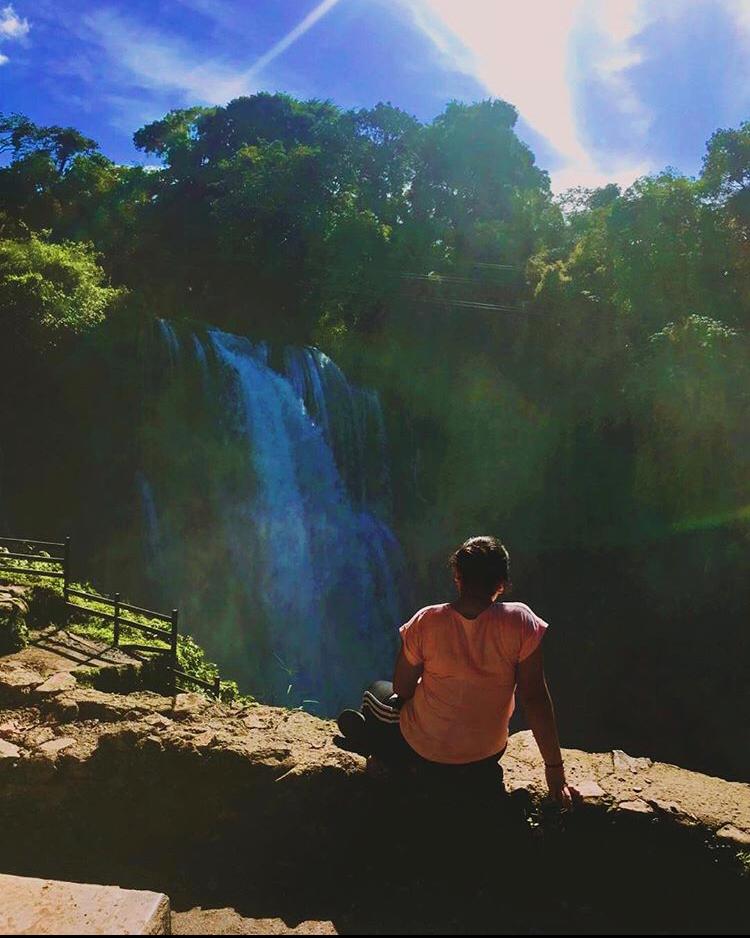
The center of the country offers gentler discoveries. Comayagua, Honduras's colonial capital for more than three centuries, keeps a grid of Spanish churches around its cathedral — whose tower clock, made in the Moorish world around 1100 AD and later donated to the cathedral, is counted among the oldest working clocks in the Americas, still striking the hours. An hour north, Lake Yojoa, Honduras's largest natural lake at roughly 16 miles long, sits between two national parks — Santa Bárbara and Cerro Azul Meámbar — and just off its shore the Río Lindo drops 140 feet (43 m) at Pulhapanzak Falls, where a trail runs behind the curtain of water. Birders come for the lake's 400-plus recorded species; everyone else comes because it is the natural rest stop the country forgot to overdevelop.
Off La Ceiba, the Cayos Cochinos are the Bay Islands' quieter sibling: an archipelago of two small islands and 13 coral cays protected as a marine reserve, managed by the Honduras Coral Reef Fund, with reef snorkeling, Garifuna fishing villages and an endemic pink boa found nowhere else. Pair them with the highland west on the way to or from Copán: Santa Rosa de Copán, a cobbled cigar-making town, and Gracias, the Lenca highland town below Celaque National Park, where Cerro Las Minas rises to 9,416 feet (2,870 m) — the highest point in Honduras — in cloud forest threaded with trails.
Picture the place
Behind Pulhapanzak's falling water the world shrinks to a green-lit cave of mist and noise: the curtain of the Río Lindo roars a few feet in front of your face while swallows cut in and out of the spray.
The easily missed detail
Honduras's most famous archaeological story is not at Copán at all: somewhere in the Río Plátano reserve, aerial LiDAR surveys in 2012 revealed the remains of previously unknown pre-Columbian settlements in the Mosquitia jungle, ground-checked by an expedition in 2015 — a reminder that the reserve guards ruins nobody has yet excavated.
A practical rhythm
- Add Yojoa to the Copán road — Break the San Pedro Sula–Copán or Tegucigalpa drives with a night at Lake Yojoa and a morning at Pulhapanzak
- Comayagua as a half-day — Time the cathedral visit to hear the medieval clock strike, and walk the colonial grid at golden hour
- Mosquitia only with logistics — Book the Río Plátano through an established operator with flights and river transport bundled; it cannot be improvised
What could complicate the plan
La Mosquitia is genuinely remote — weather delays small planes, river levels govern boat days, and the U.S. State Department rates the surrounding department of Gracias a Dios at its highest advisory level, so operator choice and current advice matter more here than anywhere else in the country. The Cayos Cochinos boats from La Ceiba cancel in rough seas, and Celaque's summit trail is a strenuous full day that needs a dawn start.
What to do next
Choose one from each shelf: Comayagua and Yojoa on the mainland drive, the Cayos Cochinos from La Ceiba, and the Río Plátano only if you have the days and the operator to do it properly.
Sources
- UNESCO World Heritage Centre — Río Plátano Biosphere Reserve, inscribed 1982 and on the List of World Heritage in Danger since 2011
- Honduras Coral Reef Fund — Cayos Cochinos marine protected area: two islands and 13 cays off La Ceiba, with its endemic pink boa
- Municipality and Diocese of Comayagua — the cathedral clock of Moorish manufacture, dated to about 1100, among the oldest in the Americas
- CONAP-equivalent Honduran protected-area authorities (ICF) — Celaque National Park and Cerro Las Minas at 2,870 m, Honduras's highest summit