Kiribati country guide Places and experiences
What should a first-time traveler see in Kiribati beyond the obvious highlights?
The short answer
Kiritimati's bonefish flats and bird sanctuaries, Abemama's great maneaba and Stevenson shoreline, Butaritari's green war history, North Tarawa's village quiet — and, on the map if not the itinerary, the Phoenix Islands Protected Area, the country's ocean-scale masterpiece.
The answer, with local context
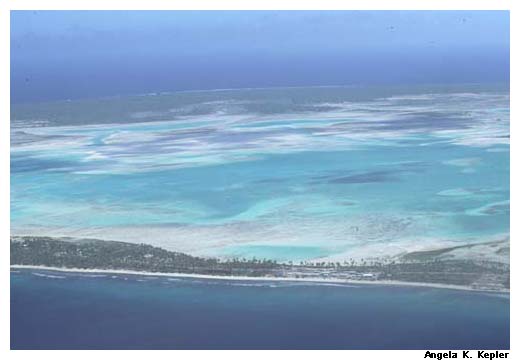
Begin east, where Kiribati's other world sits 3,300 km from Tarawa: Kiritimati (Christmas Island), which Captain Cook reached on Christmas Eve 1777, is the largest coral atoll on Earth by land area — about 388 km² of land, nearly half the nation's total — wrapped around a lagoon system of hypersaline ponds, bonefishing flats and seabird islands. The flats fishery (bonefish, trevally, triggerfish, catch-and-release from the Paris Peninsula and the lagoon's white-sand pans) is genuinely world-class and the island's economic jewel; the bird sanctuaries (Cook Island and the lagoon islets) hold breeding colonies of shearwaters, boobies and tropicbirds guarded by wardens; and the villages (London, Tabwakea, Banana, and Poland — named, by the standard account, for a Polish trader of the copra era) live a slower rhythm than Tarawa's. Kiritimati also carries the nuclear century: Britain's Operation Grapple (1957–1958) and America's Operation Dominic (1962) detonated devices off this atoll and neighbouring Malden, a history held in veterans' memorials and local memory.
The Gilbert chain's own beyonds are closer and quieter. Abemama is the literary and architectural stop: Robert Louis Stevenson lived ashore here in 1889 (his Equator Town household under the formidable King Tem Binoka), and the island's great maneaba — the traditional meeting house, with its massive coral-stone pillars, soaring thatch and floor of clan sitting-places — is Kiribati's signature building, where all ceremony, dance and decision still happens. Butaritari (the Makin of American war histories) pairs the north's greenest island (the Gilberts' rainfall rises northward) with a layered 1943: Carlson's Raiders' Makin Raid (August 1942) and the November 1943 battle ashore. Abaiang holds the mission beachhead (the Protestant missionary Hiram Bingham arrived in 1857) and a famously beautiful ocean-side church; Banaba, reachable only with effort, is the raised outlier (81 m — the nation's highest point), its phosphate mined out between 1900 and 1979, its people resettled to Rabi Island in Fiji in 1945 and still returning as citizens of 2 shores.
And then the sight no itinerary can hold: the Phoenix Islands Protected Area, inscribed by UNESCO in 2010 as (then) the largest and deepest marine World Heritage site — 408,250 km² of ocean, 8 atolls, 14 seamounts, about 800 recorded species (200 corals, 500 fish, 18 marine mammals, 44 birds), with Kanton the only inhabited island (a few families) and no visitor infrastructure at all. PIPA closed entirely to commercial fishing in 2015 and was controversially reopened in 2021–2022 (UNESCO has recorded its concern), a saga that tells you more about Kiribati's choices than any brochure. You will almost certainly never land there; knowing it exists — that this 811-km² nation stewards 11% of its vast EEZ as a single protected ocean — is the country's deepest fact, and it reframes every lagoon you do swim in.
Picture the place
Kiritimati from the air on approach: a filigree of turquoise lagoon fingers reaching into rust-red salt pans and white sand, the atoll running to the horizon in every direction the window shows.
The easily missed detail
The bonefish flats run on a permit-and-guide culture that casual visitors misread as open access: fishing inside Kiritimati's lagoon system is guided catch-and-release under local arrangements (the island's fisheries rules protect the flats that employ the villages), and the famous Christmas Island Special Permit/wader etiquette — barbless, catch-and-release, licensed guides — is what keeps the fishery world-class. The seasonal twin: the flats fish year-round, but the giant trevally and the calmest wading belong to the dry trades (roughly May–October) — the same window as the Tarawa answer, by the same wind.
A practical rhythm
- Kiritimati as its own trip — 4–5 days minimum: flats 2 days, bird islets and salt lagoons 1, villages and the Grapple shore 1
- 1 outer Gilbert island — Abemama or Abaiang for 3 nights of maneaba-and-village pace, flown from Tarawa
- North Tarawa overnight — The capital's quiet shore taken as a stay, not a day trip
What could complicate the plan
Geography is the complication: Kiribati's 3 groups are separated by open ocean and thin air links — Tarawa to Kiritimati is roughly a 3.5-hour flight on Air Kiribati's limited schedule (or enter Kiritimati directly on Fiji Airways' weekly Honolulu flight), outer Gilbert islands run on Air Kiribati's small aircraft with weather-elastic timetables, and there is no scheduled way at all to the Phoenix group (expedition and research voyages only). Permission and protocol matter beyond Tarawa: island councils and maneaba elders govern visits, some reserves (Kiritimati's bird islets) need wildlife-warden arrangements, and drones are effectively a non-starter without permits. Infrastructure is guesthouse-grade (cold-water showers, generator hours, ship-dependent supplies), banking is Tarawa-only, and the 1-month visa-free stay caps how much of this dispersed nation 1 trip can string together without an immigration extension.
What to do next
Choose your east or your west (Kiritimati or the outer Gilberts — both plus Tarawa needs a fortnight and luck), and start with the Kiritimati fishing/guides calendar if the flats call you.
Sources
- UNESCO World Heritage Centre — Phoenix Islands Protected Area (inscribed 2010; 408,250 km²; species counts; Kiribati's only World Heritage property), and UNESCO's conservation reporting on the 2021–2022 fishing reopening
- Kiribati National Tourism Office / Visit Kiribati — Kiritimati (largest coral atoll by land area, about 388 km²), the bonefishery, sanctuaries and outer-island guides
- Historical record — Cook's Christmas Eve 1777 arrival; Operations Grapple and Dominic; the Battle of Makin and the 1942 raid; Stevenson's 1889 Abemama stay; Banaba's phosphate era and the 1945 Rabi resettlement
- Air Kiribati / Fiji Airways route information — Tarawa–Kiritimati and Honolulu–Kiritimati links