Ladakh / India Things to do
What are the most worthwhile things to do in Ladakh on a first visit?
The short answer
Build the first visit on Leh's monastery circuit — Thiksey, Hemis and the nine-story Leh Palace — then cross Khardung La to Nubra's dunes, Chang La to the blue immensity of Pangong Tso, and finish, if the altitude allows, at Tso Moriri or Hanle's dark skies in the Changthang.
The answer, with local context
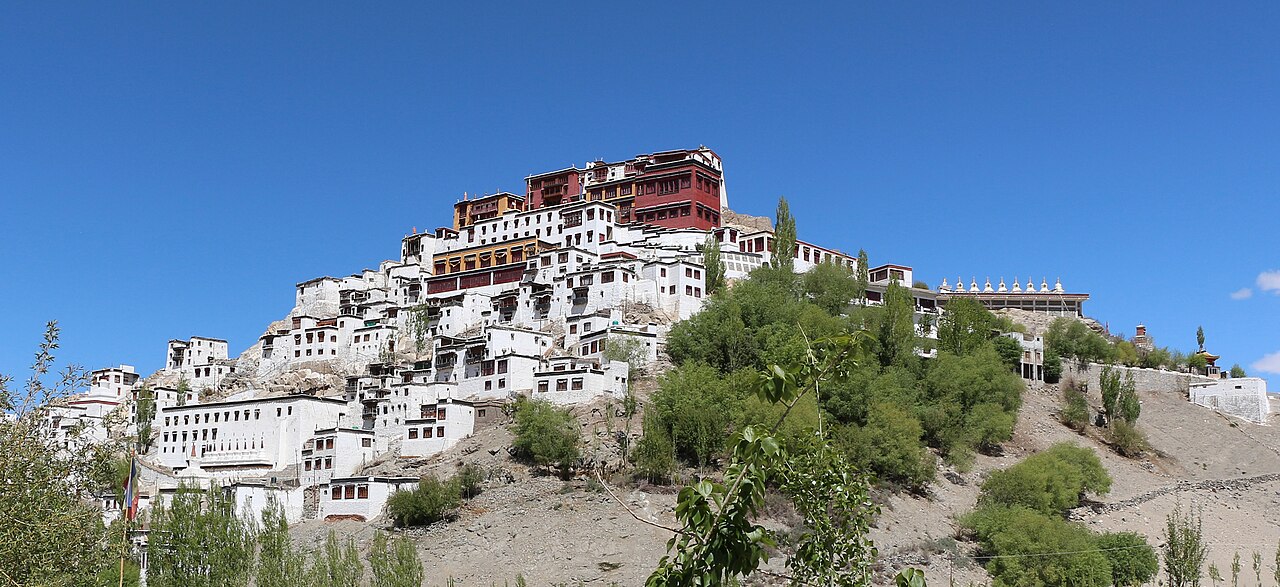
Start in the Indus valley, where Ladakh's history is stacked along one road. Thiksey Monastery, 12 miles (19 km) southeast of Leh, climbs its hill in twelve whitewashed tiers — a Gelug monastery founded in 1430 whose Maitreya temple holds a 49-foot (15 m) seated statue of the future Buddha, the largest in Ladakh, rising through two stories; it was installed to mark the 14th Dalai Lama's visit in 1970. Hemis, 28 miles (45 km) from Leh up a side gorge, is the region's largest and wealthiest monastery, founded in 1630 in the Drukpa lineage; its summer festival fills the courtyard with masked dances, and every twelve years it unfurls an enormous thangka painting, the monastery's greatest treasure. Between them stands Leh itself, crowned by the nine-story Leh Palace — built in the 17th century by King Sengge Namgyal, modeled on Lhasa's Potala and in fact raised before it — now a museum under the Archaeological Survey of India, its roof terraces giving the town's best panorama. West along the Indus, the Alchi monastery keeps 11th-century murals in a Kashmiri-inflected style found nowhere else in the Buddhist world — the oldest surviving painting in Ladakh, preserved precisely because the rain shadow kept the walls dry.
The passes are the second act. North over Khardung La — surveyed at 17,582 feet (5,359 m) — the road drops into the Nubra valley, where the Shyok river runs past the sand dunes of Hunder and their double-humped Bactrian camels, survivors of the Silk Road caravans; Diskit, Nubra's oldest and largest monastery, watches from its hill under a 105-foot (32 m) Maitreya statue inaugurated by the Dalai Lama. East over Chang La lies Pangong Tso, a brackish, endorheic lake some 83 miles (134 km) long reaching into Tibet, its shore at about 13,900 feet (4,250 m) and its water shifting through blues no filter invents. The permits are part of the plan and come from the Leh administration: foreign nationals need a Protected Area Permit arranged through a registered agent, in a group of at least two, while Indian citizens have, since 2021, simply paid the LAHDC's environment fee of ₹400 plus ₹20 a day online. Beyond the classics, the Changthang plateau offers the connoisseur's Ladakh — Tso Moriri, at 14,836 feet (4,522 m) a Ramsar-listed wetland where black-necked cranes breed, and Hanle, at some 14,764 feet (4,500 m) India's first Dark Sky Reserve, where the Indian Astronomical Observatory works above one of the clearest skies on Earth.
Picture the place
At Thiksey before dawn the long horns sound from the roof as the valley is still blue shadow, young monks stream across the courtyard with their robes gathered against the cold, and below the hill the Indus catches the first light in a country that has been Buddhist for a thousand years and arranged its mornings accordingly.
The easily missed detail
Khardung La's famous summit board announces 18,380 feet and, traditionally, the world's highest motorable road — and both halves of the sign are wrong. Surveys consistently measure the pass at 17,582 feet (5,359 m), and the Border Roads Organisation's own Umling La, in Ladakh's far east, now holds the altitude record at 19,024 feet (5,799 m). Photograph the board, by all means — everyone does — but know that you are standing at a slightly lower, still extraordinary height, on a road whose real marvel is that it is kept open at all.
A practical rhythm
- Morning — Monasteries at dawn: Thiksey's morning prayers are the day's great appointment, and the high passes are best crossed before noon, when altitude headaches and weather are both least likely.
- Midday — Midday belongs to the valley museums and murals: the Leh Palace's terraces, Alchi's painted halls at the hour when light reaches them, and the old town's streets between.
- Evening — Evenings are for the lakes and the sky: Pangong's shore changes color until dark, and at Hanle the observatory's dome and the Milky Way take over a night with almost no artificial light.
What could complicate the plan
Altitude governs everything: Leh sits at 11,562 feet (3,524 m) and the passes exceed 17,500 feet, so the first 24 to 48 hours in Leh are for rest, not sightseeing, and a night at Pangong's 13,900 feet (4,250 m) should never be a trip's first night. The permit map is equally unforgiving — Nubra, Pangong, Tso Moriri and Hanle all sit in protected zones, foreign visitors' permits require a registered agent and a traveling pair, and checkpoints collect copies along the way, so carry printed spares. Finally, the far Changthang is a privilege that weather and the army's border posture can revoke on a given day; hold Tso Moriri and Hanle as the plan's flexible end, not its foundation.
What to do next
Spend two nights in Leh for the monasteries and the altitude, cross to Nubra for one, sleep once beside Pangong, and only then — permits in hand — decide whether the Changthang is yours this trip.
Sources
- Archaeological Survey of India — Leh Palace, the nine-story 17th-century royal palace of Sengge Namgyal maintained as a museum; the Alchi monastery's 11th-century mural heritage
- LAHDC Leh / Leh district administration — the permit system: Protected Area Permits for foreign nationals via registered agents (minimum group of two); Indian citizens paying the ₹400 environment fee plus ₹20 per day online since 2021
- Ramsar Convention — Tso Moriri, listed as a high-altitude wetland of international importance at 14,836 feet (4,522 m)
- Border Roads Organisation — Khardung La's surveyed height of 17,582 feet (5,359 m) against its signboard's claim, and Umling La as the world's highest motorable road at 19,024 feet (5,799 m)