Langkawi / Malaysia When to visit
When should I visit Langkawi, Malaysia, for the best experience?
The short answer
February — the driest month of the year on Malaysia's only coast with a true dry season, with 91°F (33°C) days, an 83°F (28°C) Andaman Sea flat enough for every boat trip, and the island-hopping season at its best before the March heat peaks.
The answer, with local context
Langkawi sits at 6 degrees north latitude in the Andaman Sea, tucked into the lee of the Malay Peninsula and Sumatra — and that shelter gives it a climate no other part of Malaysia has: a genuine dry season. The Malaysian Meteorological Department's normals for the island tell the story in rainfall. January averages just 0.94 inches (23.9 mm) of rain across 3 rainy days, and February 1.29 inches (32.7 mm) across 5; by October, the wettest month, the same station records 14.67 inches (372.5 mm) falling on 23 days. The year's total is 93 inches (2,363 mm), so the dry season is not a nuance — it is the difference between an island of boats and beaches and an island of afternoon deluges. February's texture is precise in the data: a mean high of 91.8°F (33.2°C), a mean low of 75.9°F (24.4°C), and sea temperatures around 83°F (28.5°C), warm enough for long swims and snorkeling at Pulau Payar Marine Park, an hour's boat ride south.
The mechanism is the monsoon pair. From December into April the northeast monsoon blows dry continental air over the peninsula's spine, and Langkawi, on the western shore, sits in its rain shadow while the same winds drench Malaysia's east coast. The southwest monsoon reverses the arrangement from about May to October, delivering the September and October peak rains, rougher seas and the season when boat trips to the outer islands are cancelled most often. February also dodges the year's sharpest edge: the heat builds through March and April, when the station's record highs reach 99°F (37.2°C) and the pre-monsoon air turns heavy. In its biennial years the island stages LIMA, the Langkawi International Maritime and Aerospace Exhibition, an event that fills every hotel — a February visitor in an airshow year meets the island at its emptiest instead.
The wet season is not without its argument. September and October fill the waterfalls: Telaga Tujuh, the Seven Wells, and the three-tiered Temurun fall run at full power on the Cambrian sandstone of the northwest coast, and the rice fields stand at their greenest. But those are consolation months. The Langkawi that the geography promises — calm crossings to the 99 islands, sunset sails, the SkyCab running over a clear archipelago — is a December-to-March island, and February is the month when its driest weather, calmest sea and fullest excursion calendar coincide.
Picture the place
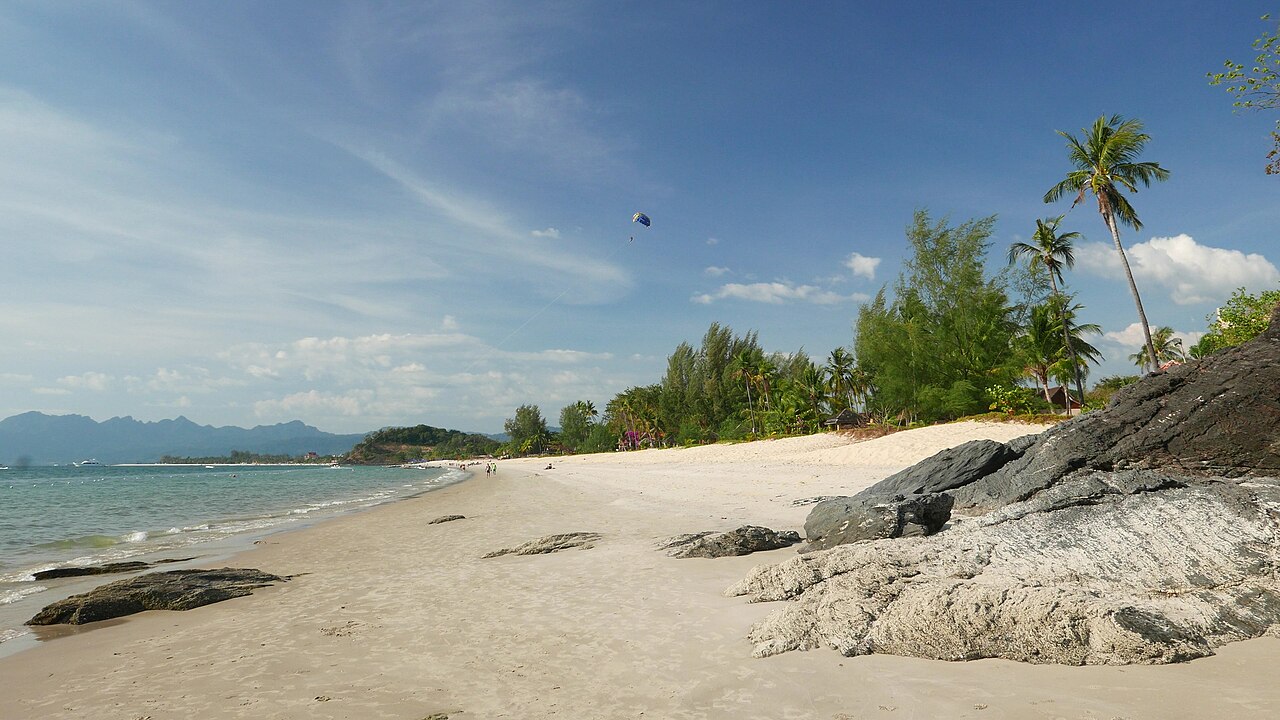
On a February morning at Pantai Cenang the Andaman lies flat and pale, the longtail boats and jet-skis setting out across water like poured glass toward the green humps of the outer islands, while the main island's two peaks — Machinchang and Raya — stand out sharp-edged in the washed dry-season air.
The easily missed detail
Langkawi's dry season runs opposite to the Malaysian east coast's: in February, when Langkawi is at its driest, the Perhentian and Redang islands on the other side of the peninsula are in full monsoon closure, their resorts shut against the northeast monsoon's seas. Travelers who treat "Malaysia's best month" as a national fact book the wrong island half the year — the country's two coasts take their turns, and February belongs to the west.
A practical rhythm
- Morning — February mornings are for the water: the Pulau Payar snorkeling boats and island-hopping trips to Dayang Bunting and Beras Basah leave in the calmest hours, before any afternoon breeze.
- Midday — Midday heat at 92°F (33°C) is the cue for the island's shade: the Kilim mangrove channels by boat, the Underwater World aquarium at Cenang, or the duty-free halls of Kuah with their air-conditioning.
- Evening — Evenings are the beach's second act: sunset at Pantai Cenang or Tanjung Rhu, then the night market — whichever village hosts the pasar malam that evening — for dinner.
What could complicate the plan
February is also the world's discovery: it overlaps Chinese New Year in many years, when Malaysian and regional holidays spike room rates and the SkyCab queues stretch long, and the island's best beach resorts sell out weeks ahead. The dry season has its own small print — the sea is calm but jellyfish, including box jellyfish, are recorded in Langkawi waters, so heed the beach flags and the vinegar stations rather than the calendar. And the dry months thin the waterfalls to a trickle: a February visitor sees Telaga Tujuh's pools at their clearest but its cascades at their weakest.
What to do next
Book February, base at Pantai Cenang for the beach or Kuah for value, and reserve the Pulau Payar trip and the SkyCab for your first two mornings, while the dry-season sea is doing its best work.
Sources
- Malaysian Meteorological Department (MetMalaysia), Langkawi station normals — February rainfall of 1.29 inches (32.7 mm) on 5 rainy days against October's 14.67 inches (372.5 mm) on 23; annual rainfall 93 inches (2,363 mm); February mean high 91.8°F (33.2°C) and record March high of 99°F (37.2°C)
- Langkawi Development Authority (LADA) — the island's dry-season excursion calendar, the LIMA exhibition at the Mahsuri International Exhibition Centre, and Langkawi's position as a duty-free port since 1987
- Department of Fisheries Malaysia — Pulau Payar Marine Park, the protected reef area south of the main island whose snorkeling trips run in the calm season