Lima / Peru When to visit
When should I visit Lima, Peru, for the best experience?
The short answer
April — the last full month of Lima's summer, when the climate normals give the city its highest sunshine hours of the year, the Pacific is still warm, the garúa fog has not yet moved in, and the summer-holiday crowds have gone home.
The answer, with local context
Lima's calendar is written by the ocean, not the equator. The city sits at 12 degrees south in a coastal desert where SENAMHI, Peru's national weather service, records less than 0.4 inches (10 mm) of rain in an entire year — a total that makes Lima one of the driest capitals on Earth, often described as the second-driest after Cairo. The cause is the Humboldt Current: the sea off Lima runs at about 61°F (16°C), some 18°F (10°C) colder than this latitude should deliver, and the chilled air above it forms a temperature inversion that traps moisture as fog instead of letting it rise and rain. Summer highs reach only 77–82°F (25–28°C) and winter lows about 57°F (14°C) — Lima is never hot and never cold; it is only, for half the year, gray.
That gray half is the garúa, the coastal mist that blankets the city from about May or June to November. SENAMHI draws a formal distinction between the two: the garúa deposits less than 0.1 mm at a time and does not even register as precipitation, yet it dampens streets, swallows the skyline and holds the city under low cloud for weeks — Lima logs only about 1,230 sunshine hours a year, among the lowest of any major city. April stands at the far end of that season: the sun is established, April records the most sunshine hours of any month in the normals, the sea is near its warmest after the February peak — February is the warmest month — and the beach suburbs of Miraflores and Barranco are still in their summer manners.
April has one more virtue, and it is national: it decouples Lima from the Andes. Peru's highland dry season runs May to September, which is exactly Lima's gray season, so a Cusco-centered trip meets the capital at its gloomiest; an April trip gives the capital its own weather — sun on the cliffs, ceviche at noon under a blue sky — and the highlands in their green, post-rain shoulder, with Machu Picchu's crowds not yet at full strength.
Picture the place
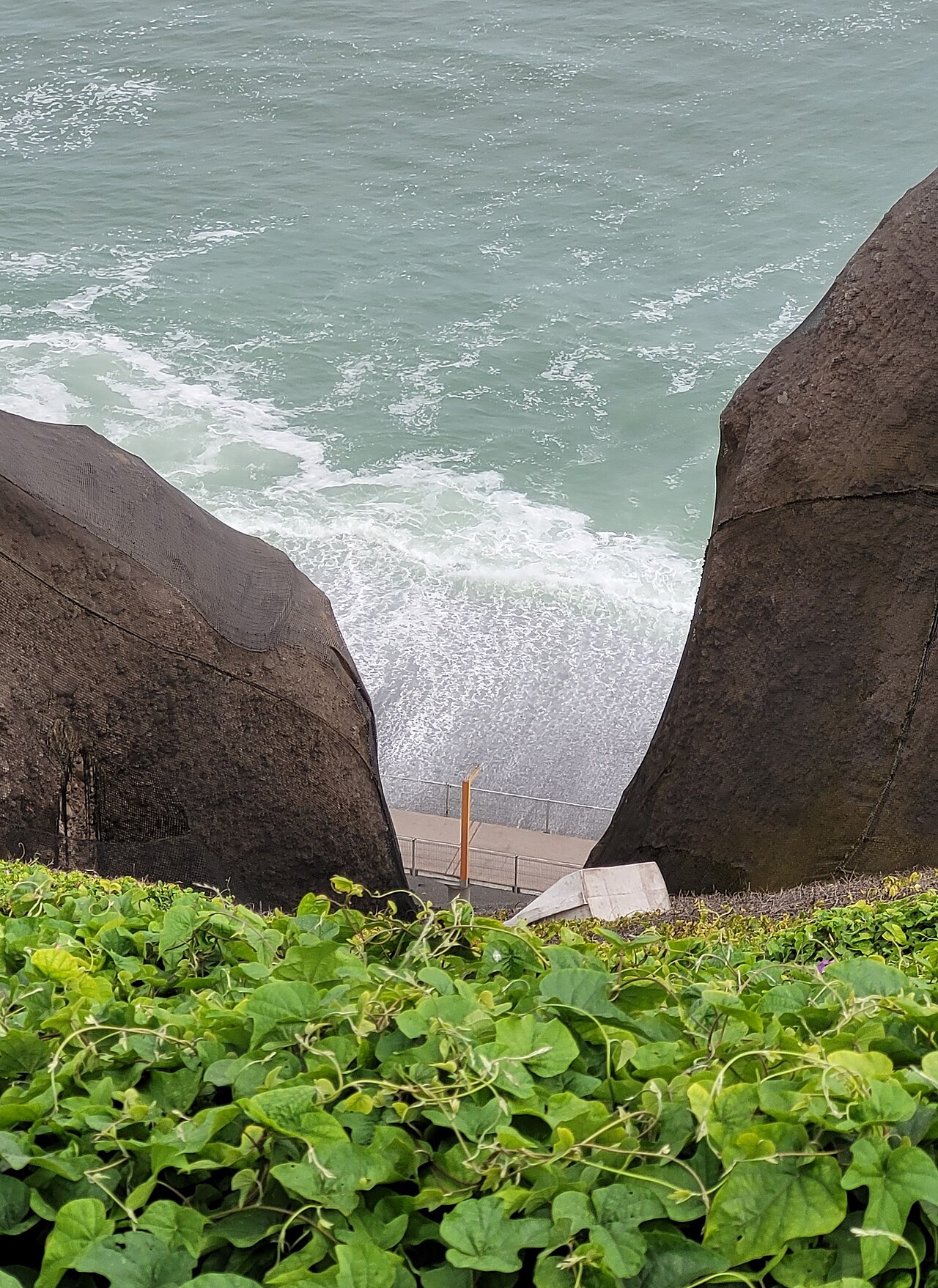
From the Miraflores malecón on an April morning the whole Costa Verde is lit: the ocher cliffs dropping to the coastal highway, the surfers in the bay below, and the paragliders launching off the cliff edge into air so clear that the Palomino Islands stand out on the horizon — the view the garúa will erase for the next six months.
The easily missed detail
The garúa, not rain, is also why Lima looks the way it does: in a city where measurable rain can be absent for years at a time, roofs are flat, drainage is an afterthought, and the great colonial houses of the old center were built for a sky that mists but never pours. The spectacular exception is El Niño, when the current warms, the inversion breaks, and Lima can receive in weeks the rain of a decade — the mechanism behind the city's rare flood years.
A practical rhythm
- Morning — April mornings on the malecón are the city's best hour: the cliff-top parks, the paragliders rigging up, and the coffee kiosks of Barranco before the day's warmth builds.
- Midday — Midday is ceviche hour and museum hour in equal measure: the cevicherías serve the morning's fish, and the Larco and the historic center take the early afternoon.
- Evening — Summer evenings end late and outdoors: the Magic Water Circuit's illuminated fountains after dark, and dinner in Barranco as the sea breeze comes up the Bajada.
What could complicate the plan
The 2026–27 El Niño is this answer's asterisk: Peru's multi-agency El Niño committee, ENFEN, has a Coastal El Niño alert in effect, forecasting a strong event peaking from about November 2026 into the following austral summer — which would make Lima hotter, more humid and, in the extreme, rainy. Check ENFEN's monthly bulletins before booking a summer trip this cycle. The calendar's other trap is October: it holds the Señor de los Milagros, the Mes Morado, one of the largest Catholic processions in South America, when hundreds of thousands in purple fill the center — magnificent if you come for it, a serious crowd if you did not. And note the January alternative: the city's founding anniversary falls on January 18, with the summer at full pitch.
What to do next
Book April, stay on the Miraflores–Barranco cliff line, and spend the sunny middays as this city's food answer directs — Lima's restaurants reward the season as much as its cliffs do.
Sources
- SENAMHI (Servicio Nacional de Meteorología e Hidrología del Perú) — Lima's climate record: under 0.4 inches (10 mm) of rain a year; the garúa defined as coastal mist depositing under 0.1 mm, distinct from measurable precipitation; roughly 1,230 sunshine hours annually
- ENFEN (Comisión Multisectorial Encargada del Estudio Nacional del Fenómeno El Niño) — the Coastal El Niño alert and the forecast of a strong event peaking from November 2026 into the austral summer
- NOAA Climate Prediction Center — concurrence in the strong 2026–27 El Niño outlook for the Peruvian coast