Loire Valley / France Things to do
What are the most worthwhile things to do in Loire Valley on a first visit?
The short answer
Five anchors — Chambord for scale, Chenonceau for grace, Villandry for gardens, Amboise for Leonardo, and Fontevraud or Chinon for the Plantagenet deep past — with a troglodyte cave and a balloon flight as the valley's two surprises.
The answer, with local context
Work the center first, where the density astounds. Chambord, in the east of the central belt, is the valley's maximal statement: François I's hunting palace begun in 1519, 440 rooms, 282 fireplaces and 84 staircases around the double-helix staircase tradition attributes to Leonardo's hand — and note its current ticketing experiment: since January 2026 entry is two-tier, €21 for EEA residents and €31 for non-EEA visitors (château plus French gardens, under-18s free, the surrounding 5,440-hectare park — Europe's largest enclosed park, ringed by a 20-mile/32 km wall — free to wander). Chenonceau, to the south over the Cher, is its intimate opposite: the "ladies' château," built by Katherine Briçonnet, extended across the river by Diane de Poitiers' bridge and Catherine de' Medici's gallery, and saved in both world wars by its river line (in WWII the Cher was the border — the gallery was the crossing). Amboise completes the triad: the royal château above the town, the Saint-Hubert chapel where Leonardo is buried, and Clos Lucé, the manor where he spent his final three years (1516–1519) at François I's invitation, now the valley's best inventor's museum.
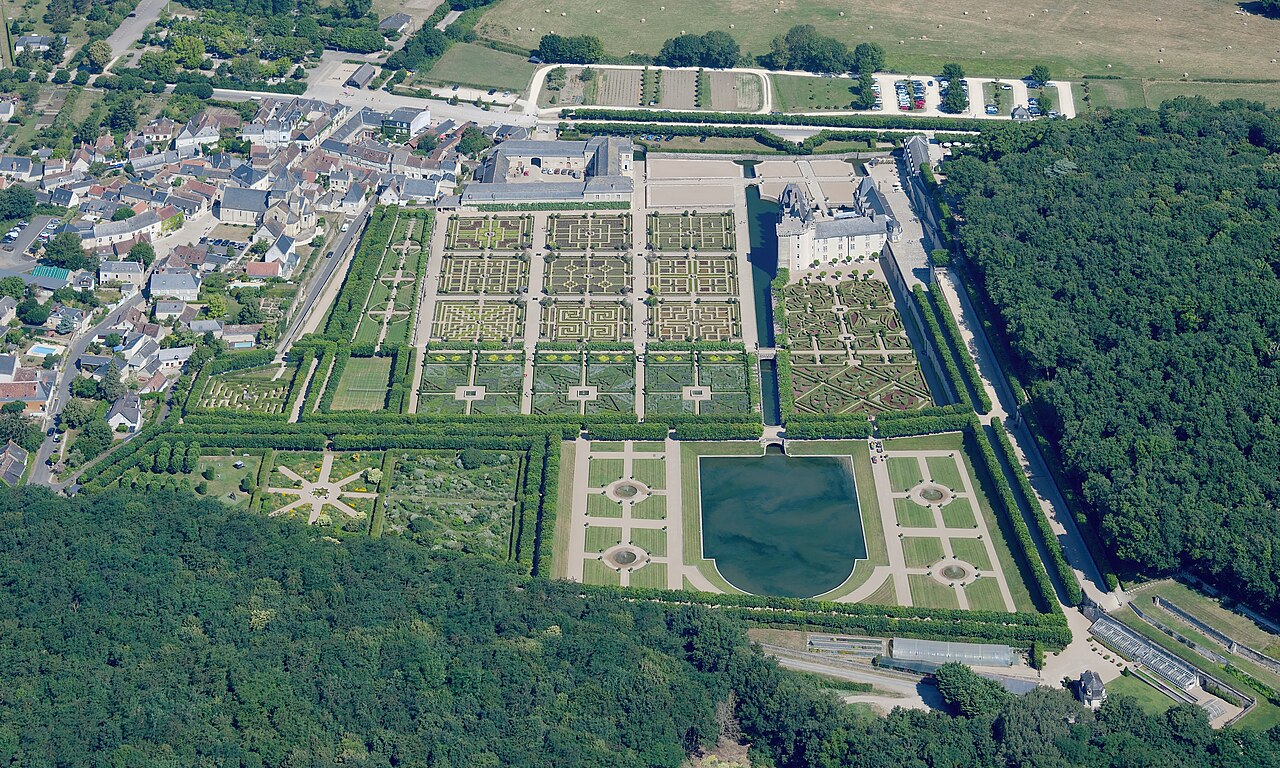
Then the gardens and the deep past. Villandry's gardens are a destination equal to any palace — the ornamental potager alone, nine squares of vegetables planted as embroidery, justifies the trip west of Tours. Blois, often skipped, holds the château that is four palaces in one courtyard (medieval, Gothic, Renaissance and classical wings) and the son-et-lumière that explains the valley's plots. For the older stratum, drive southwest: Chinon's great ruined fortress, where Joan of Arc recognised the disguised Charles VII in 1429, and Fontevraud Abbey — the largest monastic complex surviving in France, the Plantagenet necropolis holding the effigies of Henry II, Eleanor of Aquitaine and Richard the Lionheart, and for 180 years (1804–1963) one of France's harshest prisons.
The west adds the underground. Around Saumur the soft tuffeau stone was quarried into miles of caves that became dwellings (the troglodyte villages of Rochemenier and Turquant), wine cellars (the great sparkling houses of Saumur keep their bottles in the Gallo-Roman depth of the Saint-Hilaire caves) and mushroom farms — the Paris mushroom is largely a Loire cave product. Ride one morning with the Loire à Vélo between villages, and take the balloon at dawn if the wind allows: the châteaux from 1,000 feet explain the valley's geometry as no map can.
Picture the place
Chenonceau at opening: the gallery bridge doubling itself in the Cher, mist on the water, and Diane's and Catherine's gardens arguing in flowers on either bank.
The easily missed detail
Chambord's park is the free masterpiece nobody prices: the 32 km wall encloses a working royal forest the size of inner Paris, open without a ticket, where the château's deer herds graze the clearings and the September–October rut (brame) draws listeners at dusk to the park's free viewing platforms. A visitor short on days or euros can skip the interiors entirely and still have Chambord — façade, gardens from the terraces' sightlines, and the forest — by walking in like a local.
A practical rhythm
- Two châteaux a day, never three — One great house in the morning, one garden or town in the afternoon: the valley punishes greed with blur
- Cluster by bank — North bank (Blois, Chambord, Chaumont, Amboise) one day; south bank (Chenonceau, Villandry, Azay-le-Rideau) the next
- Buy the HistoPad at Chambord — The tablet (€6.50) rebuilds the empty rooms as furnished 16th-century interiors; the palace makes sense with it
What could complicate the plan
The famous houses run different rules: some are state monuments (Chambord, Azay, Angers), others private (Chenonceau, Villandry, Chaumont) with their own prices, passes and closing days — the multi-château passes sold locally cover shifting lists, so check the current partners before buying. Chambord's 2026 two-tier pricing is explicitly experimental and may not survive the year. And the valley's distances deceive: Orléans to Angers is two hours of motorway, so a first visit that tries both ends in three days will spend it in the car.
What to do next
Choose the center as the base, book Chambord and Chenonceau for the first two mornings, and keep one day unplanned for the west's caves or the balloon.
Sources
- Domaine national de Chambord — the château's 440 rooms and double-helix staircase; the 5,440-hectare park and 32 km wall; the 2026 two-tier admission (€21 EEA / €31 non-EEA)
- Château de Chenonceau — the Briçonnet, Diane de Poitiers and Catherine de' Medici building history; the gallery over the Cher
- Abbaye de Fontevraud / Centre des monuments nationaux — the Plantagenet effigies and the abbey's prison centuries (1804–1963)
- Loire à Vélo (France Vélo Tourisme) — the 900 km signed cycle route along the river