Luang Prabang / Laos Things to do
What are the most worthwhile things to do in Luang Prabang on a first visit?
The short answer
Wake for the 5:30 a.m. alms ceremony, walk the peninsula from Wat Xieng Thong to the Royal Palace, climb Mount Phousi at dusk — then give a full day each to the Pak Ou caves by boat and the turquoise tiers of Kuang Si Falls.
The answer, with local context
The town's day begins before yours does. Every morning around 5:30 to 6:30, hundreds of barefoot monks and novices file silently out of Luang Prabang's temples to receive alms — tak bat — along Sisavangvong Road and the old town's side streets, where residents kneel with baskets of sticky rice. It is a living ritual, not a performance, and the rules are the experience: watch from across the street, in silence, without flash photography, dressed respectfully; if you give, buy rice from the morning market vendors and kneel so your head stays below the monks'. From the ceremony the peninsula unfolds in order. At its northern tip, where the Nam Khan meets the Mekong, stands Wat Xieng Thong, built in 1559–1560 by King Setthathirath of Lan Xang — the royal temple and coronation site until the monarchy's end, its ordination hall's roof sweeping nearly to the ground, its rear wall carrying the glass-mosaic Tree of Life. A short entry fee (about ₭20,000) applies, and shoulders and knees must be covered.
Down the main street, the Royal Palace Museum occupies the palace built in 1904 for King Sisavang Vong — a fusion of French Beaux-Arts and Lao design that housed the royal family until 1975 and opened as a museum in 1995, with split visiting hours (8:00–11:30 a.m. and 1:00–3:30 p.m.) that close it at lunch like an office. Its chapel, the Haw Pha Bang, was built for the Pha Bang, the gold-alloy Buddha image that is the palladium of Laos and the statue the town itself is named for. Next door, Wat Mai's five-tiered roof and gilded veranda reliefs mark the temple that once housed the Pha Bang and served the court. End the day up the 328 steps of Mount Phousi, the 328-foot (100 m) hill at the town's center, crowned by That Chomsi — a golden stupa built in 1804 by King Anourouth — for the sunset over both rivers.
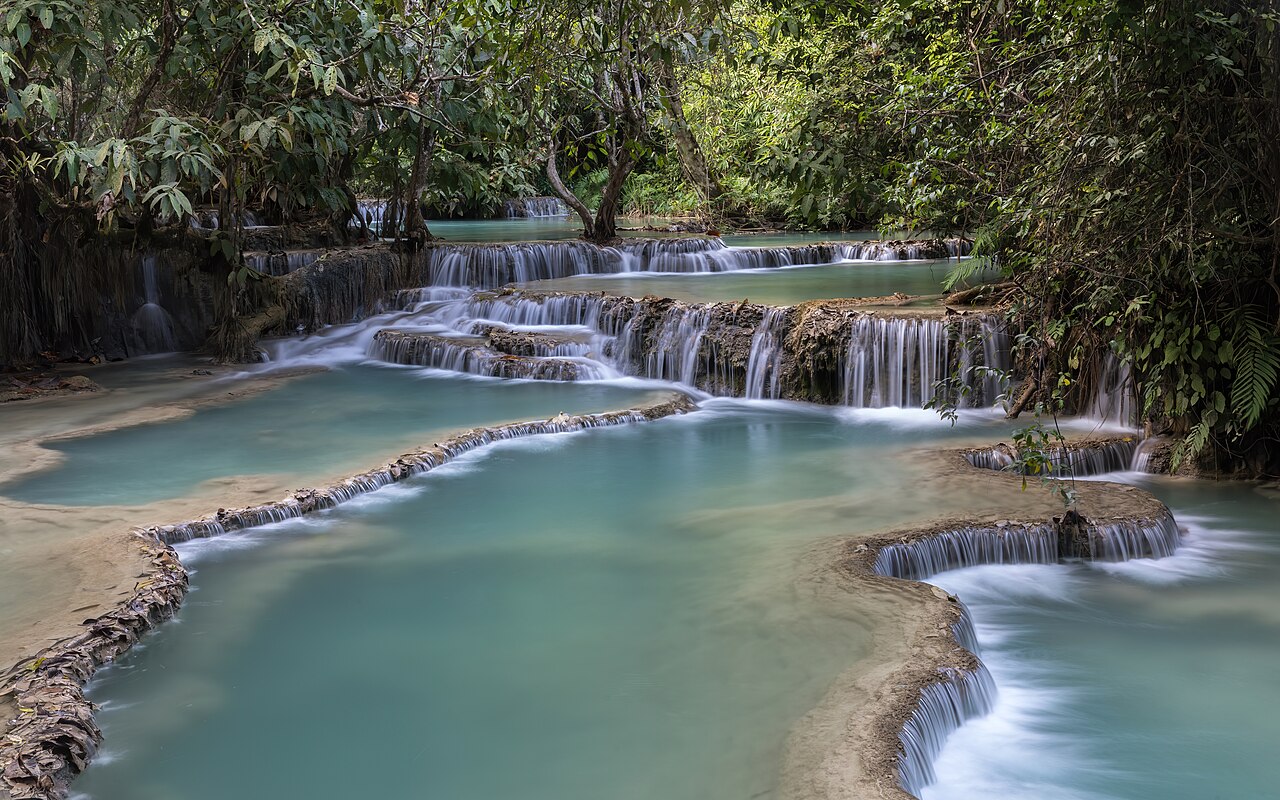
The two excursions complete the visit, and they face opposite directions. Upriver, two hours by longtail boat, the Pak Ou caves hold more than 4,000 Buddha images accumulated over centuries of pilgrimage in two limestone caverns — Tham Ting, the lower cave, open to the river light, and Tham Theung above it, dark enough to need a flashlight — with the rice-whisky village of Ban Xang Hai as the customary stop on the way. South by road, Kuang Si Falls drop 200 feet (60 m) in a main cascade above three tiers of travertine pools colored by dissolved limestone; the foreign-visitor gate fee is ₭60,000, including the shuttle and entry to the Tat Kuang Si Bear Rescue Centre, where Free the Bears cares for more than 20 Asiatic black bears confiscated from the wildlife trade. Swim only in the designated lower pools — some close in rotation to let the mineral terraces recover — and never beneath the main fall itself.
Picture the place
From That Chomsi at dusk the whole geography explains itself at once: the peninsula of tiled roofs and temple spires squeezed between two rivers, the Mekong sliding broad and copper-colored past the town's western edge, and the Nam Khan curling in from the east under its seasonal bamboo bridge.
The easily missed detail
The palace's lunch closure is the itinerary trap everyone meets: the Royal Palace Museum keeps civil-service hours — doors shut from 11:30 a.m. to 1:00 p.m. — so the traveler who saves it for after lunch at noon finds a locked gate, while the one who goes at 8:00 a.m. has the throne room nearly alone. In a town run on monastic time, the museum is the one sight that runs on office time.
A practical rhythm
- Morning — The alms ceremony dictates the dawn: on the route by 5:30, then breakfast and Wat Xieng Thong in the cool hours, and the Royal Palace Museum at its 8:00 a.m. opening before the heat and the crowds.
- Midday — Midday is excursion time: the Pak Ou boat rides the river's bright hours, or Kuang Si's pools — reached in 45 minutes by road — give the hot middle of the day to cold water.
- Evening — Evenings climb down from Phousi's sunset into the night market, which closes Sisavangvong Road to traffic from about 5 p.m. and runs the length of the old town in textiles, carvings and food stalls.
What could complicate the plan
The alms ceremony's popularity is its threat: the main street sections fill with tour groups whose behavior — flashbulbs, drones, crowding the line — has led the town to publish etiquette codes, and the quieter side streets near Wat Xieng Thong offer a more fitting vantage. Kuang Si's pools rotate their closures and the swim areas shrink when the flow runs high, so the swim you planned is subject to the park's morning decision. And everything in the heritage zone keeps early hours: temples are best before ten, the palace closes mid-afternoon at 3:30 p.m., and a Luang Prabang day is won or lost before lunch.
What to do next
Order it as the town does: dawn ceremony, peninsula temples, palace at opening; a boat day north to Pak Ou; a falls day south to Kuang Si; and no evening that misses the night market once.
Sources
- UNESCO World Heritage Centre and the Luang Prabang Heritage Office — the old town's protected temples and the tak bat alms tradition on Sisavangvong Road
- Luang Prabang National Museum (Royal Palace) — the palace built in 1904 for King Sisavang Vong, its museum opening in 1995, and its visiting hours of 8:00–11:30 a.m. and 1:00–3:30 p.m.; the Haw Pha Bang chapel
- Free the Bears / Tat Kuang Si Bear Rescue Centre — more than 20 rescued Asiatic black bears at the falls entrance; the Kuang Si park's ₭60,000 foreign-visitor fee, designated swimming pools and pool rotation