Luang Prabang / Laos When to visit
When should I visit Luang Prabang, Laos, for the best experience?
The short answer
November — the first full month of the cool, dry season, when the falls still run at monsoon strength, the water at Kuang Si is turning turquoise, mornings open in river mist at 65°F (18°C), and the town is still a few weeks ahead of its December crowds.
The answer, with local context
Luang Prabang's year pivots on water — how much is in the Mekong, how much is in the falls, and how much is in the air. The WMO's 1991–2020 normals for the town give November a mean high of 85.8°F (29.9°C) and a mean low of 64.6°F (18.1°C), with the rains of the May-to-October monsoon finished and the cool northeast air arriving. What makes November singular is the inheritance it spends: six months of rain leave the Kuang Si Falls, 18 miles (29 km) south, at full flow while the dry season's clarity turns their limestone pools the famous turquoise — in the wet months the same water can run brown with sediment after storms, and by April the flow has thinned to a fraction. The Mekong and the Nam Khan, which meet at the peninsula's tip below the town at about 1,000 feet (305 m) of elevation, are likewise still high in November, so the two-hour boat run up to the Pak Ou caves travels on a full river.
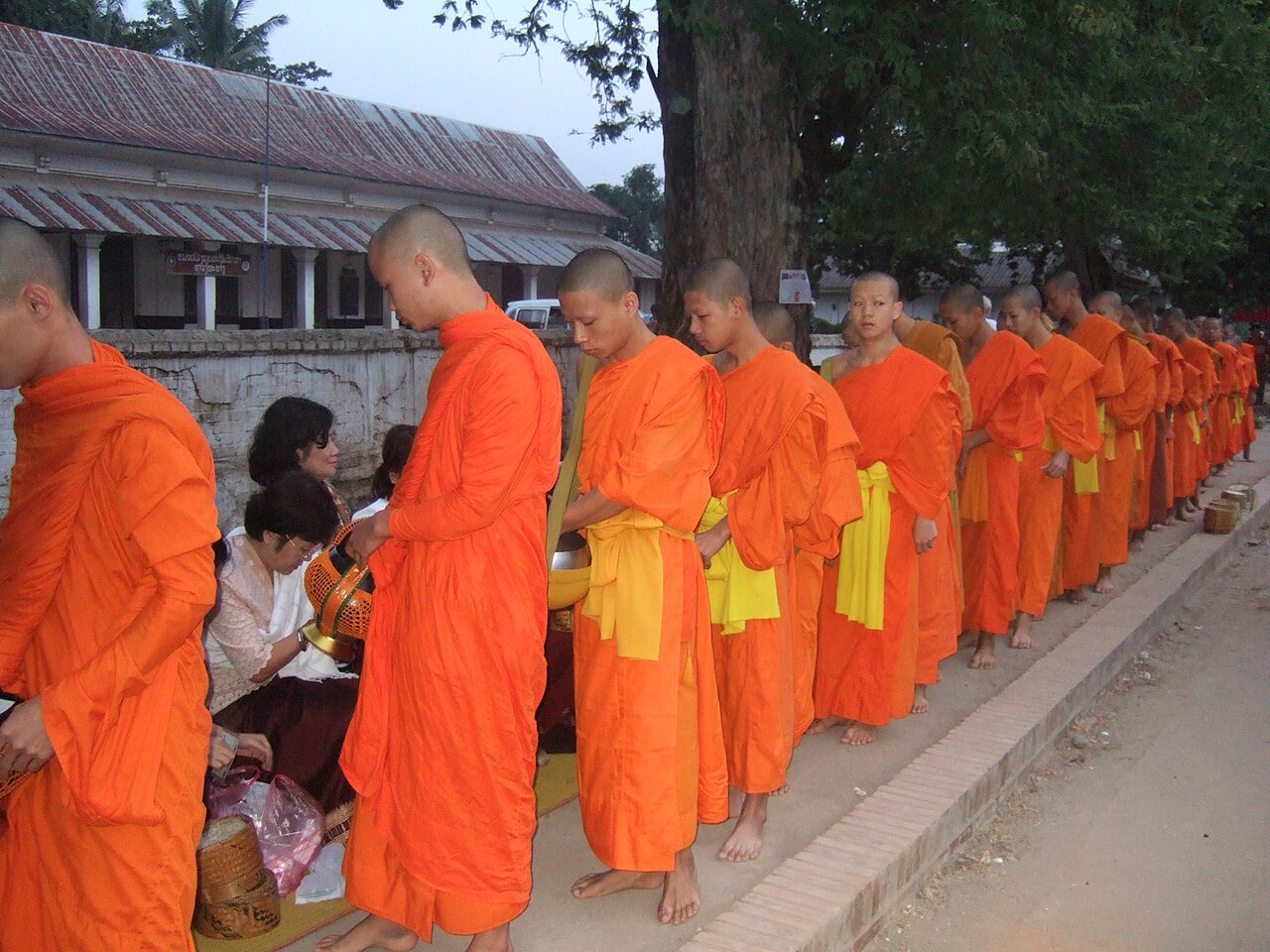
The festival calendar brackets the choice. In October, at the full moon that ends Buddhist Lent, Luang Prabang celebrates Boun Ok Phansa with Lai Heua Fai, the festival of the fireboats, floating candle-lit bamboo boats down the Mekong — beautiful, but still in the tail of the rains. December and January are the safest months on paper and the busiest in fact, when the heritage town's small hotel stock fills and the dawn alms ceremony draws its largest crowds of onlookers. February holds on — an 88.9°F (31.7°C) mean high — but from late February the agricultural burning in the surrounding hills begins to haze the valley, March's high climbs to 93.4°F (34.1°C), and the town's postcard view from Mount Phousi starts to vanish into smoke weeks before April's Pi Mai New Year redeems the heat with water fights.
November sits in the gap all of that leaves: post-monsoon green, harvest gold in the paddies beyond the town, mornings that begin in mist at 65°F (18°C) and burn off to blue, and every excursion — caves, falls, river — running in its best condition simultaneously. It is the month Luang Prabang's own rhythms, monastic and agricultural, are most legible, before the peak-season machinery of December takes the town over.
Picture the place
At six on a November morning the Nam Khan carries a raft of mist past the bamboo bridge, the alms line moves through it in saffron and silence, and above the peninsula the gilded tip of That Chomsi catches the first sun while the town below is still deciding between fog and daylight.
The easily missed detail
Kuang Si's color is a calendar, not a constant. The turquoise that fills the postcards is a dry-season phenomenon — dissolved calcium carbonate suspended in clear, slow water — which peaks from about November to February. Visit in August and the pools may be a magnificent, thunderous, entirely brown waterfall; the falls are at their most powerful and least photogenic in the same weeks, and no amount of filtering reconciles the two versions.
A practical rhythm
- Morning — November mornings are the town's sacrament: the alms ceremony in the mist at 5:30, then the morning market and Wat Xieng Thong in the cool first hours, before the day warms to its 86°F (30°C) high.
- Midday — Midday belongs to the falls: Kuang Si at the hour when the sun reaches the pools and the turquoise is at full saturation, swimming in the designated lower tiers while the tour groups thin at lunch.
- Evening — Evenings cool toward the mid-60s Fahrenheit (around 18°C): the night market takes over Sisavangvong Road from five, and the Mekong bank cafés fill for the sunset hour.
What could complicate the plan
November's first week can still catch the monsoon's tail — a late rain system may muddy the falls and swell the Nam Khan enough to sweep away the seasonal bamboo bridge to the far bank, which is rebuilt each dry season and is a fair barometer of the river's mood. The month's perfection is also becoming known: Luang Prabang's heritage-zone hotels are few, and November weekends now book like December ones, so reserve the old-town addresses early. And the cool season's dawn chill is genuine at 65°F (18°C) on an open boat — the Pak Ou trip's first hour wants a layer that the afternoon will make redundant.
What to do next
Book November, arrive for a Thursday or Friday to catch the town before the weekend, and spend the first dawn at the alms route, the first midday at Kuang Si, and the first evening on the Mekong bank.
Sources
- World Meteorological Organization (WMO) 1991–2020 climate normals for Luang Prabang (via NOAA NCEI) — November mean high 85.8°F (29.9°C) and low 64.6°F (18.1°C); February high 88.9°F (31.7°C); March high 93.4°F (34.1°C)
- UNESCO World Heritage Centre — the Town of Luang Prabang, on the peninsula at the Mekong–Nam Khan confluence, inscribed in 1995
- Luang Prabang provincial tourism authorities — the Boun Ok Phansa and Lai Heua Fai fireboat festival at the end of Buddhist Lent, and the Kuang Si Falls park seasons