Medellín / Colombia When to visit
When should I visit Medellín, Colombia, for the best experience?
The short answer
Early August, for the Feria de las Flores — ten days when the city stages its defining festival in the middle of its second dry spell, with the Desfile de Silleteros as the centerpiece and spring weather doing what it does here in every month of the year.
The answer, with local context
Medellín's climate is the famous constant: the city fills the Aburrá Valley at 4,905 feet (1,495 m), six degrees north of the equator, and the altitude cancels the latitude. IDEAM's normals for the Olaya Herrera station give a mean annual temperature of about 72°F (22°C), with afternoon highs of 79–82°F (26–28°C) and nights of 62–64°F (17–18°C) in essentially every month — no frost, no heat wave, no winter to avoid. What varies is rain, and it varies in a bimodal rhythm: two wet seasons, peaking April–May and again September–November, divided by two dry spells, December–February and June–August, when the rain that does fall arrives as an afternoon shower rather than a ruined day.
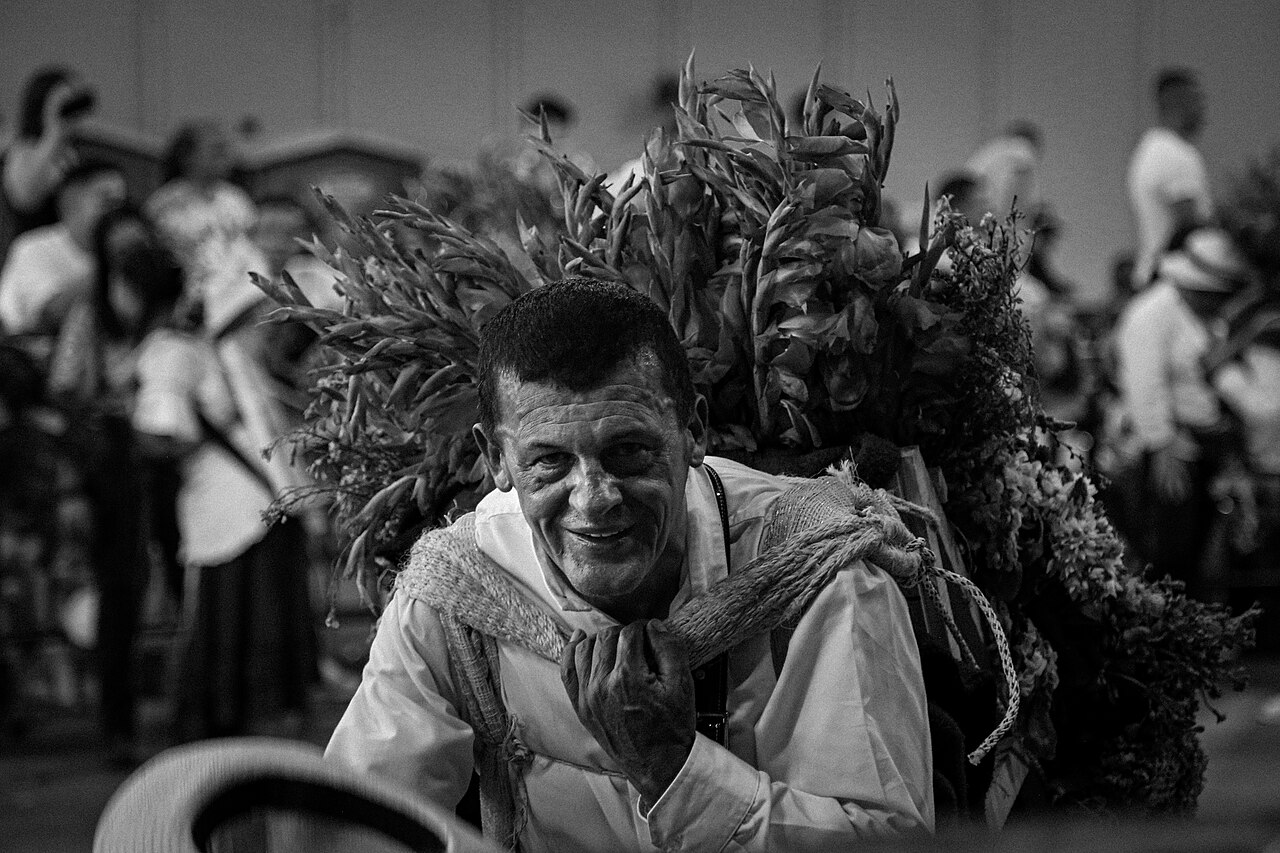
August sits inside the second dry spell, and the city has built its year around exactly that fact. The Feria de las Flores, first held in 1957 and organized by the Alcaldía, runs about ten days in early August: concerts, classic-car and horse parades, flower exhibitions across the city — and at its heart the Desfile de Silleteros, in which more than 500 flower farmers from Santa Elena, the rural district 11 miles (17 km) east of the center, walk the parade route carrying silletas, wooden frames loaded with elaborate flower arrangements strapped to their backs. The largest silletas weigh as much as the person carrying them. It is not a show staged for visitors; it is the city's flower-growing hinterland presenting its credentials downtown, and Medellín at festival pitch is the fullest version of itself.
The counterweight on the calendar is December, the driest month of all, when the Alumbrados — the city's Christmas light installations along the river and across its parks — run from early December into January and draw their own crowds. Between the two festivals, the honest summary is that Medellín punishes no month: the wet seasons lower prices and empty the Metrocables, and the mornings stay usable even then, since the rain's habit is to arrive after lunch and leave by dinner.
Picture the place
On parade day the avenue fills hours ahead, and then the first silletero appears — a farmer in a white shirt and straw hat, bent slightly forward under a towering disc of marigolds, orchids and carnations arranged into pictures and portraits, the crowd reading each silleta aloud as it passes like pages of a book the whole city wrote.
The easily missed detail
The silleta is not a festival invention but a tool with a history: before the roads, Santa Elena's farmers carried their flowers — and before that, goods, children and even the sick — down to Medellín's markets on these same wooden frames, the silletero's name itself coming from silla, a chair. The parade is a working technology promoted to civic symbol, which is why the farmers, not dancers or models, carry the flowers.
A practical rhythm
- Morning — Medellín mornings are the city's reliable hours in every season: clear, mild, and — in August — the time to walk the center, ride the Metrocable to Parque Arví, and claim parade-day positions before the crowds thicken.
- Midday — Midday belongs to the museums and the long Paisa lunch: the Museo de Antioquia in the center, then a bandeja or a mondongo while the afternoon shower, if one comes, passes over the valley.
- Evening — Festival evenings run late and outdoors: the Feria's concert stages, the food stalls, and the city's terraces in El Poblado and Laureles, in air that asks for nothing more than a light layer.
What could complicate the plan
August is the year's second price spike: hotels in El Poblado and Laureles fill for the Feria, and the parade route rewards those who arrive early and punishes latecomers. The city's one genuine seasonal hazard is air quality: SIATA, the valley's early-warning system, records its pollution episodes at the season transitions, chiefly February–March and October–November, when thermal inversions trap particulates in the valley — travelers with asthma should weight the dry-season months accordingly, and August happily avoids both windows. Rain insurance is the third note: even in the dry spell, carry the compact umbrella; the valley's showers ignore calendars.
What to do next
Book early August and claim a parade-side hotel before the Feria program is even published — then read the sights answer and ride the transit system that is half the show.
Sources
- IDEAM (Instituto de Hidrología, Meteorología y Estudios Ambientales) — Medellín's climate normals (Olaya Herrera station): mean annual temperature about 72°F (22°C), bimodal rainfall with maxima in April–May and September–November and dry spells December–February and June–August
- Alcaldía de Medellín — the Feria de las Flores, first held in 1957 and held for about ten days each August, with the Desfile de Silleteros of more than 500 Santa Elena flower farmers; the Alumbrados installations from early December
- SIATA (Sistema de Alerta Temprana de Medellín y el Valle de Aburrá) — the valley's air-quality episodes concentrated at the February–March and October–November season transitions