Moorea / French Polynesia When to visit
When should I visit Moorea, French Polynesia, for the best experience?
The short answer
September into mid-October — inside the dry season's tail and at the peak of the humpback season (French Polynesia's regulated whale window runs July 20 to November 20), when Moorea's north coast of twin bays and lagoon sandbars gets calm water, warm seas and mothers with calves close offshore.
The answer, with local context
This answer treats Moorea's north coast — Cook's Bay and Opunohu Bay, the Belvedere ridge between them, and the lagoon from Papetoai to Maharepa — as the island's center of gravity, with the west coast (Haapiti) and the south and east (Afareaitu, Temae) as the quieter counterweight. Moorea has two seasons that matter. The dry season runs roughly May to October, when the southeast trades steady the weather; within it, the island's defining wildlife calendar opens: French Polynesia's environment authority (DIREN) fixes humpback observation and swimming to July 20–November 20, and the encounters build through August to their peak from mid-August to mid-October, when mothers rest with new calves in the lee of the north coast and off the reef passes. September to mid-October is where the two calendars overlap at full strength: dry-season skies, a lagoon around 79–82°F (26–28°C), and the whales at their most numerous and least hurried.
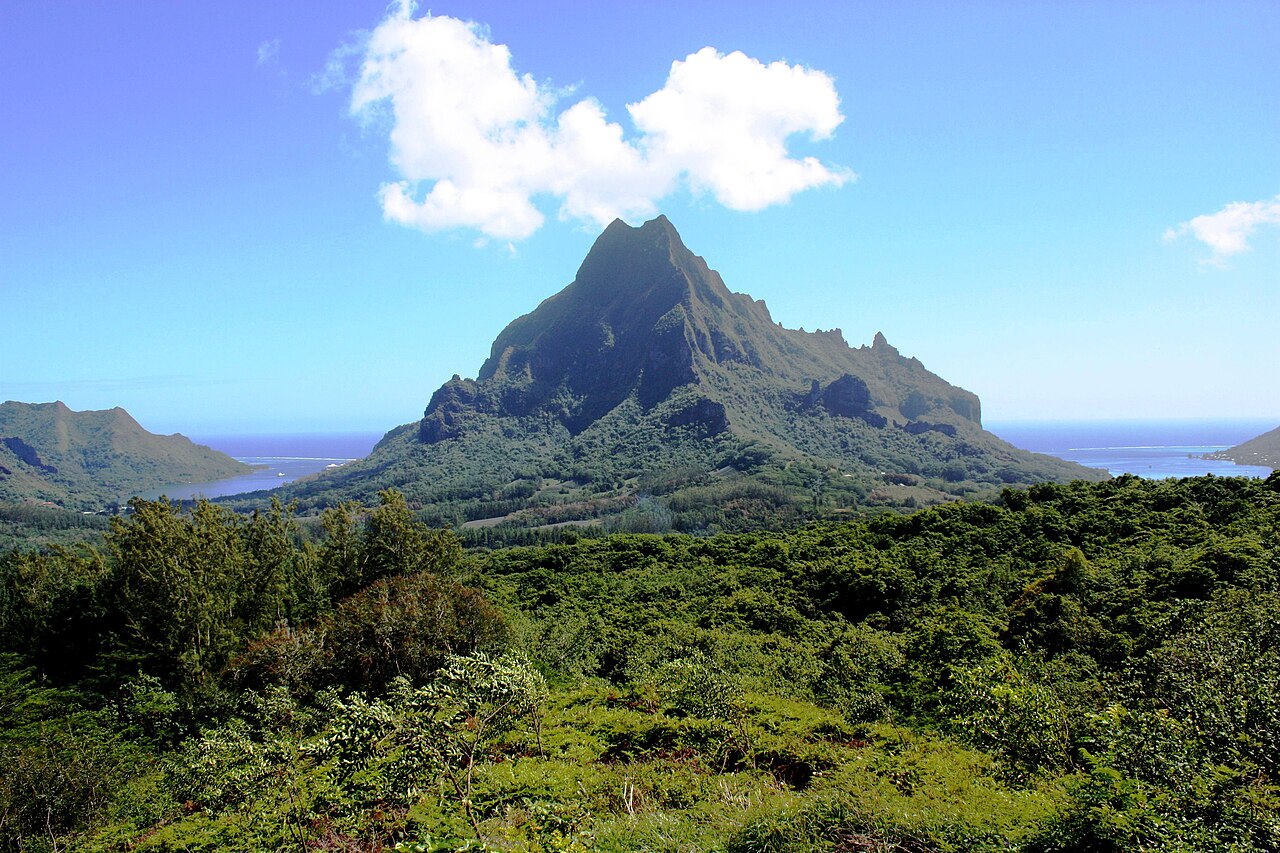
The island's scale makes the season forgiving. Moorea lies 17 km (11 miles) northwest of Tahiti across the Sea of the Moon, and the Aremiti and Terevau ferries cross from Papeete to Vaiare in about 30 minutes, many times a day — so a Moorea trip is not hostage to flight schedules, and a mistimed week can be rescued by simply staying longer. On land, a single 60 km coastal road rings the island beneath peaks that explain the drama: Mount Tohiea at 1,207 m (3,960 ft) is the summit, Mount Rotui (899 m) stands between the two great bays, and the pierced Mouaputa (830 m) guards Cook's Bay. In September the Belvedere lookout and the Opunohu valley trails run dry underfoot, the pineapple fields are in full production, and the north-coast sandbars hold their glassy mornings.
The rivals are real but narrower. July adds Papeete's Heiva (the great dance and chant festival, whose contests run through July on Tahiti, a ferry ride away) and the season's first whales — at the price of the year's peak visitor numbers and prices. May and June are the gentle shoulder: dry season beginning, the island green from the wet months, no whales yet. November keeps the whales until the 20th but reopens the rain account, and December to April is the wet, humid arc — lush, cheaper, beloved of surfers and locals, and the wrong answer to a question about the best experience. Choose the whale peak inside the dry season and Moorea gives you both of its signatures at once: the lagoon and the giants beyond the reef.
Picture the place
From the Belvedere at eight in the morning: Rotui's green wall dropping into two blue bays at once, Cook's to the right and Opunohu to the left, the reef a pale ring beyond them — and, in season, a humpback's blow hanging briefly over the pass.
The easily missed detail
The whale rules are law here, not etiquette, and they shape what a good trip looks like: only DIREN-authorised operators may approach, boats keep 100 m (150 m from a mother and calf), a maximum of six swimmers may be in the water at once, and private boats must stay 300 m away at under 3 knots. The practical consequence is scarcity — the small, compliant boats sell out in peak weeks — so the whale day is the first thing a September traveler books, before the hotel it sails from. The second missed detail is the ferry's mercy: because the crossing is half an hour, Moorea does not need the weather commitment that Bora Bora's flights demand — a grey morning can simply be spent in Papeete's market, and the island tried again tomorrow.
A practical rhythm
- Whales booked first — Authorised-operator places (six swimmers at a time) reserved before flights and rooms for a September trip
- North coast mornings — Lagoon and sandbar time early, when the trades are down and the water is glass
- Valley afternoons — Belvedere, marae and pineapple country in the cooler half of the day
What could complicate the plan
Peak whale season is peak demand season on an island of family pensions and a handful of resorts: the best-located rooms (Cook's Bay, Temae, the west-coast sunset strip) go early, and intercontinental flights into Papeete price accordingly. The season's edge is fixed by regulation, not by the whales — a trip sliding past November 20 loses the swimming encounters entirely, however many whales remain. And the dry season is a tendency, not a promise: a wet week in September is possible, the Opunohu trails turn to red mud after rain, and the lagoon excursions that sell the island cancel in strong trades.
What to do next
Fix September to mid-October, book the whale operator the same day as the ferry-side hotel, and give the island at least four nights — it is close to Tahiti, but it is not a day trip's worth of place.
Sources
- Direction de l'Environnement (DIREN), French Polynesia — the regulated humpback season (July 20–November 20) and approach rules (100 m for authorised boats, 150 m for mothers and calves, six swimmers maximum, 300 m for private vessels)
- Tahiti Tourisme — Moorea's dry season, geography (Mount Tohiea 1,207 m; Mount Rotui 899 m) and the twin bays of the north coast
- Aremiti and Terevau — the Papeete–Vaiare ferry service (about 30 minutes, multiple daily sailings)
- Moorea whale-operator codes of conduct (Moorea Moana Tours et al.) — the season's build to a mid-August to mid-October peak