Moorea / French Polynesia Food and drink
Where should I eat in Moorea, and which local food or drink is worth trying?
The short answer
Start with i'a ota ha'ari — poisson cru au lait de coco, raw fish marinated in coconut milk and lime juice, which the islands' tourism board describes as the national dish of Tahiti and the usual opening course at a tama'ara'a.
The answer, with local context
Polynesian cooking on Mo'orea divides between the raw and the very slowly cooked. Poisson cru is the raw end and can be eaten at any time of day. The slow end is the ahima'a, an underground oven in which food cooks for several hours — roast pork, fish, fe'i bananas and taro — and which is the centerpiece of a tama'ara'a, a festive meal with music and singing that the board says often runs well into the early hours.
Beyond those two poles the repertoire is specific and worth asking for by name: poe, a sweet taro pudding flavored with banana, vanilla, papaya or pumpkin; poulet fafa, chicken cooked with spinach and coconut milk; grilled mahi mahi; and fafaru, raw fish marinated in fermented sea water, which is pungent enough to be a genuine test. Dessert is treated as non-negotiable. At the casual end, roulottes — food trucks — serve chow mein, savory pancakes, steak and fries and Chinese fried noodles, and restaurant kitchens on the islands run French, Chinese, Hawaiian, Vietnamese, Japanese and Italian alongside Polynesian.
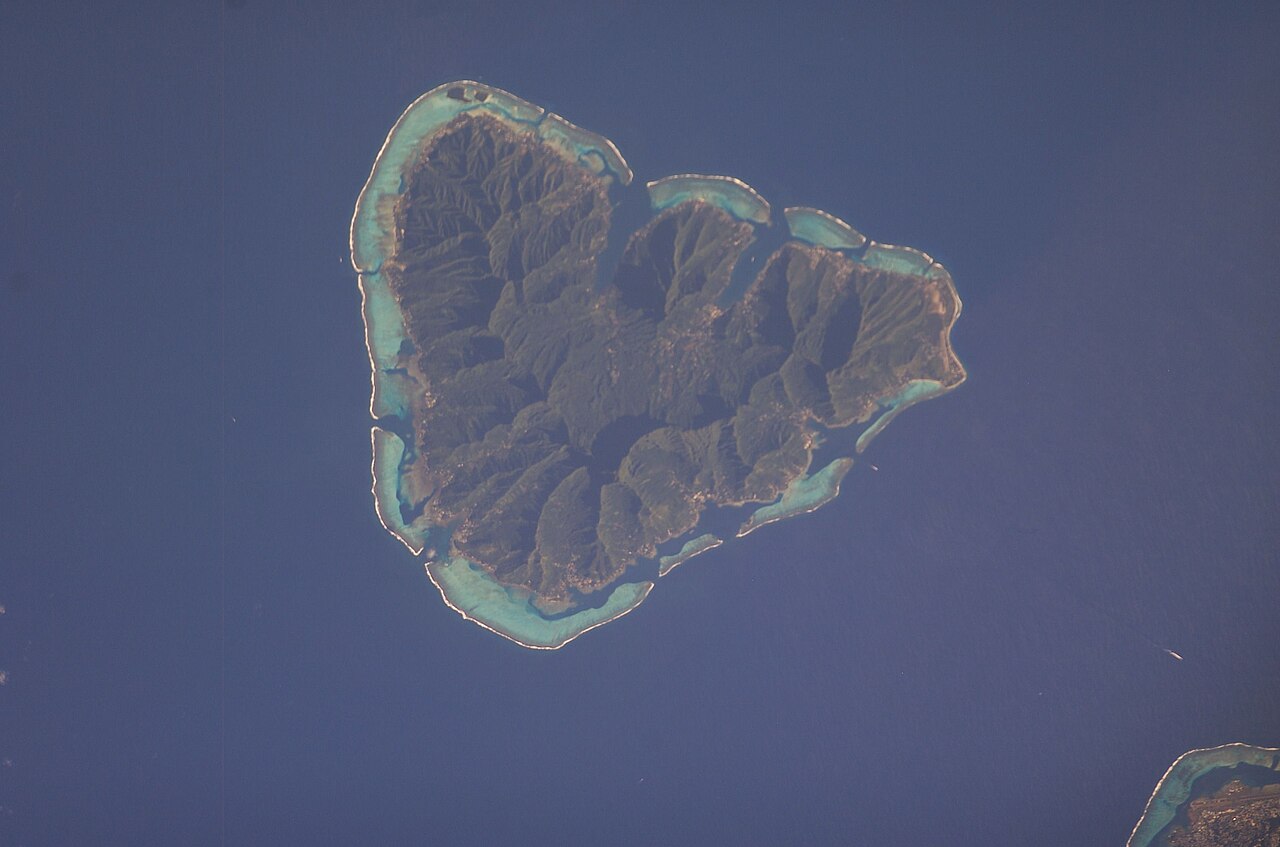
Scale sets expectations. Mo'orea is a commune of 18,201 municipal residents, 18,332 in total at the 2022 census, on an island with a perimeter of about 60 km (37 miles) — so the eating map is a ring road, not a restaurant quarter, and a picnic on a motu is a mainstream option rather than a novelty.
The easily missed detail
The Polynesian food year has a formal opening. Matari'i i ni'a, the season of abundance, begins every year on 20 November, tied to the rising of the Pleiades in the Polynesian calendar. That makes late November a meaningful moment to be eating here, and it happens to coincide with the last day of the territory's marine mammal observation permits, on 20 November.
A practical rhythm
- Any hour — Poisson cru, which the board notes is eaten at any time of day, works as a lunch in its own right.
- Evening, booked ahead — A tama'ara'a built around an ahima'a; the oven needs several hours, so this is not a walk-in.
- Late November — Matari'i i ni'a opens the season of abundance on 20 November.
What could complicate the plan
The fish on the plate comes from a reef that is documented as disturbed: a crown-of-thorns seastar outbreak beginning in 2007 and a near miss from tropical cyclone Oli in early 2010 both reduced live coral cover around the island, with effects varying by site. Supply on an island of roughly 18,000 people is finite, and anything built around an underground oven has to be arranged in advance. Fafaru's fermented marinade is an acquired taste and is better ordered as a shared plate than as a main.
What to do next
The Moorea things-to-do question in this group explains the reef structure that supplies the island's fish, and the when-to-visit question sets out the whale-season dates that frame late winter and spring here.
Sources
- Tahiti Tourisme, traditional cuisine — named dishes, ahima'a method and duration, tama'ara'a structure, roulottes, restaurant cuisines, Matari'i i ni'a date
- Institut de la statistique de la Polynésie française, legal populations 2022 — Moorea-Maiao population at the 2022 census
- Moorea Coral Reef LTER (US National Science Foundation) — island perimeter, 2007 crown-of-thorns outbreak, cyclone Oli in early 2010
- Direction de l'Environnement de la Polynésie française, marine mammal observation rules (MMM 2025) — the 20 November end of the observation permit period