Mount Fuji / Japan Things to do
What are the most worthwhile things to do in Mount Fuji on a first visit?
The short answer
Climb one of the four official trails to the crater rim, then walk the sacred foothill sites and the Fuji Five Lakes, because the mountain's worship routes and its lakes explain the cone better than the summit alone.
The answer, with local context
Four trails lead from four different 5th stations to the same summit, and the choice shapes the day. The Yoshida Trail starts at 2,305 meters on the Fuji Subaru Line, covers 6.8 kilometers up in about 6 hours and 7 kilometers down in about 4 hours. The Fujinomiya Trail starts highest, at 2,400 meters, and is the shortest at 4.3 kilometers each way, about 5 hours up and 3 hours down over rocky ground. The Subashiri Trail starts at 2,000 meters, runs 6.9 kilometers up in about 7 hours through a forest zone before joining the Yoshida route above the 8th station, and descends 6.2 kilometers in about 4 hours. The Gotemba Trail starts lowest, at 1,440 meters, and is the longest at 10.5 kilometers up in about 9 hours and 8.4 kilometers down in about 4 hours over volcanic gravel. Every climber on all four trails pays a mandatory fee of 4,000 yen per person, which covers trail access and the conservation and safety system for the season, and reservations are made in advance through the prefectural systems.
The mountain is divided into ten stations, with the first at the foot and the tenth at the summit, and the foothill stations hold the other half of a first visit. Fujisan Hongu Sengen Taisha, in Fujinomiya, is the head shrine of more than 1,300 Sengen shrines across Japan. Oshino Hakkai, on the northern side, is a group of eight ponds fed by Fuji subsoil water and revered as sacred springs. Shiraito Falls, also on the Fujinomiya side, is a broad curtain of spring water falling over a lava cliff and listed among the inscribed component sites. Together, the shrines, springs and falls show why Fuji was climbed as an act of worship long before it was climbed for sport.
The Fuji Five Lakes complete the circuit at the northern foot: Yamanaka, Kawaguchi, Saiko, Shoji and Motosu. Kawaguchi is the busiest base, with boats and a lakeside promenade facing the cone, while Motosu is the quietest and the most distant from the main resort strip. A first visit that pairs one lake morning with one shrine afternoon sees both registers of the mountain: the water that reflects it and the religion that grew up around it.
Picture the place
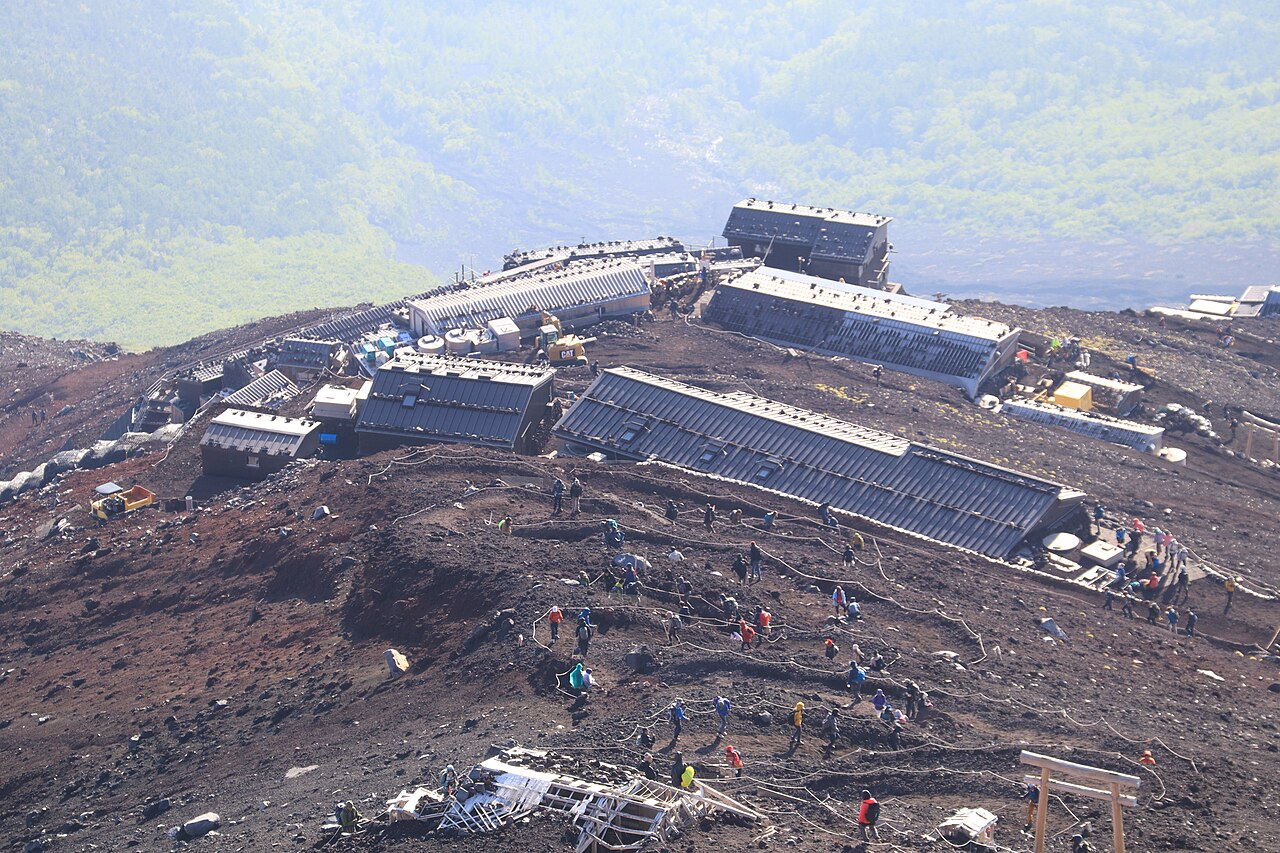
On the Yoshida route above the tree line, the path turns to loose volcanic rock and zigzags between low stone huts, with the slope falling away on one side and the crater rim appearing as a dark, broken edge against the sky.
The easily missed detail
The four trails do not end at four different summits, and descending by the wrong one strands a climber at the wrong 5th station, miles from a bag or a bus. The Subashiri and Yoshida routes merge above the 8th station, and the Gotemba descent runs over a long sand slope that looks gentle and moves underfoot, so the return route deserves as much attention as the ascent.
A practical rhythm
- Morning — Begin at a 5th station in the early morning, when the trail is least crowded and the rock is dry, and reach a hut by afternoon rather than pushing for the summit in one pull.
- Midday — Spend the middle of a non-climbing day at the Fuji Five Lakes, where the northern shore of Kawaguchi gives the straightest view of the cone.
- Evening — End at a foothill shrine town such as Fujinomiya, where the Sengen shrine and its streets close the day at the mountain's spiritual base.
What could complicate the plan
Altitude affects even fit walkers above 2,500 meters, and the final stretch is steep, rocky and exposed to wind, so a single-day dash from sea level to the summit is the riskiest version of the climb. The mandatory fee and reservation system also mean that arriving without a booking can end the attempt at the gate, especially on the capped Yoshida Trail. Off-season, the huts, toilets and first-aid posts that make the summer climb feasible are shut, and the upper trails are not maintained for walkers.
What to do next
After choosing a trail here, eat on the side of the mountain you climbed, starting with the Fujinomiya and Fujiyoshida noodle dishes in the next answer.
Sources
- The Official Website for Mt. Fuji Climbing, run with Yamanashi and Shizuoka prefectures — the four trailhead elevations, ascent and descent distances and times, the ten-station system, and the mandatory 4,000 yen fee per person on all four trails
- Fujisan World Heritage Council — Fujisan Hongu Sengen Taisha as head shrine of more than 1,300 Sengen shrines, Oshino Hakkai as eight ponds fed by Fuji subsoil water, and Shiraito Falls among the inscribed component sites
- Yamanashi Prefecture and Shizuoka Prefecture tourism authorities — the Fuji Five Lakes as Yamanaka, Kawaguchi, Saiko, Shoji and Motosu, and Kawaguchi as the principal northern lakeside base