Mount Fuji / Japan When to visit
When should I visit Mount Fuji, Japan, for the best experience?
The short answer
Climb in the official season from early July to September 10, and come to look at the mountain in the cold, clear months from late autumn through winter, when snow returns to the summit.
The answer, with local context
Mount Fuji rises 12,389 feet (3,776 meters) on Honshu, on the border between Yamanashi and Shizuoka prefectures, about 62 miles southwest of Tokyo. The Japan Meteorological Agency classes it as an active stratovolcano, and its last eruption was the Hoei eruption of 1707 to 1708. UNESCO inscribed Fujisan in 2013 as a cultural property under criteria (iii) and (vi), as a sacred place and a source of artistic inspiration, with 25 component sites. That split purpose drives the timing question: the mountain is one trip when its trails are open and a different trip when it is simply being watched from below.
The climbing window is short and formally managed. The Yoshida and Subashiri trails run from July 1 to September 10, while the Fujinomiya and Gotemba trails run from July 10 to September 10. On the Yoshida Trail, passage through the 5th-station gate is barred from 2 p.m. to 3 a.m. for climbers without a confirmed mountain-hut reservation, and the trail is capped at 4,000 climbers per day. Outside the season, the official climbing site states that mountain huts and first-aid stations close, mobile service becomes unreliable, and severe weather becomes a greater danger, which is why an out-of-season ascent is a different undertaking from a summer climb.
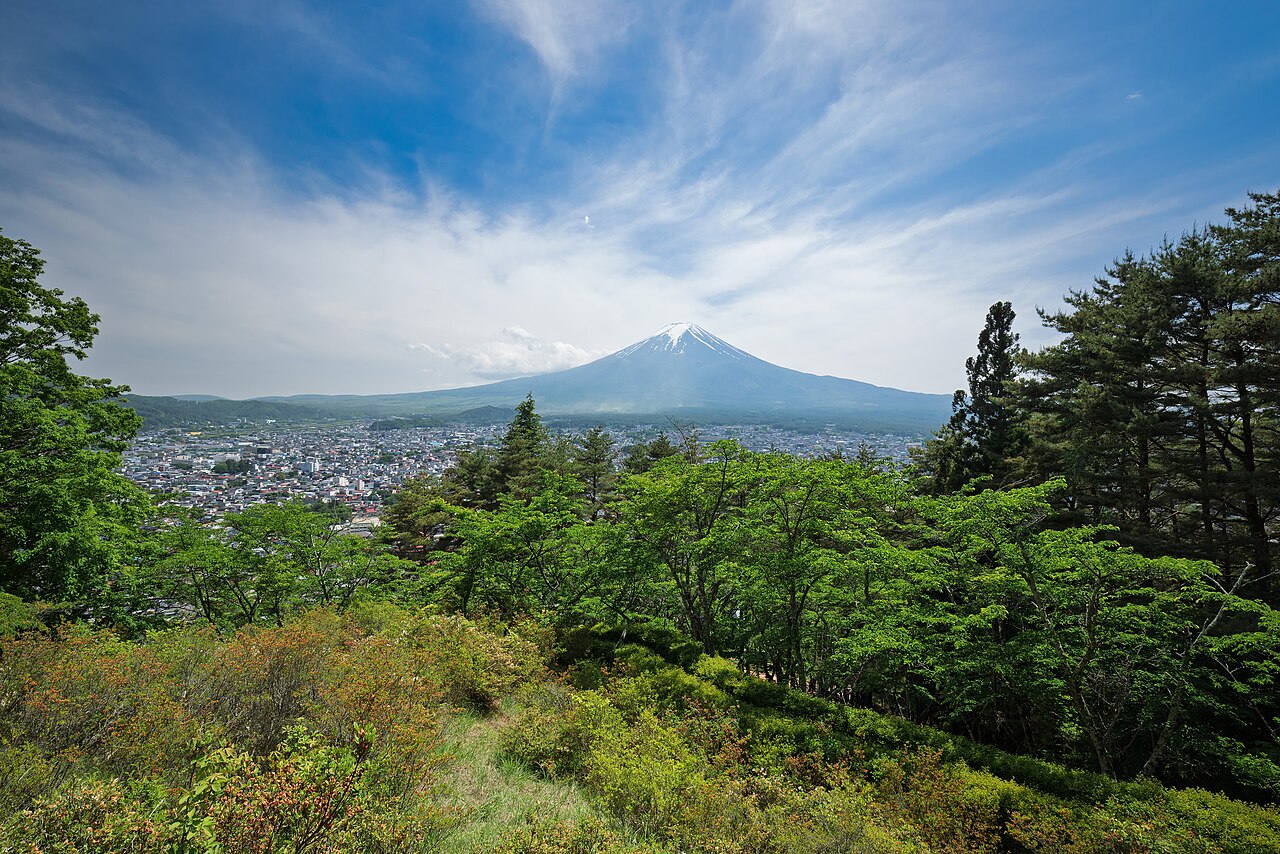
Viewing follows the opposite calendar. The summit station's annual mean temperature is 21.4°F (-5.9°C), and its October mean is 28.4°F (-2.0°C), so even a July ascent meets cold air at the top. The Kofu Local Meteorological Office has recorded the mountain's first snowcap since 1894, and the long-term average date for that first cap is October 2. From late autumn onward, the white cone that defines Fuji in prints and photographs is back, and the low winter sun keeps the symmetrical profile sharp against the sky from the northern viewpoints around Fujiyoshida.
Picture the place
In January the cone stands alone above a dark, forested base, its snowline cutting a clean diagonal across the slope while the foothill towns sit in thin, cold air and the mountain throws a long shadow across the plain before noon.
The easily missed detail
Fuji is not one climate. A summer day at the Fuji Subaru Line 5th station can feel warm while the summit, more than 4,600 feet higher, sits near freezing, and wind at the crater rim strips heat faster than the thermometer suggests. Packing for the 5th station alone is the classic preparation error, and it is why the season's hut and first-aid network matters as much as the calendar dates.
A practical rhythm
- Morning — Start a summer climb before dawn from a mountain hut, so the final rocky stretch is walked in daylight and the summit is reached before afternoon weather builds.
- Midday — Spend a viewing day's midday on the northern side, where the sun is high over the cone and the foothill lakes and towns are in full light.
- Evening — Return to a foothill town for the night rather than descending in darkness, since the trails are long, rocky, and unlit once the huts close.
What could complicate the plan
Cloud hides Fuji for days at a time, even in the climbing season, and a summit day can be clear at the 5th station and closed in at the crater. Summer is also the crowded season on the Yoshida side, so the daily cap and the overnight gate rule can end a poorly timed plan at the trailhead. Winter viewing avoids the crowds but brings its own limits: the climbing trails are shut, the upper mountain is snowbound, and a viewpoint trip still depends on a break in the cloud.
What to do next
Use the climbing-season dates above to choose a trail in the next answer, and save a winter viewpoint day for the clearest photograph of the cone.
Sources
- UNESCO World Heritage Centre — Fujisan inscribed in 2013 under criteria (iii) and (vi), with 25 component sites
- The Official Website for Mt. Fuji Climbing, run with Yamanashi and Shizuoka prefectures — the July 1 and July 10 opening dates, the September 10 closing date, the Yoshida gate hours, the 4,000-per-day Yoshida cap, and the out-of-season closure of huts and first-aid stations
- Japan Meteorological Agency, including the Kofu Local Meteorological Office — Fuji as an active stratovolcano, the Hoei eruption of 1707 to 1708, the summit temperature normals, and the first-snowcap record dating from 1894 with an average date of October 2