Myanmar country guide Places and experiences
What should a first-time traveler see in Myanmar beyond the obvious highlights?
The short answer
The Pyu Ancient Cities — Halin, Beikthano and Sri Ksetra — are the country's other World Heritage property and the one almost nobody includes: 3 brick-built, walled and moated cities in the dry zone of the Ayeyarwady basin, from a civilization UNESCO dates from about 200 BC to AD 900.
The answer, with local context
The inscription rests on criteria (ii), (iii) and (iv), and each one points at something visible. Criterion (ii) covers Buddhism's early foothold in Southeast Asia, evidenced in brick stupas and other early ritual structures. Criterion (iii) identifies the Pyu as the region's first historically documented Buddhist urban civilization, with water management, craft production and trade. Criterion (iv) recognizes an urban model of walled, moated cities with extended settlement areas beyond the walls. What survives on the ground is partly excavated: palace citadels, burial grounds, manufacturing sites, monumental brick stupas, stretches of standing wall, and water-management features some of which are still in use.
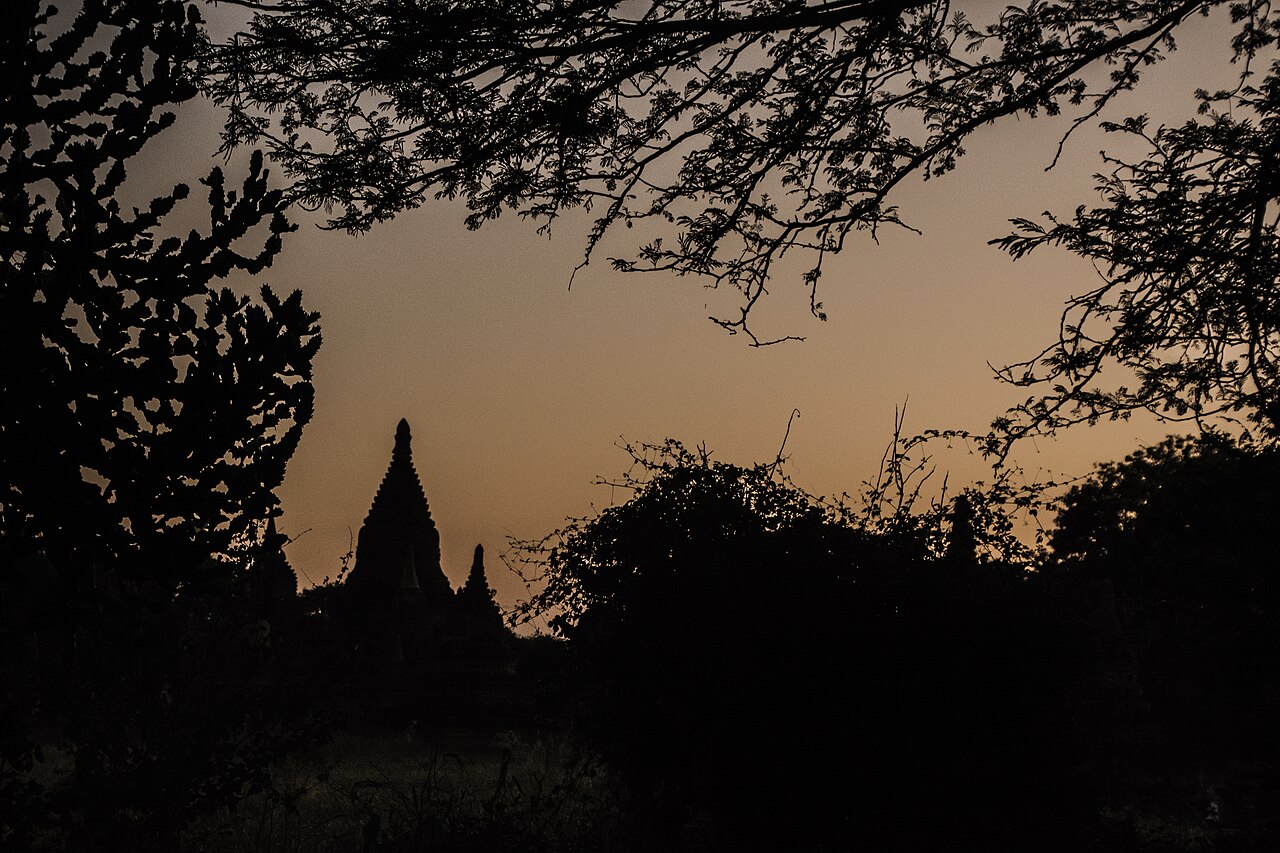
Bagan repays a second look for the same reason. Its serial inscription covers 8 components, 7 components on one side of the Ayeyarwady and 1 component on the opposite bank — so the component most visitors never reach is across the river from everything they photographed.
Getting to any of it is an aviation question before it is a sightseeing one. US commercial guidance notes that air access to the country runs mainly through regional hubs such as Singapore, Seoul and Bangkok, that most domestic flights pass through Yangon with limited direct links between provincial cities, and that rail exists but is not recommended because of slow service. Road travel in border areas requires government permission.
Picture the place
The Pyu sites read as earthworks rather than monuments: brick walls and moat lines cut through irrigated farmland in the dry zone, with stupas standing clear of a landscape whose canals in places still carry water the Pyu engineered a channel for.
The easily missed detail
Myanmar's conflict map, not its heritage map, decides what is reachable. The State Department records ongoing fighting in parts of Kachin, Kayah, Kayin, Shan, Rakhine, Mon and Chin States and in the Mandalay, Sagaing, Magway and Tanintharyi Regions, and advises avoiding those areas and all borders with neighboring countries. That list covers a large share of the country's geography, including regions that contain archaeological landscapes.
A practical rhythm
- Dry zone — Halin, Beikthano and Sri Ksetra sit in the same arid belt of the Ayeyarwady basin as Bagan, so they combine logically rather than as separate trips.
- Across the river — Bagan's 8th component lies on the far bank, which takes a crossing rather than a drive.
- Everything else — Domestic flights route through Yangon, so a multi-site plan usually means returning to the hub between legs.
What could complicate the plan
Checkpoints run by the military and by ethnic armed groups are common outside tourist areas, and the regime may restrict access to highways and airports in ways that can leave travelers stranded. The US Embassy's ability to help in remote or conflict-affected areas is limited, and US government employees may themselves be barred from traveling within the country. Landmines and unexploded ordnance exist throughout the country and are often unmarked, which is a direct constraint at partly excavated archaeological sites where walking off a path is the natural instinct. Cell coverage is confined to Yangon, Mandalay, Bagan and surrounding areas.
What to do next
The Myanmar when-to-visit question explains the rainy-season road problem and Bagan's protective zone; the trip-planning question covers visas, accommodation rules and health.
Sources
- UNESCO World Heritage Centre, Pyu Ancient Cities — the 3 cities, criteria, date range, surviving features
- UNESCO World Heritage Centre, Bagan — component count and river split
- US Department of State, Burma country information — conflict regions, checkpoints, consular limits, landmines
- US International Trade Administration, Burma business travel — air hubs, domestic routing, rail, border-road permission, cell coverage