Nepal country guide Places and experiences
What should a first-time traveler see in Nepal beyond the obvious highlights?
The short answer
The sacred south and the wild west: Lumbini, where the Buddha was born; Bardia, the Terai's largest and quietest national park; Rara Lake high in the northwest; and the rain-shadow valley of Mustang, behind the Himalaya.
The answer, with local context
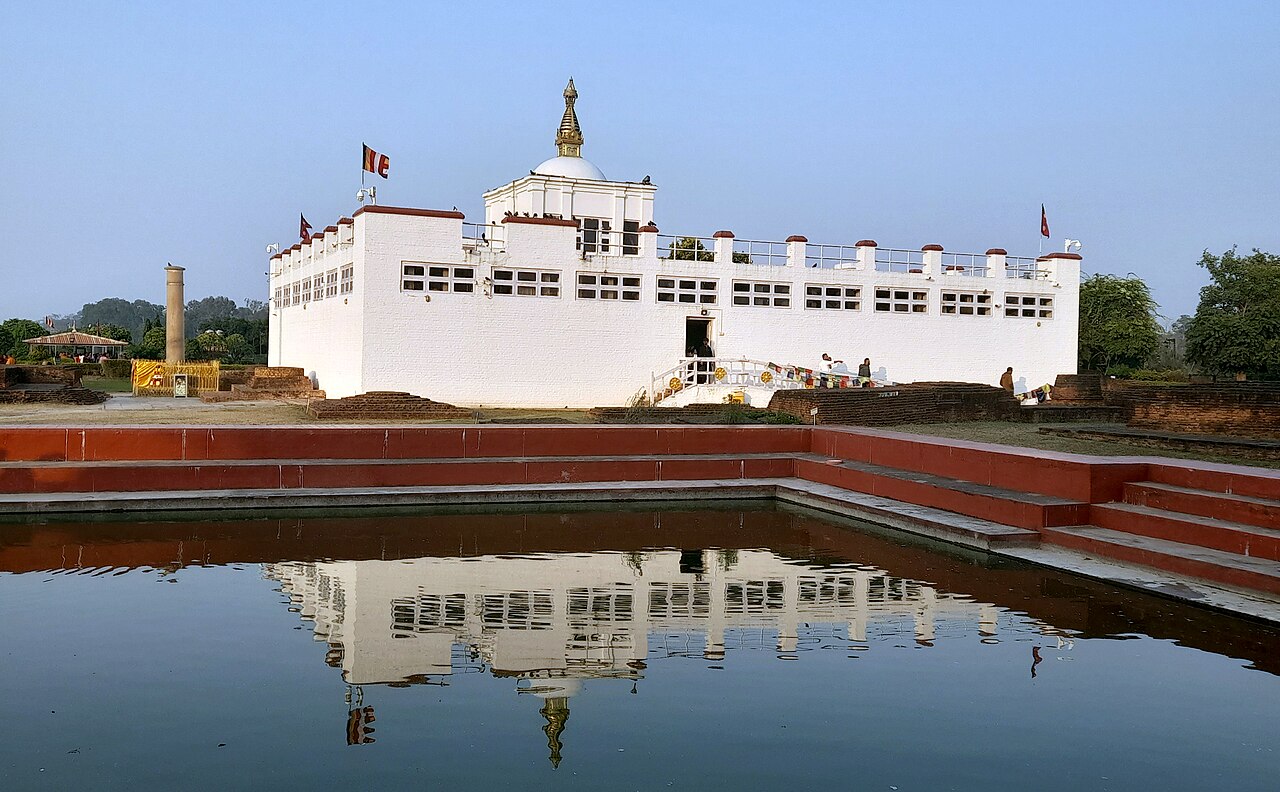
Begin on the flat southern plain, in Rupandehi District, where the country's most consequential ground looks like almost nothing. Lumbini, inscribed by UNESCO in 1997, is the birthplace of Siddhartha Gautama: the Maya Devi Temple stands over the marker stone that fixes the birth spot, and beside it rises the sandstone pillar the Mauryan emperor Ashoka erected on his pilgrimage in 249 BCE, its Brahmi inscription the earliest written evidence naming this as the Buddha's birthplace. The site is laid out on a master plan drawn up by the Japanese architect Kenzo Tange in 1978, with a Sacred Garden at its heart and a monastic zone where Buddhist nations have each built a monastery — a whole world religion's geography arranged around one small garden.
The Terai holds a second, wilder layer that most itineraries skip by stopping at the famous park. Chitwan deserves its fame — the Department of National Parks and Wildlife Conservation's 2021 count found 752 greater one-horned rhinoceroses in Nepal, 694 of them in Chitwan alone, and the national tiger count reached 355 in 2022, nearly triple the 121 of 2009 — but Bardia National Park, farther west, is the connoisseur's version: at 374 square miles (968 km²) it is the largest and most undisturbed park in the Terai, established in 1988 along the Karnali River, holding tigers, wild elephants, gharial and Gangetic river dolphins for a fraction of Chitwan's visitor numbers. Together with neighboring Banke National Park it forms a protected block of 555 square miles (1,437 km²) managed as a single tiger conservation unit.
The far northwest answers with altitude and silence. Rara Lake, at 9,810 feet (2,990 meters), is Nepal's largest lake at 4.2 square miles (10.8 km²) and up to 548 feet (167 meters) deep, held inside Rara National Park — at 41 square miles (106 km²) the country's smallest national park, created in 1976. North of the Annapurnas, Mustang offers the opposite of the green hills: a high desert in the rain shadow of the main range, where the walled town of Lo Manthang preserves a Tibetan culture that the monsoon never reaches. And underneath every route runs the human variety the 2021 census recorded — 142 caste and ethnic groups speaking 124 mother tongues in a country smaller than Florida — which is why the village one valley over so often cooks, dresses and worships differently from the last.
Picture the place
In Bardia's grasslands at dawn the elephant grass stands taller than the jeep, mist sits on the Karnali, and a rhino crosses the track ahead in complete silence, gray as the light itself.
The easily missed detail
Lumbini's power is archaeological, not scenic. Travelers who arrive expecting a grand monument often leave underwhelmed by a white temple, a pillar and a pond; the site's weight is in the inscription of 249 BCE and the brick remains running from the 3rd century BCE onward, so it rewards an hour with the evidence rather than a photograph from the gate.
A practical rhythm
- South first — Pair Lumbini with a Terai park in one southern swing, since both sit on the same flat plain and share its winter season.
- West over east — Choose Bardia over a second Chitwan visit if the trip has the extra travel day; the wildlife is comparable and the crowds are not.
- One remote reach — Add either Rara or Mustang, not both: each is a multi-day commitment in a different corner of the country, and together they would consume the whole trip.
What could complicate the plan
Distance is the tax on all of it. Bardia is a flight to Nepalgunj plus a drive, Rara is a flight-and-trek combination in the far northwest, and Mustang's restricted status means permits arranged in advance through a registered agency — none of these bolts onto a free afternoon. Lumbini's heat is the other limit: the Terai summer makes the Sacred Garden punishing by midday, which is why the south belongs in the cooler half of the year.
What to do next
Pick your one remote reach — Bardia, Rara or Mustang — then build the food days of the next answer into the valley and hill stages that connect them.
Sources
- UNESCO World Heritage Centre — Lumbini inscribed in 1997 as the birthplace of the Lord Buddha, with remains of pilgrimage from the 3rd century BCE
- Lumbini Development Trust — the Maya Devi Temple and marker stone, the Ashoka Pillar of 249 BCE with its Brahmi inscription, and Kenzo Tange's 1978 master plan with its Sacred Garden and monastic zone
- Department of National Parks and Wildlife Conservation, Nepal — the 2021 national rhino count of 752 (694 in Chitwan), the 2022 tiger count of 355 against 121 in 2009, Bardia's 968 km² as the Terai's largest park (established 1988) and the Bardia–Banke tiger conservation unit, and Rara Lake's 10.8 km² inside the 106 km² Rara National Park
- National Statistics Office, Nepal — the 2021 census recording 142 caste and ethnic groups and 124 mother tongues