Noto / Italy Things to do
What are the most worthwhile things to do in Noto on a first visit?
The short answer
Walk the Corso Vittorio Emanuele end to end at golden hour — cathedral, palace balconies and three church-crowned piazzas in one golden line — then give a day to the Vendicari reserve's beaches and ruins, and an evening to Marzamemi's tonnara piazza.
The answer, with local context
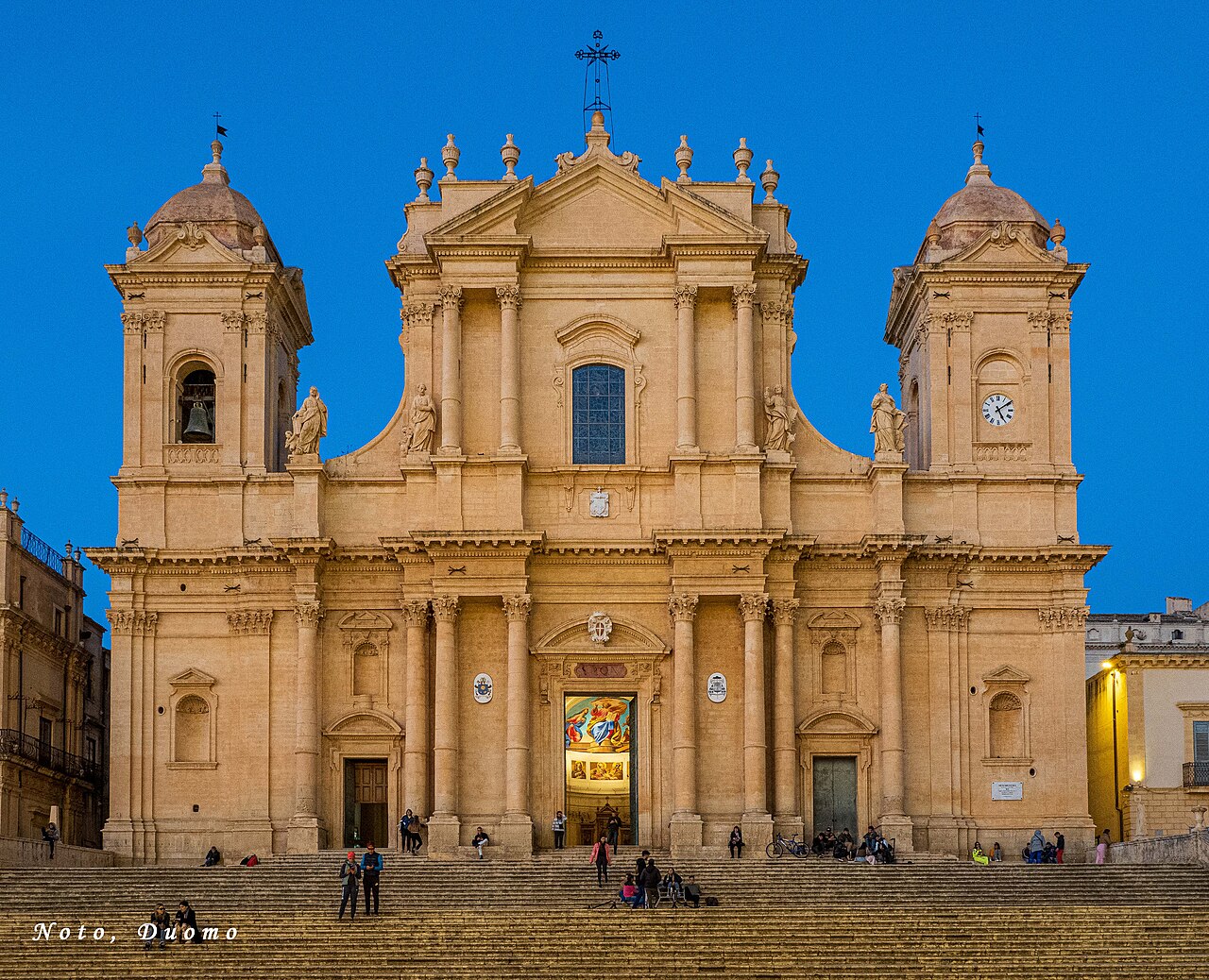
Noto is the most legible great town in Sicily: rebuilt after 1693 on a regular grid along one ceremonial axis, the Corso Vittorio Emanuele, and a first visit is simply that axis walked slowly. It runs through three piazzas like beads. At its heart, Piazza Municipio holds the town's set piece: the Cathedral of San Nicolò, raised on its broad ceremonial staircase above the square (Rosario Gagliardi and successors; its dome, collapsed in 1996, was rebuilt and the church reopened in 2007), facing the Palazzo Ducezio, the town hall designed by Vincenzo Sinatra, whose Hall of Mirrors keeps French-style frescoed ceilings behind the civic facade. West along the Corso, the churches stack up: San Francesco all'Immacolata, Santa Chiara (its terrace overlooks the corso), the monastery of the SS. Salvatore. Then turn up Via Nicolaci for the town's signature detail: the Palazzo Nicolaci di Villadorata, whose balconies are held up by carved sirens, horses, cherubs and lions — Gagliardi's stone menagerie, the most photographed ironwork-and-limestone in the Val di Noto — and the convex-facaded San Domenico, which connoisseurs call Gagliardi's masterpiece, stands a few streets north. The town is a UNESCO listing made walkable (Late Baroque Towns of the Val di Noto, 2002) in perhaps ninety minutes of street; the skill is walking it twice, in the cool morning for the interiors and again at dusk when the stone performs.
For height, climb: the bell tower of San Carlo al Corso opens its terrace over the rooftops and the cathedral dome, and Santa Chiara's terrace reads the whole grid — from above, the rebuilt town's geometry (three social levels on the slope, churches placed as full stops) finally makes sense. The Teatro Tina Di Lorenzo (opened 1870 as the Teatro Vittorio Emanuele) runs concerts and productions in season inside a jewel-box interior worth any ticket. And the Porta Reale (1838), the neoclassical arch at the Corso's east end, marks where the ceremonial town lets you out toward the sea.
The second day belongs to the coast the town was rebuilt facing. The Vendicari Nature Reserve (established 1984, a few miles south) stacks an entire shore in one park: the ruined tonnara (tuna fishery) and Sveva tower, flamingos and spoonbills on the lagoon paths, and a chain of beaches ending at Calamosche, the cove between two rocky headlands that locals name Sicily's finest swim. In the evening, drive ten minutes further to Marzamemi, the Arab-founded fishing village around its tonnara and Piazza Regina Margherita — a stone square of fishermen's houses turned into the southeast's prettiest open-air dining room. Noto's hinterland adds a third gear if days allow: the Roman villa mosaics and the Eloro beach ruins toward Avola, and Modica — the chocolate city, Noto's Baroque twin — half an hour inland.
Picture the place
The cathedral staircase at 7 p.m.: students on the steps, swifts over the dome, and the whole square turning the color of honey an hour before dinner.
The easily missed detail
Ask at the cathedral about the dome. Its collapse on March 13, 1996 — four years after restoration work — was the town's modern trauma, and its reconstruction (completed and the cathedral reopened in 2007) was done by studying Gagliardi's original methods and rebuilding in the same local stone with traditional techniques, a twenty-year civic project the town is quietly proud of. Inside, the rebuilt dome's clean new limestone against the 18th-century fabric is the visible seam between the two Notos — the Baroque original and the town that refused to lose it.
A practical rhythm
- Corso twice — Interiors and terraces in the morning; the same street at golden hour is a different, greater sight
- Beach by reserve rules — Vendicari's gates, paths and Calamosche's walk-in access keep their own hours; arrive before 10 in summer
- Marzamemi after 7 — The piazza wakes at aperitivo; dinner bookings matter in season
What could complicate the plan
Noto's sights keep provincial hours: palazzi (Nicolaci) and church terraces open in morning and late-afternoon windows with a long midday closure, and several close a weekday — the golden-hour walk is unaffected, but interiors need planning around the siesta rhythm. Summer heat on pale stone is the real adversary (the Corso at noon in August is a lesson in reflected light); Vendicari has almost no shade and no beach services at Calamosche, by design — water and a hat are the entry fee. Parking sits outside the old town's closed core; the town is best done on foot by anyone based inside it.
What to do next
Walk the Corso tomorrow morning from the Porta Reale, book nothing before the San Carlo tower, and put Vendicari on the clearest day of the stay.
Sources
- UNESCO World Heritage List — Late Baroque Towns of the Val di Noto (2002): Noto's post-1693 reconstruction, Gagliardi's palazzi and churches
- Comune di Noto — Palazzo Ducezio and the cathedral of San Nicolò (dome collapse 1996; reopened 2007); Palazzo Nicolaci di Villadorata and its balconies
- Riserva Naturale Orientata Vendicari — the reserve (1984): the tonnara, the lagoon birdlife and Calamosche
- Teatro Tina Di Lorenzo, Noto — the theatre's 1870 opening (as Teatro Vittorio Emanuele) and current season