Noto / Italy Food and drink
Where should I eat in Noto, and which local food or drink is worth trying?
The short answer
Breakfast on almond granita with a warm brioche at the Corso's great caffès, dine on fish in Marzamemi's piazza, and drink the two wines this corner invented its name for — Nero d'Avola red and Moscato di Noto — with the almond in all its forms between meals.
The answer, with local context
Noto's day is structured by granita. Sicily's southeast takes the frozen breakfast seriously, and Noto's address is Caffè Sicilia on the Corso Vittorio Emanuele, run by Corrado Assenza — the pastry chef whose almond and lemon granitas, made from the Avola groves' own harvest, are the town's edible landmark (his work reached a global audience via Chef's Table). The order is ritual: a granita — mandorla (almond) above all, the Pizzuta d'Avola almond being among Italy's most prized, or lemon, coffee, mulberry in season — with a brioche col tuppo, the knotted bun torn and dipped, and whipped cream (panna) if the morning allows. The town's other historic caffès along the Corso run the same liturgy with local partisans; the argument about whose almond granita leads is Noto's favorite sport. Around it, the pastry canon of the southeast: cannoli filled to order, cassata, almond paste fruits (pasta reale), torrone, and the granite in flavours that change with the orchards.
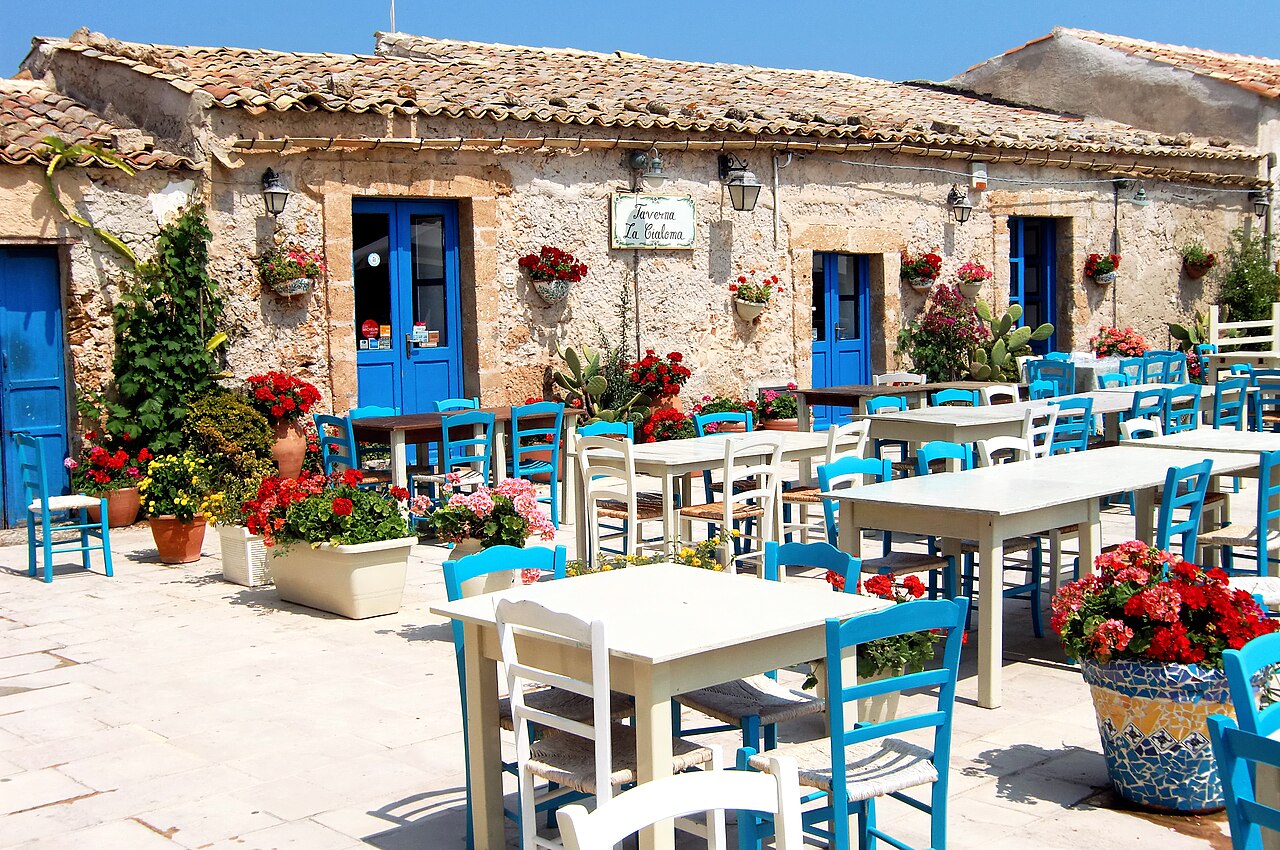
The savoury table faces the sea and the Pachino fields. The Pomodoro di Pachino IGP — the cherry and costoluto tomatoes grown in the sun-trap between Pachino and the coast, a few miles south — anchors the salads and the pasta sauces of the whole corner; the fish is landed at Marzamemi and Portopalo, Sicily's southernmost port, and eaten best in Marzamemi itself, where the old tonnara's piazza fills with restaurant tables: grilled swordfish and tuna (the tonnara's own tradition), crudo of the day, pasta with bottarga or with Pachino tomatoes and basil. In Noto's centro, the trattorias run the inland side — caponata, scacce and savoury pies from the bakery ovens, cheeses from the Hyblaean plateau — and the town's small fine-dining rooms reinterpret the almond and the tomato at tasting-menu level. Book the piazza tables in Marzamemi in season; it is a village of two streets and the whole southeast has the same idea.
The wines are the headline the rest of Sicily envies: the grape Nero d'Avola is named for Avola, ten minutes up the coast, and the Eloro DOC — Sicily's southeastern red appellation, covering Noto, Avola, Pachino and Rosolini — grows it in the limestone-and-sand soils of its home parish: dark, plummy, sea-breezed reds that are the natural glass with the tonnara's tuna. The second glass is the Moscato di Noto DOC, the ancient sweet white of the town itself, made from Moscato Bianco grown around Noto since long before the earthquake — golden, orange-blossomed, and the correct ending with almond pastries. Between the two, the southeast's table is complete: almond at dawn, tomato and tuna at dusk, the red of Avola with dinner and the Moscato of Noto with the sweet — a whole cuisine inside fifteen miles.
Picture the place
Breakfast at a Corso marble table: a glass of almond granita the color of ivory, the brioche's little topknot soaking at its edge, and the cathedral steps filling with morning light across the square.
The easily missed detail
The almond has a hierarchy here, and the menus encode it: the Pizzuta d'Avola — one of three Avola varieties (with Fascionello and Romana), grown in the quarries-and-groves country between Avola and Noto — is the confectioners' almond, reserved for granita, latte di mandorla and pasta di mandorla, while lesser almonds go to torrone and baking. Caffè Sicilia's fame rests substantially on using the Pizzuta at the right harvest moment. When a caffè lists "granita di mandorla d'Avola," that is the claim being made; taste it against a generic almond granita elsewhere in Sicily and the hierarchy becomes obvious.
A practical rhythm
- Granita is breakfast — Take it before 9 at the Corso caffès, brioche col tuppo, standing or at a marble table like a citizen
- Fish in the village, meat in the town — Marzamemi and Portopalo for the catch; Noto's trattorias for the Hyblaean inland table
- Red then gold — Eloro Nero d'Avola with dinner; Moscato di Noto with the almond dolci, in that order, every day
What could complicate the plan
The best tables in this answer sit in a village with almost no tables. Marzamemi is 2 streets of fishing harbor and the whole southeast books it in season, so a piazza dinner there is a reservation made days ahead rather than a drive-down decision — and the road back to Noto afterwards is unlit country road. Granita is a morning product: the Corso caffès churn it fresh through the early hours and the orchard flavours go first, so the mulberry or the fig somebody came for may simply be finished by afternoon. The fish villages and the Pachino tomato fields all lie south of the town, which makes this a car itinerary; without one, the food map shrinks to the Corso and its pastry counters.
What to do next
Start tomorrow at Caffè Sicilia with the almond granita, book Marzamemi for the evening, and ask the waiter for the Eloro by name.
Sources
- Consorzio di Tutela del Pomodoro di Pachino IGP — the Pachino tomato's protected zone between Pachino and the coast
- Consorzio Tutela Vini Eloro DOC / Moscato di Noto DOC — the southeast's red appellation (Noto, Avola, Pachino, Rosolini) and Noto's historic Moscato
- Comune di Noto / Pro Loco — the Corso's historic caffès and Caffè Sicilia under Corrado Assenza
- Slow Food Foundation — the Avola almond (Pizzuta, Fascionello, Romana) and its presidium