Paraguay country guide Places and experiences
What should a first-time traveler see in Paraguay beyond the obvious highlights?
The short answer
The Jesuit missions of the south (Trinidad and Jesús), the Mennonite Chaco and its thorn-forest wildlife, the pottery and lace towns of the central circuit, and the Itaipú hydroelectric giant: Paraguay's highlights hide in 3 regions that share almost nothing but a flag.
The answer, with local context
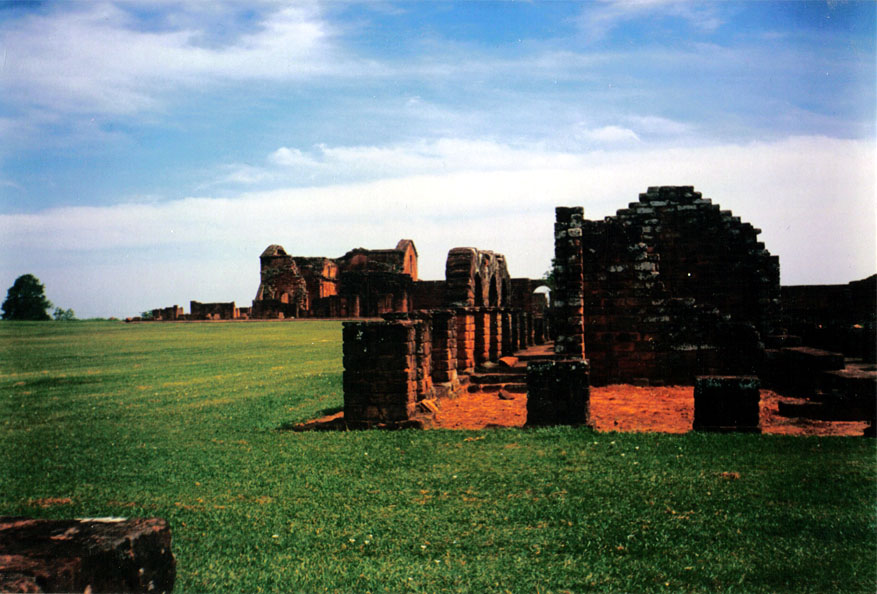
The south carries the country's 1 UNESCO inscription: the Jesuit Missions of La Santísima Trinidad de Paraná and Jesús de Tavarangue (inscribed 1993), the stone remains of the Guaraní-Jesuit reductions that ran 1609–1768. Trinidad (founded 1706) is the showpiece — a great sandstone church with its carved friezes, the plaza, the arcaded houses and a bell tower you can climb, floodlit on weekend nights for a son-et-lumière that justifies an Encarnación overnight; Jesús de Tavarangue (begun 1685, never finished — its vast roofless church, 3 aisles wide, abandoned at the 1767 expulsion) sits 10 km away in green silence. The mission circuit strings further: San Ignacio Guazú (the first reduction, 1609, gateway town with the Diocesan Museum's Guaraní baroque statues), Santa María de Fe (the museum holding Bernardino de Cárdenas-era carvings) and Santiago — best run as a 2–3-day loop out of Encarnación, the Paraná river city (360 km southeast of Asunción) with its own costanera beaches and the country's biggest Carnival (January–February, in its sambadrome). Add Yaguarón, 45 km from the capital: its Franciscan church (1760s) holds some of the finest polychrome woodcarving in the Americas behind a plain facade.
The west is the other Paraguay: the Gran Chaco — 60% of the territory, under 3% of the people, thorn forest, salt lakes and the continent's least-visited wilderness. Filadelfia (about 450 km northwest of Asunción on the paved Transchaco) anchors the Mennonite colonies (Menno 1927, Fernheim 1930, Neuland 1947 — refugees via Canada and the USSR who turned thornbush into dairy country; the Jakob Unger museum and the colonies' co-op stores tell it). Beyond, the Defensores del Chaco National Park (about 780,000 hectares, the country's largest protected area, Cerro León its only hill) and the private reserves and estancias deliver the wildlife list: jaguar, puma, giant anteater, lowland tapir, the Chacoan peccary (declared extinct, rediscovered alive in the 1970s), and the seasonal salt lakes (Lagunas Saladas) with flamingos. The east gives the circuit its industrial sublime: Itaipú (at Hernandarias, by Ciudad del Este, 330 km east) — the Brazil-Paraguay binational dam, 14,000 MW of installed capacity from 20 turbines on the Paraná, perennially among the world's 2 largest hydro plants by generation — runs free guided visits including a night-lighting show; Ciudad del Este itself is the shopping bazaar of legend (go for the spectacle and the street food, keep border-street smarts per this guide's first answer), and Foz do Iguaçu's falls lie 25 minutes across the bridge in Brazil for those with the visa picture sorted.
Picture the place
Trinidad at floodlit dusk: red sandstone angels watching over an empty grass plaza, swallows working the tower, and not another visitor in the frame.
The easily missed detail
The central circuit's craft towns out-charm their size: Itauguá for ñandutí — the spiderweb lace (its name means "imitation spiderweb" in Guaraní) made on frames in doorways; Areguá for pottery and its lakeside colonial streets on Lake Ypacaraí; Tobatí for woodcarving; Luque for filigree jewellery and harps — Paraguay's harp is a national instrument (36 strings, played with fingernails), and the towns run on a circuit of day trips from the capital that most visitors never learn exists. The second detail is the Chaco's season discipline: everything in the west — tracks, wildlife concentrations, the salt lakes' birds — peaks in the dry winter; a summer Chaco trip is a mud-and-heat expedition, not a safari.
A practical rhythm
- The southern loop — Asunción → Yaguarón → San Ignacio → Encarnación (Trinidad + Jesús) in 3–4 days
- The Chaco block — Filadelfia 2 nights + a reserve or estancia 2 nights, winter only
- Itaipú as a day — From Ciudad del Este with the falls across the river if the paperwork agrees
What could complicate the plan
Paraguay's sights are far apart on roads of 2 speeds: the paved arteries (Asunción–Encarnación, Asunción–CDE, the Transchaco to Filadelfia) are good, everything off them is not — the missions loop is easy, the Chaco's parks are expedition logistics (4×4, guides, dry-season-only), and distances (360 km to Encarnación, 450 km to Filadelfia, 330 km to Ciudad del Este) punish the traveler who draws the triangle on a map without counting hours. Ciudad del Este and the northeast border departments sit at Level 2 in the State Department's advice (organized-crime country at the frontier): the Itaipú visit and a supervised shopping day are standard practice; independent wandering in border towns is not. Mission sites run official hours with modest fees and limited English interpretation (a guide from Encarnación doubles the value); Trinidad's floodlit nights are weekend-pattern — plan the overnight on a Friday or Saturday. Paraguay has exactly 1 UNESCO property — the traveler expecting a circuit of listings should recalibrate: the country's riches are regional, not inscribed. And the language fact that shapes everything: Guaraní (co-official, spoken by the great majority, many monolingually in the countryside) means rural Paraguay runs bilingually — a phrasebook of jopará (the Spanish-Guaraní mix) earns smiles no Spanish alone will.
What to do next
Plan the south first (Encarnación base, 3 nights, Trinidad at dusk), and decide with open eyes whether the Chaco's winter expedition earns its days in your trip.
Sources
- UNESCO — Jesuit Missions of La Santísima Trinidad de Paraná and Jesús de Tavarangue (inscribed 1993); Paraguay's single World Heritage property
- SENATUR (Paraguayan tourism authority) — the missions circuit; Itaipú visitor programme (free tours; night lighting); the Transchaco and Filadelfia
- Itaipú Binacional — 14,000 MW installed capacity, 20 generating units on the Paraná River
- Chaco record — Mennonite colonies (Menno 1927, Fernheim 1930, Neuland 1947); Defensores del Chaco National Park (about 780,000 ha); the Chacoan peccary rediscovery