Paraguay country guide When to visit
When is the best time to visit Paraguay for Asuncion?
The short answer
June — the heart of the mild, dry southern winter, when Asunción trades its 104°F summer furnace for 74°F days (24°C), the eastern roads and the Chaco tracks are all firm, and the San Juan festival fires up the streets on June 23–24.
The answer, with local context
Paraguay's seasons are the northern hemisphere's flipped, and its governing force is not rain but heat. The WMO 1991–2020 normals for Asunción tell the story: January averages a 93°F (34°C) high with humidity to match and heatwave spikes past 104°F (40°C) in bad weeks, while June and July sit at 74°F (24°C) highs with cool nights; rainfall concentrates October–April (the wet season, roughly 200 mm in the wettest summer months) against a May–September dry season when winter months drop under 50 mm. The whole country plays by the same 2 registers with regional accents: the east (Asunción, the missions, Ciudad del Este) is humid subtropical green — about 1,400 mm a year around the capital, more toward the Paraná — while the Gran Chaco, the western 60% of the country, bakes drier (some 500–800 mm, falling mostly in summer) and becomes properly passable only in the dry winter, when its clay tracks set hard and its salt lakes and thorn forest open to vehicles. June threads everything: the missions' grass is still green from autumn, the Chaco is dry and not yet cold-dusted, Encarnación's carnival crowds are a memory, and surazos (the polar cold snaps that can drop the capital to near 40°F overnight) arrive as crisp episodes, not conditions.
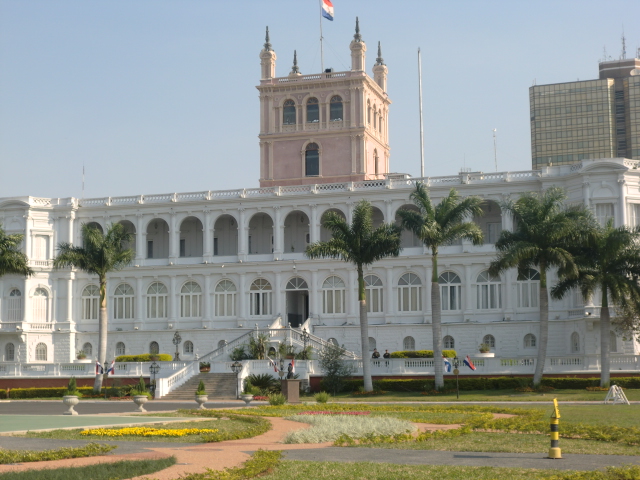
The anchor's visitor core is walkable in the winter light: the Palacio de los López, the presidential palace lit pink-white over the bay; the Costanera, the riverfront promenade along the Paraguay River where the city walks at dusk; the Panteón Nacional de los Héroes; the Casa de la Independencia; the Manzana de la Rivera cultural row; and the Museo del Barro. Entry runs on a law rather than a courtesy: Paraguay's own consular guidance states that Law 7314/2024 extends Law 6790/2021 by 3 years and removes the visa requirement for tourists from the United States, Canada, Australia and New Zealand for stays of up to 90 days. The U.S. State Department says the same from its side, and the advisory stands at Level 1 (Exercise Normal Precautions) nationally, with Level 2 caution in 5 border departments (Alto Paraná, Amambay, Canindeyú, Concepción, San Pedro) — the calmest advisory profile in this guide's South American set, with a date on it this guide flags below.
Picture the place
The Costanera at 6 p.m. in June: families with tereré thermoses along the balustrade, the Palacio de los López catching the low sun across the bay, and a 74°F breeze doing what no air conditioner in January ever could.
The easily missed detail
June 23–24 is San Juan Ára, the festival the whole country actually celebrates: streets and clubs fill with fire games — the pelota tata (a burning football kicked around the plaza), the toro candil (a bull-frame with flaming horns charging the crowd), Judas effigies, and stalls selling mbejú and chipa hot off the comal. A June trip that misses San Juan night has missed Paraguay's favorite party — Asunción's neighborhood clubs (clubes sociales) run the biggest ones, visitors welcome. The quieter detail: winter in Paraguay still means tereré o'clock — the iced yerba circle (this guide's food answer) runs at every temperature, because the ritual is social, not thermal.
A practical rhythm
- June, 10–14 days — Asunción 3–4, the missions loop 3–4, the Chaco 3–4 if the west calls
- San Juan night in Asunción — June 23–24 at a neighborhood club's fiesta
- Book the Chaco early — Winter is the only Chaco season; lodges and guides are few
What could complicate the plan
The visa waiver has an expiry date: the U.S./Canada/Australia/New Zealand exemption runs by law until August 13, 2027 (Law 7314/2024) — after that, absent renewal, the old regime (visa on arrival at Asunción's airport only, formerly US$160) may return; anyone traveling near or after that date must confirm the rule before booking and again before flying. Summer trips need heat honesty: December–February Asunción is one of South America's hottest capitals, with flooded streets in storm season and siesta-dead afternoons — the winter choice is not marginal, it is the trip. Cold snaps cut the other way in June–July (a surazo can mean 45°F mornings — pack a real layer, which no one believes packing for Paraguay). The Level 2 border departments are the northeast/east frontier (the Ciudad del Este day trip is routine and commercial; lingering at remote border crossings is the pattern to avoid), road blockades appear periodically on national routes (leave schedule slack), and yellow fever vaccination paperwork is required if arriving from a risk country (and sensibly held anyway — the Chaco and east are vaccination country per WHO guidance).
What to do next
Book a June trip anchored on San Juan night in Asunción, and confirm the visa-waiver law still stands if your dates fall near August 2027.
Sources
- World Meteorological Organization — the 1991–2020 climatological normals for Asunción: January highs of 93°F (34°C) against June–July highs of 74°F (24°C); the May–September dry season; about 1,400 mm of rain a year
- U.S. Department of State, Paraguay (advisory August 19, 2026; Level 1, with Level 2 in Alto Paraná, Amambay, Canindeyú, Concepción and San Pedro) — no visa for stays up to 90 days
- Ministry of Foreign Affairs of Paraguay, consular visa page — Law 7314/2024 extending Law 6790/2021 by three years, removing the visa requirement for tourists from the United States, Canada, Australia and New Zealand for stays up to 90 days, with the exemption running to August 13, 2027, and the US$160.00 visa-on-arrival fee that page still lists alongside it