Penang / Malaysia Things to do
What are the most worthwhile things to do in Penang on a first visit?
The short answer
Walk the UNESCO-listed George Town core — clan houses, jetties and street art inside 270 protected acres — then take the funicular up Penang Hill and finish at Kek Lok Si, Malaysia's largest Buddhist temple.
The answer, with local context
George Town's historic center was inscribed by UNESCO on July 7, 2008, jointly with Melaka as the Historic Cities of the Straits of Malacca, under criteria (ii), (iii) and (iv). The numbers give the walk its scale: a core zone of 270 acres (109.38 ha) wrapped in a 371-acre (150.04 ha) buffer, holding more than 5,000 historic buildings — shophouses, clan temples, mosques, churches and godowns layered by five centuries of trade between East and West. Work the core on foot in a deliberate loop: the Leong San Tong Khoo Kongsi, the most ornate Chinese clan temple in Malaysia, with its gilded beams and stone carvings; the Cheong Fatt Tze Mansion, the indigo-blue courtyard house built in the 1890s whose restoration won UNESCO's Asia-Pacific Heritage Award for Culture Heritage Conservation in 2000; and Jalan Masjid Kapitan Keling, where the Kapitan Keling Mosque (built 1801), the Goddess of Mercy Temple and St George's Church — the oldest Anglican church in Southeast Asia, completed in 1818 — stand within a few hundred yards of each other.
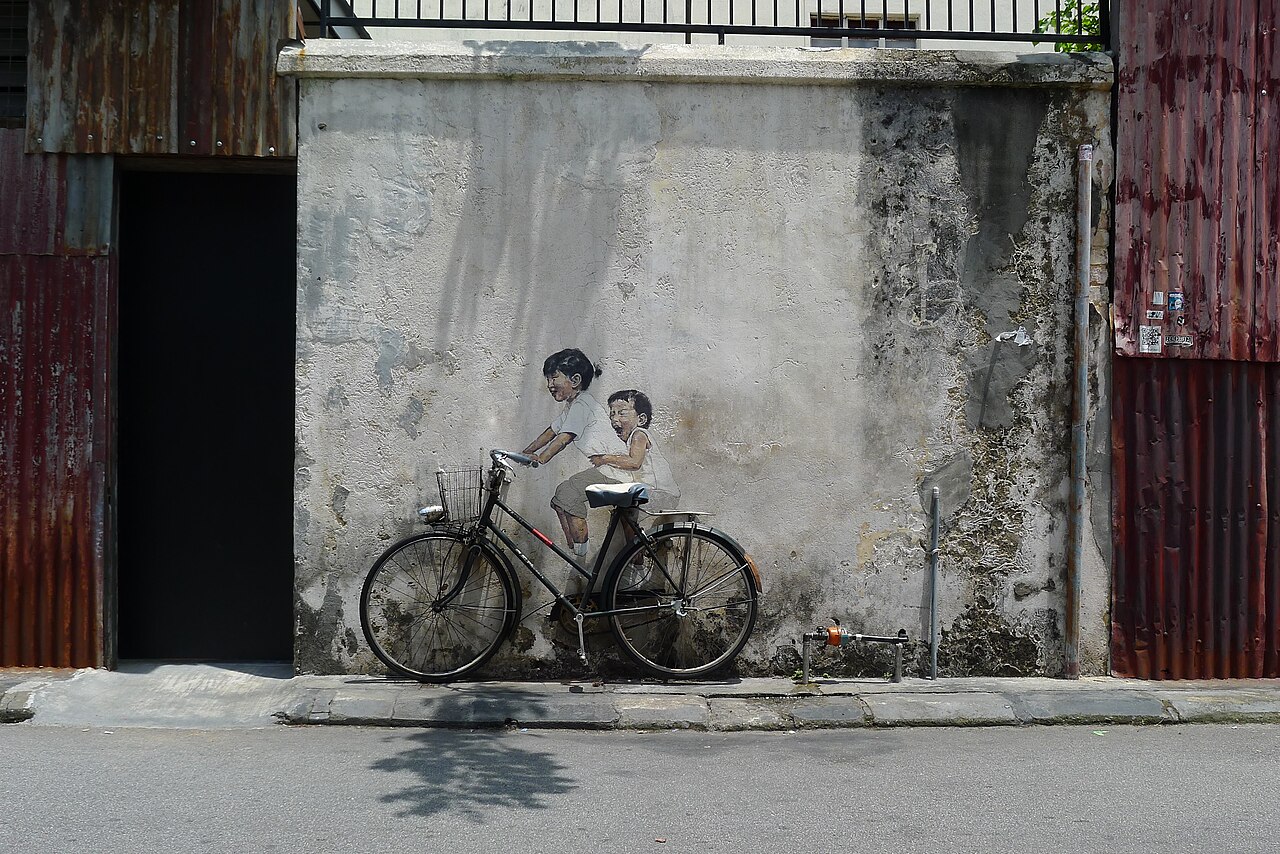
Two of the core's sights are alive rather than preserved. The Clan Jetties, a row of wooden villages on stilts along Weld Quay, are each owned by a single Chinese clan — Ong, Lim, Chew, Tan, Lee, Yeoh and the Mixed Clan jetty — and Chew Jetty, the largest, still houses around 75 families along its 650-foot (200 m) boardwalk some two centuries after the first piles were driven. The street art is younger: in 2012 the state commissioned Lithuanian artist Ernest Zacharevic's Mirrors George Town murals, and his "Little Children on a Bicycle" on Armenian Street became the emblem of a treasure hunt of wall paintings and steel-rod sculptures that now threads the whole core zone.
Leave the old town for altitude and scale. The Penang Hill funicular rises from Air Itam to the oldest British hill station in Southeast Asia, founded in the late 1700s; at the top, The Habitat's Langur Way canopy walk and the 43-foot (13 m) Curtis Crest treetop platform put visitors in 130-million-year-old rainforest canopy above the city. Below the hill, Kek Lok Si spreads across its Air Itam hillside as the largest Buddhist temple complex in Malaysia: begun in 1890, it stacks a seven-tiered Pagoda of Ten Thousand Buddhas — Chinese base, Thai middle, Burmese crown, completed in 1930 — beneath a 99-foot (30.2 m) bronze statue of Kuan Yin, the Goddess of Mercy, finished in 2002. If a fourth outing fits, Penang National Park at the island's northwest tip is the country's smallest at 6,330 acres (2,562 ha), gazetted in 2003, with jungle trails to the meromictic lake at Pantai Kerachut, where green turtles nest.
Picture the place
From the end of Chew Jetty at dusk the boardwalk planks run back toward a skyline of clan-house roofs and minarets, washing lines hang over green water, and the strait behind you is full of anchored ships waiting for the port.
The easily missed detail
The murals are not the original street-art layer. Before the paintings came the steel-rod caricatures — cartoon sculptures mounted on walls across the core, each telling a piece of local history in a speech bubble — and reading those first turns the walk from photo stops into a narrative about how each street earned its living.
A practical rhythm
- First morning — The clan houses and places of worship inside the core zone, on foot, before the tour groups and the heat.
- Midday — One mansion interior, either Cheong Fatt Tze or the Pinang Peranakan Mansion, while the streets are at their hottest.
- Second day — Kek Lok Si in the morning, then the funicular up Penang Hill for the canopy walk and the late-afternoon light over the strait.
What could complicate the plan
The jetties are people's homes, not a museum: lanes are narrow, some houses are firmly private, and photography etiquette matters more there than anywhere else in the city. Several clan houses and mansions run fixed tour times and close one day a week, so the core loop needs a quick hours check the night before. On public holidays the funicular and Kek Lok Si both absorb heavy domestic crowds, and the hill's fast-lane ticket exists precisely because the ordinary queue can eat an hour.
What to do next
Stay inside or beside the heritage zone so the core loop starts at your door, and let the next answer plan the meals — in Penang the eating is scheduled as seriously as the sights.
Sources
- UNESCO World Heritage Centre — Melaka and George Town, Historic Cities of the Straits of Malacca, inscribed July 7, 2008 under criteria (ii), (iii) and (iv)
- George Town World Heritage Incorporated — core zone of 109.38 ha, buffer zone of 150.04 ha and more than 5,000 heritage buildings within the inscribed area
- Penang Hill Corporation and The Habitat Penang Hill — the funicular in service since 1923 and the hill station founded in the late 1700s; the Langur Way canopy walk and Curtis Crest platform
- Malaysia's Department of Wildlife and National Parks (PERHILITAN) — Penang National Park gazetted in 2003 at 2,562 ha, the smallest national park in the country