Penang / Malaysia Food and drink
Where should I eat in Penang, and which local food or drink is worth trying?
The short answer
Eat at hawker stalls inside George Town — charcoal char kway teow, Air Itam's sour asam laksa and a flooded plate of nasi kandar — because Penang's famous dishes are made by single-dish specialists, not restaurants.
The answer, with local context
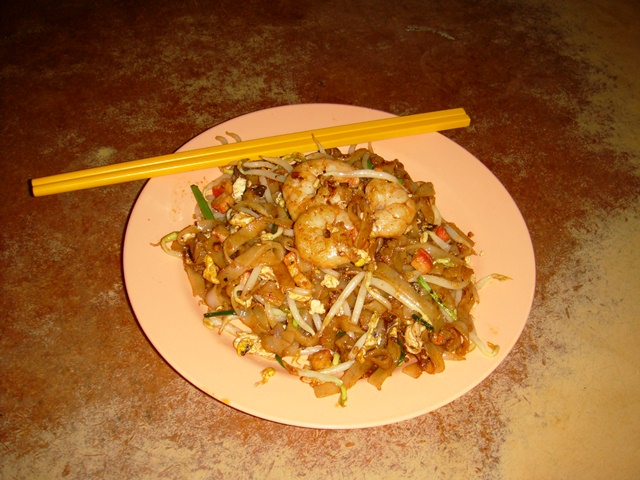
Penang's hawker system is built on radical specialization: a stall sells one dish, has usually sold it for decades, and is judged against rivals doing exactly the same thing a few streets away. Start with char kway teow, flat rice noodles seared over charcoal with prawns, cockles, Chinese sausage, bean sprouts and chives in dark soy — the Penang version is defined by wok hei, the smoky breath of a properly hot wok, and by duck egg ordered as the upgrade. The benchmark stalls, on Lorong Selamat and Siam Road, fry plate by plate at lunch, and the queue is part of the quality control. Order it where the cook fries nothing else.
The dish Penang claims as its own invention is asam laksa: thick rice noodles in a broth of flaked mackerel sharpened with tamarind — asam — and fragrant with torch ginger, mint, pineapple and a spoon of prawn paste. There is no coconut milk in it at all, which is what separates it from every southern laksa, and in 2011 CNN's ranking of the world's best foods placed Penang's asam laksa seventh. The reference bowl is sold at the Air Itam market stall below Kek Lok Si, ladling the same recipe since the 1950s, which makes the temple-and-laksa pairing the island's most efficient half-day. Third in the canon is nasi kandar, the Tamil Muslim meal Penang perfected: steamed rice pointed at through a glass case of curries and then banjir — flooded — with a ladle of several gravies at once. Its name remembers the kandar, the shoulder pole on which itinerant vendors once carried rice and curry to the docks; Hameediyah on Lebuh Campbell, serving since 1907, is the city's oldest nasi kandar house, and Line Clear on Penang Road runs around the clock.
Build the rest of the eating day around the heat. Cool down the way locals do at the Penang Road Famous Teochew Chendul cart on Lebuh Keng Kwee, pushing out bowls of shaved ice, coconut milk, palm-sugar syrup and green pandan jelly since 1936, eaten standing in the lane. Drink kopi — coffee roasted with margarine and sugar in the Hainanese kopitiam tradition — thick and sweet in a porcelain cup at breakfast, and try nutmeg juice, sour-sweet and spiced, made from the fruit Penang's farms at Balik Pulau still grow. Evenings belong to the hawker centers: Gurney Drive's seafront stalls from about 5 p.m., and New Lane, where George Town's night carts assemble for oyster omelettes, Hokkien prawn mee and satay in one sitting.
Picture the place
At a Lorong Selamat stall the wok sits over a charcoal brazier at waist height, the cook working one plate at a time in a halo of smoke and flying sparks, while the queue watches the flames the way other cities watch a chef's counter.
The easily missed detail
Each famous stall keeps its own hours and its own rest day, and several of the greats sell out by early afternoon — char kway teow is fundamentally a lunch dish in Penang, and a food plan that saves the icons for dinner will find their shutters down. The correct unit of planning is the stall's schedule, not the neighborhood.
A practical rhythm
- Breakfast — Kopi and kaya toast in a kopitiam, then a first noodle round — Hokkien mee or curry mee — while the morning stalls are open.
- Lunch — The headline dishes in sequence: char kway teow at Lorong Selamat or Siam Road, cendol standing up on Lebuh Keng Kwee for dessert.
- One expedition — Ride out to Air Itam for asam laksa under Kek Lok Si, and make nasi kandar the late, flooded finale — Line Clear serves it at hours when everything else has closed.
What could complicate the plan
Penang's hawker economy runs largely on cash and small notes, and the most celebrated stalls are exactly the ones least likely to take a card. Pork and lard run through much of the Chinese hawker canon, including classic char kway teow, so halal eaters should route toward the nasi kandar houses and certified stalls instead. And the queue economy is real: at the two or three most famous names, waiting thirty minutes is normal, which is why the plan above orders dishes by stall hours rather than by appetite.
What to do next
Mark three stalls on the map — one char kway teow, the Air Itam laksa, one nasi kandar house — and let every other meal be improvised around them.
Sources
- CNN's World's 50 Best Foods ranking (2011) — Penang asam laksa placed seventh, for its tamarind-soured mackerel broth
- Hameediyah Restaurant, Lebuh Campbell — nasi kandar served since 1907, Penang's oldest house for the dish
- Penang Road Famous Teochew Chendul, Lebuh Keng Kwee — chendul sold from the same lane since 1936
- George Town's hawker trade — Lorong Selamat and Siam Road charcoal char kway teow stalls, the Air Itam market asam laksa stall trading since the 1950s, and Gurney Drive Hawker Centre's evening hours