Porto / Portugal When to visit
When should I visit Porto, Portugal, for the best experience?
The short answer
July through early September — the IPMA station at Porto/Pedras Rubras records a July precipitation normal of just 0.65 inches (16.6 mm) across 3.1 rain days, against 6.53 inches (165.9 mm) over 13.0 rain days in November.
The answer, with local context
Porto is wet on a scale that surprises people who think of Portugal as dry. The Portuguese Institute for Sea and Atmosphere's 1991–2020 normals for station 545 at Pedras Rubras, just north of the city at 68 meters, give an annual precipitation total of 45.15 inches (1,146.9 mm) across 105.4 days with a millimeter or more. That works out at nearly 11 mm on every wet day — Atlantic systems arriving off the ocean rather than drizzle.
The seasonal swing is extreme and it is the whole answer. January brings 5.94 inches (151.0 mm) over 12.8 rain days, December 6.04 inches (153.3 mm) over 12.4, and November the annual maximum at 165.9 mm. Then it stops: June falls to 1.33 inches (33.7 mm) over 4.9 days, July to 16.6 mm over 3.1 days, and August to 1.15 inches (29.3 mm) over 3.2 days. More than two-thirds of Porto's rain falls in the six months from October to March.
Temperature never becomes the problem. The Atlantic holds the summer down: July averages a daily high of 75.7°F (24.3°C) with nights at 59.9°F (15.5°C), and August 76.6°F (24.8°C) and 60.3°F (15.7°C). Winter stays mild — January highs average 57.2°F (14.0°C) with lows of 43.5°F (6.4°C). Porto's annual mean daily maximum is 66.7°F (19.3°C). This is a city where the question is whether it will rain, not whether it will be hot or cold.
Picture the place
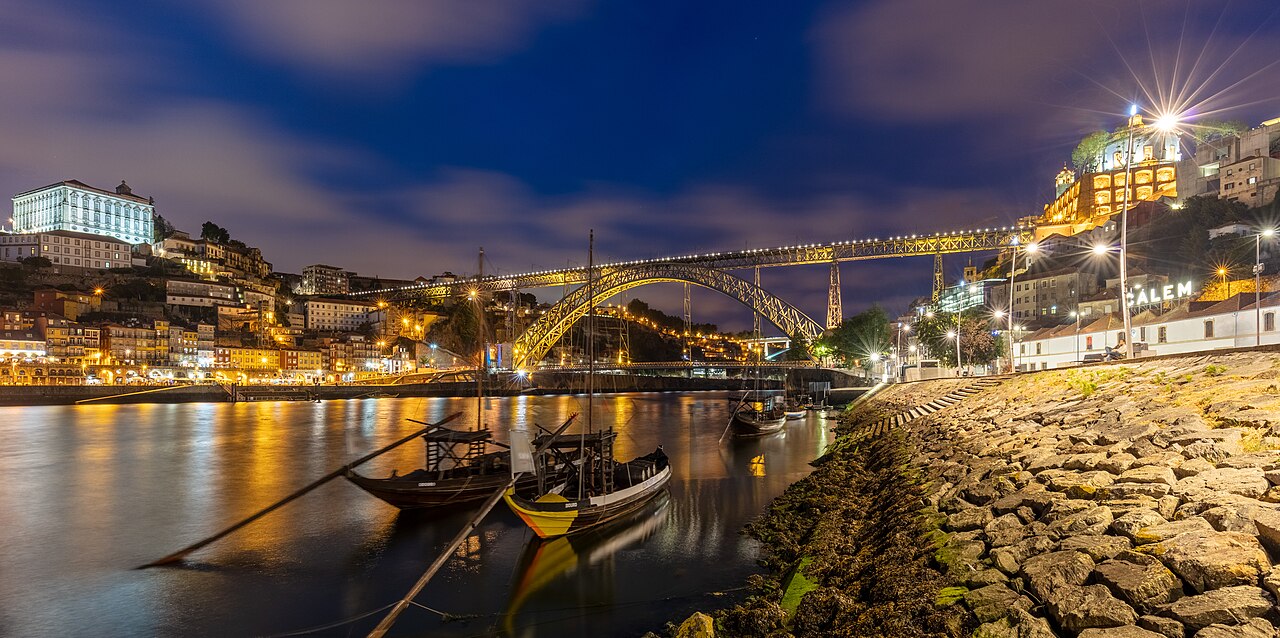
Porto is built on hills above the mouth of the Douro, and the gradient between the riverside and the upper city is steep enough to be felt in the legs. In the dry months the granite steps and the tiled façades hold the afternoon heat; from October the same slopes run with water, and the cobbles on the steeper lanes become genuinely slippery.
The easily missed detail
September is the month the figures argue for most strongly, and it is underused. Its 2.69 inches (68.2 mm) over 5.8 rain days is more than August but still well under half the November total, while the daily maximum averages 74.3°F (23.5°C) — within a degree and a half of July. It also coincides with the grape harvest in the Douro valley upriver, which is the working season of the trade that gave the city its name abroad. The UNESCO property here, the Historic Centre of Oporto, Luiz I Bridge and Monastery of Serra do Pilar, was inscribed in 1996 under criterion (iv), and the harvest is when the river that the inscription is built around is busiest.
A practical rhythm
- July and August — Three rain days a month on the normals, highs in the mid-70s Fahrenheit, ocean-moderated nights. The reliable window.
- June and September — Four to six rain days, temperatures within two degrees of midsummer, noticeably fewer visitors.
- November to January — Twelve to thirteen rain days a month and more than 150 mm each. Fine for a short indoor-weighted visit.
What could complicate the plan
Porto's winter rain is heavy rather than persistent, which means the risk is not a grey week but individual days that make the hill streets unwalkable. The gradient is the real constraint in any season: the drop from the upper city to the riverside is severe, with long stair runs, and anyone with limited mobility should plan around the riverside and the Vila Nova de Gaia bank rather than the climb. Summer brings the opposite problem — the dry months are also when the narrow lanes of the historic center are at their most congested, and the cruise and river-boat traffic peaks with them. Entry itself is the easy part: no visa is needed for a Schengen stay under 90 days inside any 180-day period, a fresh period opens only after 90 days away from the zone, and the passport has to offer 2 blank pages and 3 months of validity beyond the intended departure date.
What to do next
For what to see once you are there, read the Porto things-to-do answer in this group, and the Porto food answer for the river trade that shaped the city's cooking.
Sources
- Instituto Português do Mar e da Atmosfera (IPMA) — Porto/Pedras Rubras station 545, 1991–2020 monthly and annual temperature, precipitation and rain-day normals, station altitude
- UNESCO World Heritage Centre — official property name and criterion (iv)
- UNESCO World Heritage Centre — Historic Centre of Oporto inscription year, 1996
- US Department of State, Portugal country information — no visa required for Schengen stays under 90 days within a 180-day period, new period after a 90-day absence, two blank passport pages, three months' validity beyond intended departure (retrieved 5 November 2026)