Qatar country guide Places and experiences
What should a first-time traveler see in Qatar beyond the obvious highlights?
The short answer
The pearling past and the empty quarters: Al Zubarah's ruined merchant town, the 874 petroglyphs of Al Jassasiya, the Inland Sea where dunes pour into the Gulf, and Richard Serra's steel plates standing alone in the western desert.
The answer, with local context
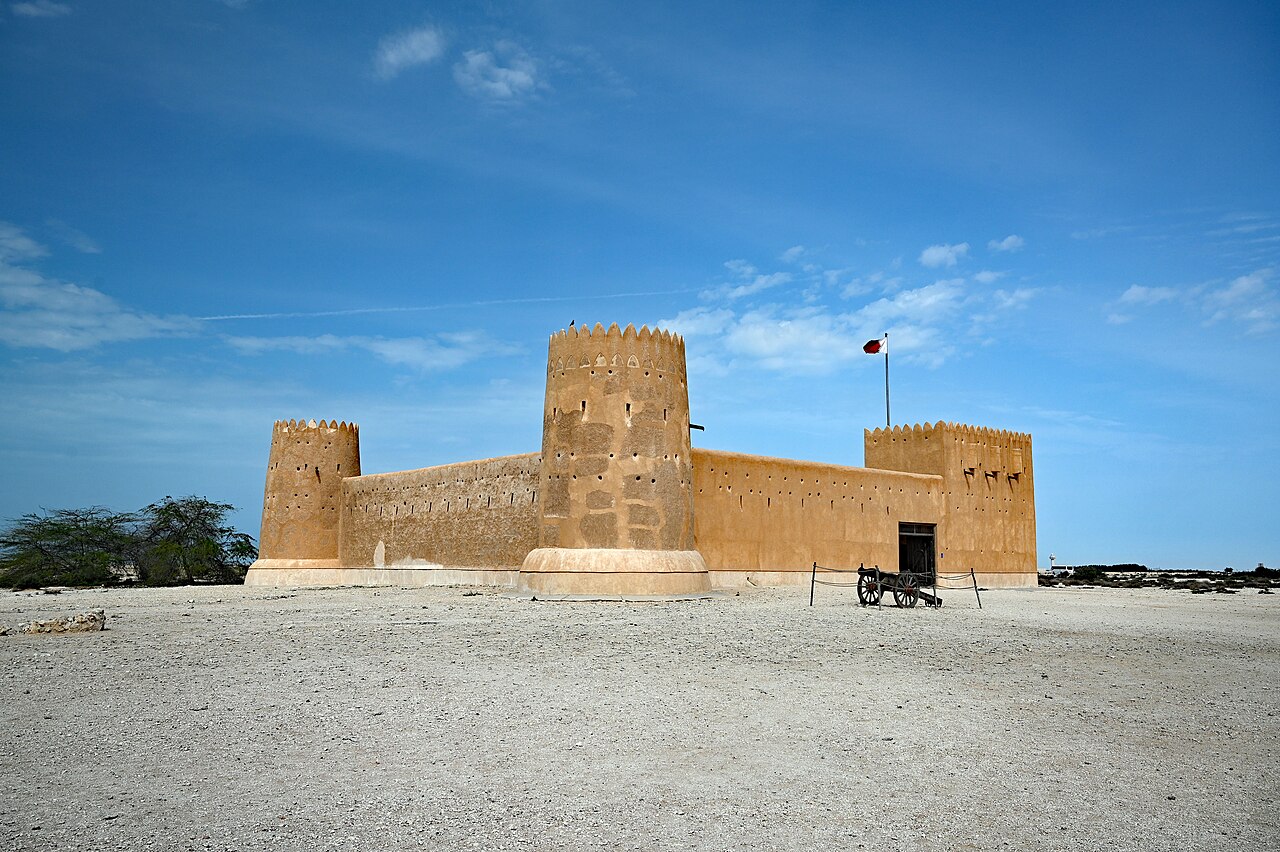
Start in the northwest, where Qatar keeps its one UNESCO inscription. Al Zubarah was founded in the 1760s and grew into the Gulf's most important pearling and trading town of the late 18th and early 19th centuries, its merchants' palaces, courtyard houses, mosques and fishermens' huts strung inside a town wall before abandonment left it to the sand — which preserved it as the largest archaeological site on the Qatari peninsula. The landmark visible for miles is younger: Al Zubarah Fort, built in 1938 under Sheikh Abdullah bin Jassim Al Thani as a coastal guard post, now a museum in the middle of the ruins. A short drive east, the limestone ridge of Al Jassasiya holds Qatar's greatest rock-art site, discovered in 1957 and catalogued at 874 petroglyphs — rows of cup marks that may be board games or pearl stores, rosettes, footprints and carved bagala boats that connect the stones to the same seafaring world as Zubarah.
The south holds the country's natural wonder. Khor Al Adaid, the Inland Sea, is a tidal arm of the Gulf that reaches miles into the dunes almost to the Saudi border — one of the very few places on the planet where a full sand desert meets a sea with no coast road, no village, nothing in between. It sits on UNESCO's Tentative List for Qatar, and there is no sealed road in: convoys deflate their tires and cross the soft sand, which is why the Inland Sea is sold as a half-day or overnight expedition rather than a stop. The western desert answers with art at the same scale. In the Brouq Nature Reserve near Zekreet, Richard Serra's East-West/West-East, installed in 2014, sets four steel plates, each over 46 feet (14 m) tall, in a line spanning more than 0.6 miles (1 km) across a gypsum plateau, their tops level with each other despite the undulating ground.
Fill the remaining days with the living traditions the highways pass. At Al Shahaniya, west of Doha, the camel racetrack runs its season from October to February, races most Fridays: the camels carry small robot jockeys, introduced after child jockeys were banned, while the owners race alongside in SUVs, working the robots by remote control and shouting through loudspeakers. On the northeast coast the Al Thakira mangroves shelter one of Qatar's oldest forests and a winter population of flamingos and herons, with Purple Island — named for the purple dye its murex shells supplied in ancient times — reachable by kayak through the channels. Near the highway south, the gypsum cave of Dahl Al Misfir drops about 131 feet (40 m) into the earth, its crystals faintly phosphorescent in the dark.
Picture the place
At Al Zubarah the town is a rumor of walls under pale sand, the sea flat and white-blue beyond, and the 1938 fort stands square and immaculate in the middle of it — the only vertical thing in a landscape that swallowed a city.
The easily missed detail
The petroglyphs' cup marks are not decoration. The leading readings of Al Jassasiya's rows of carved cups are that they served as boards for the mancala-style game of Al Haloosa, or as stores and counters in the pearl trade — either way, the ridge was a workplace and a playground of the same maritime economy that later built Zubarah, not a temple.
A practical rhythm
- North day — Al Zubarah in the morning light, then Al Jassasiya's ridge, then fish lunch in Al Khor on the way back to Doha.
- West day — The Serra plates and Zekreet's mushroom rocks, timed to end at Al Shahaniya if the Friday racing calendar aligns.
- South expedition — The Inland Sea as a full half-day with a licensed operator, overnight in a desert camp if the season allows.
What could complicate the plan
None of the northern or western sites has meaningful public transport; each direction is a car-and-driver day, and the Inland Sea is strictly a 4x4 convoy trip on deflated tires, unsafe to improvise in a rental sedan. Al Zubarah and Al Jassasiya are open-air archaeology with no shade and minimal interpretation on the ground, rewarding visitors who read the fort museum's displays first. Camel racing is seasonal and Friday-weighted, so a midweek summer trip finds only an empty track and grandstand.
What to do next
Give the country three day-trips — north, west and south — rather than one grand circuit, and read the food answer next to eat Qatari in the towns those roads pass through.
Sources
- UNESCO World Heritage Centre — Al Zubarah Archaeological Site, inscribed 2013 under criteria (iii), (iv) and (v), the town founded in the 1760s and flourishing in the late 18th and early 19th centuries; Khor Al Adaid on Qatar's Tentative List
- Qatar Museums heritage documentation — Al Zubarah Fort built in 1938; Al Jassasiya discovered in 1957 with 874 catalogued petroglyphs; Dahl Al Misfir cave at about 40 m deep
- Qatar Museums public art program — Richard Serra's East-West/West-East (2014), four steel plates over 14 m tall spanning more than 1 km in the Brouq Nature Reserve