Rio de Janeiro / Brazil Food and drink
Where should I eat in Rio de Janeiro, and which local food or drink is worth trying?
The short answer
Eat where Rio's own rituals point: feijoada at lunch on Wednesday or Saturday, filé à Oswaldo Aranha in the old center, sopa Leão Veloso at the Rio Minho — pouring since 1884 — coffee and pastries under the mirrors of Confeitaria Colombo, and a Biscoito Globo with iced mate on the beach.
The answer, with local context
Rio's dishes carry name tags, because its golden age as Brazil's capital — until 1960 — put diplomats' names on menus. The filé à Oswaldo Aranha was the weekly order of the diplomat Oswaldo Aranha at his regular restaurant in Lapa in the 1930s: a filet buried under fried garlic, served with Portuguese-style potato chips, egg farofa and rice, copied by every kitchen in the city until the man's lunch became the city's dish; traditional houses such as Lamas in Flamengo still plate it as it was. The sopa Leão Veloso tells the same story from the sea: the diplomat Paulo Leão Veloso, back from France in the 1930s with bouillabaisse on his mind, asked his favorite restaurant to build a Brazilian version — fish, shrimp, octopus, squid and mussels in a tomato broth — and the Restaurante Rio Minho, founded in 1884 in the center and still serving, keeps its namesake soup as the house emblem. Order both in the old center, where they were invented, at lunch, when those dining rooms are in full voice.
The feijoada — the black-bean and pork stew this library's Brazil answer treats nationally — has a Carioca timetable: in Rio it is a lunch dish of Wednesdays and Saturdays, served complete with rice, collard greens, farofa and orange, and it organizes the week of the city's traditional restaurants; houses like Casa da Feijoada in Ipanema serve it daily for the uninitiated, but the Saturday original, eaten slowly among families, is the institution. The boteco, Rio's corner bar, is the other institution: draft chope pulled cold, bolinhos by the plate — at Aconchego Carioca, chef Kátia Barbosa's celebrated bolinho de feijoada compresses the whole stew into one fried mouthful — and no ceremony at all.
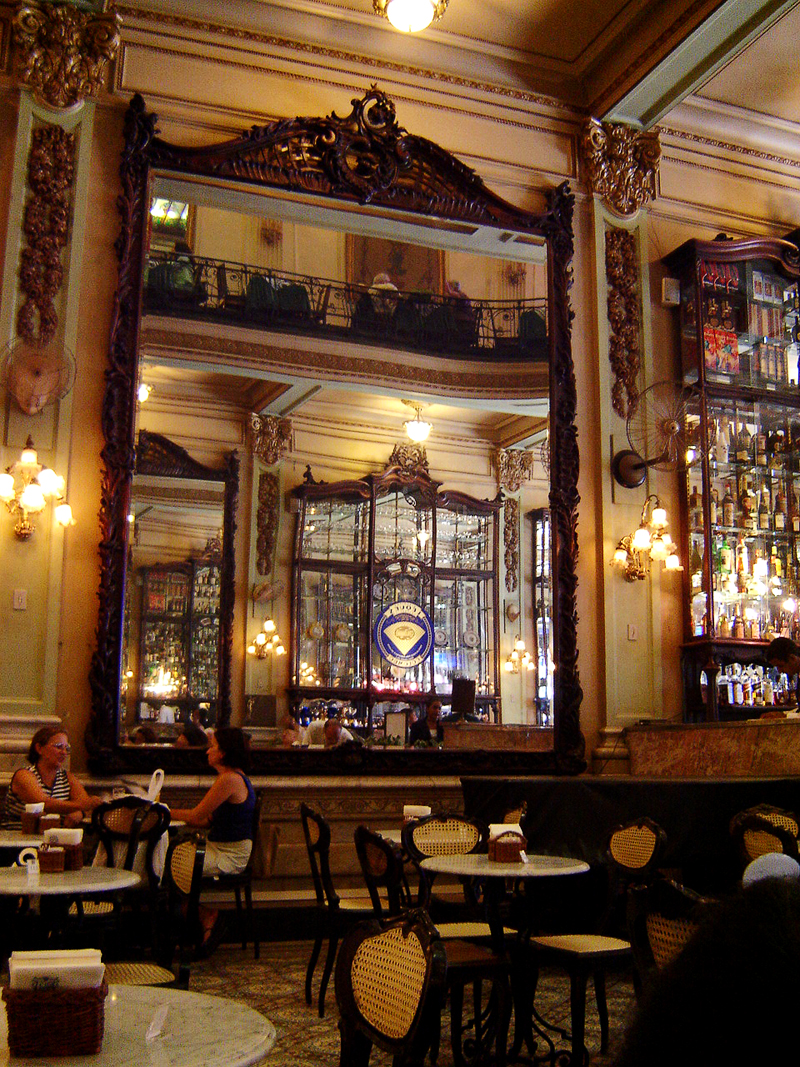
For the sweet and ceremonial hours, Confeitaria Colombo, founded in 1894 at Rua Gonçalves Dias 32 in the center, is a Belle Époque salon of Belgian mirrors and stained glass that functioned as an annex of the Brazilian Academy of Letters — go for coffee, pastries and the famous afternoon tea, or to its Café do Forte branch inside Copacabana Fort for the same menu above the sea. On the beach itself the ritual is portable: vendors with metal barrels sell mate gelado, sweetened iced mate, and the Biscoito Globo — the cassava-starch biscuit brand founded in 1964 whose green and red packets are as much a part of Copacabana as the lifeguard posts. And in Ipanema, the bar now called Garota de Ipanema — the old Bar Veloso, opened in 1945 — is where Tom Jobim and Vinícius de Moraes watched Heloísa Pinheiro pass in 1962 and wrote "The Girl from Ipanema": come for the chope, stay for the corner.
Picture the place
Inside Colombo at four in the afternoon the light comes greenish through stained glass onto marble tables and ten-foot mirrors, the waiters move in waistcoats through the hum of the old center's tea hour, and for the length of one coffee Rio is exactly what it was in 1900 — sure of itself, sweet-toothed and in no hurry whatsoever.
The easily missed detail
The two name-tag dishes encode the same forgotten fact: Rio was a capital of diplomats, and its classic menu is a guest book. Aranha went on to preside over the UN General Assembly — he chaired the 1947 session that voted the partition of Palestine — and Leão Veloso served as foreign minister; the city's most traditional lunch is, dish by dish, the canteen of a vanished foreign ministry, preserved in garlic and fish stock long after the capital moved to Brasília in 1960.
A practical rhythm
- Morning — Mornings are for the center's cafés and the markets: coffee and a pastry under Colombo's mirrors before the lunch rush, or the feira's tropical fruit stalls in whichever neighborhood you slept in.
- Midday — Lunch is Rio's main act: feijoada on its appointed days, the Oswaldo Aranha in a traditional dining room, the Rio Minho's soup — then the Carioca pause, because these are not meals that permit a hurried afternoon.
- Evening — The evening belongs to the boteco and the beach: a chope at the Garota de Ipanema corner, bolinhos in Santa Teresa at Bar do Mineiro, and an iced mate bought from a barrel on the sand if the day ends where it should.
What could complicate the plan
The timetable rules everything: the old-center dining rooms are lunch institutions and many close by late afternoon; feijoada outside Wednesday and Saturday narrows to the tourist-facing houses; and Colombo's main room fills at tea hour on weekends. The center itself empties after dark — do its restaurants at noon and move to the South Zone by night. Finally, the honest seasoning warning: Carioca classics are generous with garlic, salt and pork fat by design; the Oswaldo Aranha is not a light lunch that happens to be famous, and the afternoon should be planned in its image.
What to do next
Anchor one old-center lunch — Rio Minho or a traditional house for the Oswaldo Aranha — book a Saturday feijoada, and take tea at Colombo on a weekday afternoon, when the mirrors have room to breathe.
Sources
- Restaurante Rio Minho — founded in 1884 in Rio's center; the sopa Leão Veloso created there in the 1930s from the diplomat Paulo Leão Veloso's account of French bouillabaisse
- Confeitaria Colombo — founded in 1894 at Rua Gonçalves Dias 32, Centro; Belle Époque interior of Belgian mirrors and stained glass; the Café do Forte branch inside Copacabana Fort
- Rio restaurant tradition, via the city's classic dining rooms (Lamas; Casa da Feijoada) — the filé à Oswaldo Aranha, the diplomat's 1930s Lapa lunch of garlicky filet, Portuguese chips and egg farofa; feijoada as Rio's Wednesday and Saturday lunch
- Biscoito Globo — the cassava-starch biscuit brand founded in 1964, sold with iced mate by the beach vendors of Copacabana and Ipanema