Rotorua / New Zealand Things to do
What are the most worthwhile things to do in Rotorua on a first visit?
The short answer
Begin at Te Puia in the Whakarewarewa Valley — the one geothermal attraction in New Zealand whose carving and weaving schools are written into an Act of Parliament — the New Zealand Māori Arts and Crafts Institute Vesting Act 2020 received Royal assent on 24 July 2020 and came into force the next day.
The answer, with local context
That Act did something unusual. It dissolved the New Zealand Māori Arts and Crafts Institute, repealed the 1963 Act that created it, and transferred its assets and liabilities to the Te Puia NZMACI Limited Partnership, which is owned by 3 trusts: the Wahiao Tuhourangi o Whakarewarewa Trust, the HTK Te Puia Trust and the Pukeroa Oruawhata Trust. The land it sits on, defined in the Act as the Whakarewarewa Valley Land, comprises the Whakarewarewa Thermal Springs Reserve and the Southern Arikikapakapa Reserve, with fee simple title held by the Whakarewarewa Joint Trustees under an earlier 2009 Act. The Partnership is required to keep running the institute's functions, which include training in whakairo rākau, carving, and raranga, weaving. The Act also names Te Aronuiarua, a carved meeting house built by students and graduates of the carving school, as a taonga that may not be disposed of.
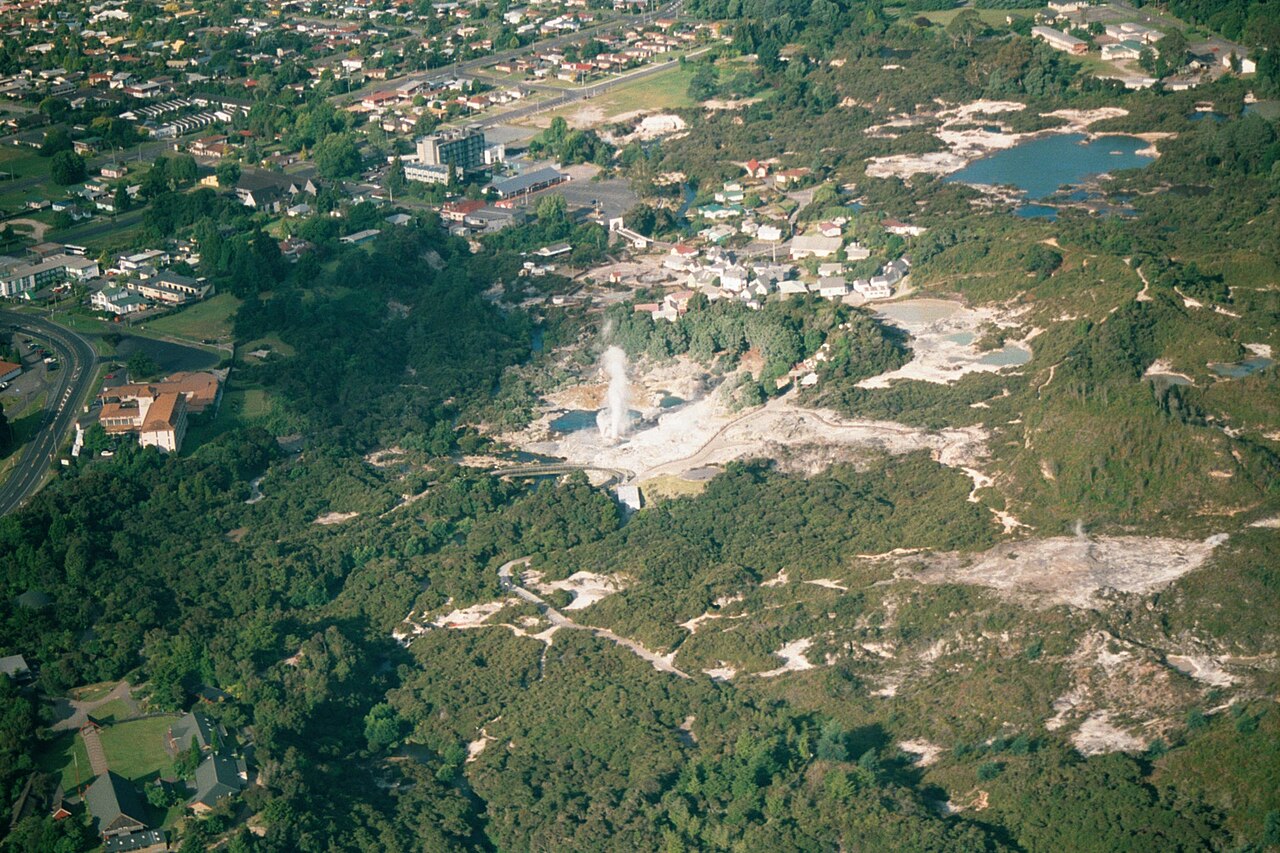
The geothermal spectacle sits inside the same valley. Pōhutu erupts regularly to between 15 m and 20 m (49 ft and 66 ft) and sometimes much higher. It is 1 of 7 geysers on Geyser Flat, which sits among more than 500 hot springs at Whakarewarewa, and the geysers are aligned north to south along a buried fault.
Its neighbor has a documented biography. The vent now called the Prince of Wales Feathers began spurting in June 1886, after the Mount Tarawera eruption and probably triggered by the earthquakes that came with it. It was originally known as the Indicator, was renamed in 1901, and has played almost continuously since 1992.
For a second, quieter geothermal stop, the Department of Conservation's Waiotapu area covers roughly 18 km² (6.9 square miles) and lies within the Maunga Kākaramea, Waiotapu and Te Kōpia Scenic Reserves.
Picture the place
Geyser Flat is not a scatter of vents but a line of them. Seven geysers stand in a north–south row because they are all drawing on the same buried fault, and the whole row sits in a field of more than 500 hot springs — which is why the ground steams between the features as well as at them.
The easily missed detail
The 2020 Act is a transfer of ownership, not a reorganization of a government agency. Three named iwi trusts own the partnership that now runs Te Puia and the schools inside it, which means the money a visitor spends at the valley goes to the body training the next generation of carvers and weavers rather than to a Crown entity. The 1963 statute that governed the institute for 57 years no longer exists.
A practical rhythm
- Valley first — Geyser Flat and the carving and weaving schools are inside the same Whakarewarewa Valley Land defined by the Act, so one visit covers both.
- Watch the second vent — The Prince of Wales Feathers has played almost continuously since 1992, so it is the reliable one while you wait on Pōhutu.
- Second site, different scale — Waiotapu's 18 km² reserve complex is a drive out rather than a walk from town.
What could complicate the plan
The Act protects the institute; nothing protects the geysers. Te Ara records that most New Zealand geysers have been damaged or affected by human activity, above all the withdrawal of steam and hot water for heating, and that a geyser's reservoir water is superheated above its boiling point — which is the reason for the rules at every managed site. Those rules are strict: stay on the tracks, keep off the silica terraces, supervise children closely, do not pick plants or throw stones onto the features, and do not cycle on the boardwalks. Thin crust and carbon dioxide and sulphur gases are the stated hazards, not theoretical ones.
What to do next
The Rotorua food answer in this group explains how the same geothermal heat is used for cooking, and the when-to-visit answer sets out what the fishing calendar opens and closes.
Sources
- New Zealand Parliamentary Counsel Office, legislation.govt.nz — Royal assent 24 July 2020 and commencement, the dissolution and repeal, the 3 owning trusts, the Whakarewarewa Valley Land and its 2 reserves, the 2009 Act title, the carving and weaving functions, Te Aronuiarua's protection
- Te Ara — Pōhutu's eruption height, the 7 geysers of Geyser Flat, the 500-plus hot springs, the buried fault alignment, the Prince of Wales Feathers chronology from 1886 to 1992, geyser damage from steam and hot-water withdrawal
- Department of Conservation — the 18 km² thermal area, the 3 scenic reserves, the geothermal conduct rules and hazards