Rotorua / New Zealand Food and drink
Where should I eat in Rotorua, and which local food or drink is worth trying?
The short answer
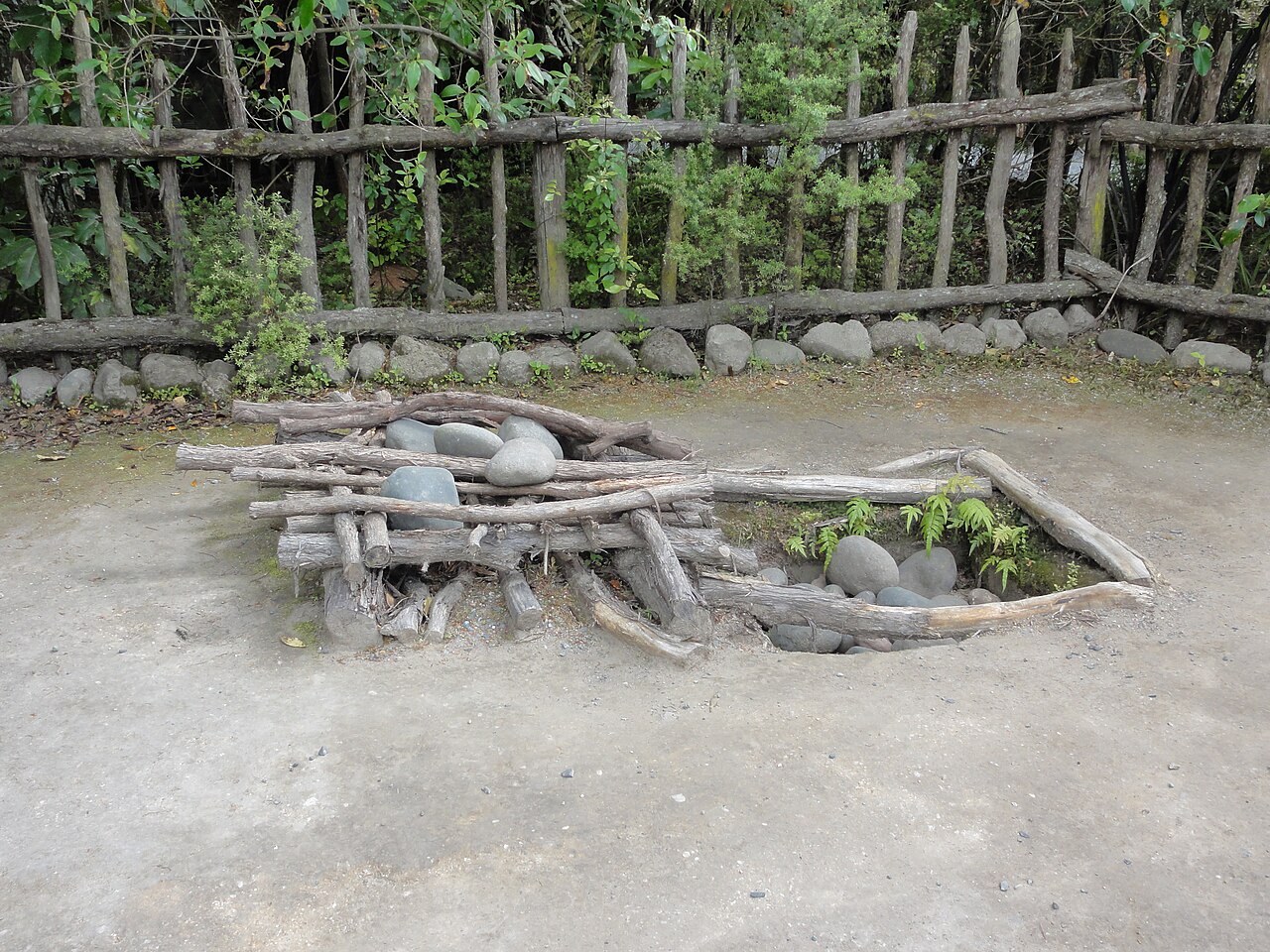
Eat food cooked by the ground — the 2 geothermal methods Te Ara records as still in use around Rotorua, food steamed in an earth oven and food lowered in flax baskets on cords into a boiling pool.
The answer, with local context
Both techniques are documented, not folkloric. Te Ara's kai Māori story, written by Charles Royal and Jenny Kaka-Scott and published on 3 December 2012, carries photographs from 1901 of cooking at Whakarewarewa village, and states plainly that both methods are still used in the region. The geothermal field supplies 2 different cooking media: boiling water for the suspended baskets and superheated steam for the earth oven.
The other Rotorua speciality is trout, and the rules around it are the most interesting thing about it. Brown and rainbow trout are listed as sports fish in Schedule 1 of the Freshwater Fisheries Regulations 1983, and the regulations police commercial dealing in them hard. Regulation 30 prohibits selling cans containing sports fish, with an infringement fee of $800 or a court fine of up to $1,600. Regulation 31 prohibits trading, exchanging, giving or receiving sports fish for canned sports fish or empty cans. Regulation 37 caps possession at 50 kg gross weight of canned sports fish, including the cans, and regulation 38 bars posting or consigning more than 23 kg in a single day.
The practical route to trout, then, is to catch it. Fish & Game New Zealand requires a valid sports fish licence, carried while fishing and produced to a ranger on request; one licence covers the whole country except Taupō. On the Rotorua lakes and their inflowing tributary streams the minimum size is 350 mm and the daily bag limit is 8 trout, of which no more than 2 may be brown.
Picture the place
The suspended-basket method is the one that shows what Rotorua is: a woven basket on a cord, let down into a pool that is already boiling without anyone lighting anything, in a village where that pool is a fixture of the street rather than an attraction.
The easily missed detail
Rotorua's warm water is both the kitchen and the health question. The CDC's Yellow Book advises against entering recreational water at all while you have diarrhea, flags legionellosis risk in hot tubs for anyone aged 50 or over or immunocompromised, and recommends a nose clip in warm fresh water because Naegleria fowleri infection, though rare, is almost always fatal. The chapter's point is that getting water up the nose is the exposure route — which changes how you use a hot pool rather than whether you use one.
A practical rhythm
- Order it cooked and hot — Geothermal steaming is a long, thorough cook, which lands it on the safer side of the CDC's 2 categories.
- Licence before rod — A Fish & Game licence has to be on you while fishing and shown on demand, and it covers every region except Taupō.
- Count before you clean — 8 trout a day, no more than 2 of them brown, nothing under 350 mm from the Rotorua lakes.
What could complicate the plan
Those regulations govern dealing in sports fish rather than restaurant menus, so the question to ask about trout on a board here is where it came from. Carrying food away from the valley has its own limits: the CDC sets 40°F (4°C) as the ceiling for perishables and 2 hours as the longest spell above it, and where there is no soap and water it asks for a hand sanitizer of at least 60 percent alcohol, warning that such products do little on visibly dirty hands and little against norovirus. Raw or undercooked fish and shellfish sit on its higher-risk list, which is worth remembering if a lake catch is offered any way other than cooked through.
What to do next
The Rotorua when-to-visit answer in this group gives the lake-by-lake season dates that decide whether you can fish at all, and the things-to-do answer covers the Whakarewarewa valley where the cooking pools are.
Sources
- Te Ara — the 2 geothermal cooking methods, the 1901 Whakarewarewa photographs, the story's authors and publication date, boiling water and superheated steam as the 2 media
- New Zealand Parliamentary Counsel Office, legislation.govt.nz — Schedule 1 listing brown and rainbow trout as sports fish, regulations 30, 31, 37 and 38 with their fees, fines and weight limits
- Fish & Game New Zealand, Eastern region sports fishing regulations — the licence requirement and its national scope, the 350 mm minimum size, the 8-fish daily bag and the 2-brown sub-limit
- CDC Yellow Book 2026, Food and Water Precautions for Travelers — recreational-water guidance, legionellosis and Naegleria fowleri advice, cooked-food and perishable-storage rules, the 60 percent sanitizer threshold