Russia country guide Places and experiences
What should a first-time traveler see in Russia beyond the obvious highlights?
The short answer
For the kept itinerary: Kazan's two-faith Kremlin, the Golden Ring's Suzdal and Sergiev Posad, Kizhi's wooden skyline, the Solovetsky Islands' monastery-fortress, Lake Baikal and Olkhon Island, Kamchatka's volcanoes, and the Trans-Siberian itself — Russia's depth, written under the same advisory as the capital cities.
The answer, with local context
Russia's 33 UNESCO properties draw the map. The near ring first: the Golden Ring northeast of Moscow strings the white-stone 12th-century churches of Vladimir and Suzdal (UNESCO, 1992) — Suzdal alone keeps some 40 churches and 5 monasteries in a town of under 10,000 people, frozen as a museum-reserve — and Sergiev Posad's Trinity Lavra of St. Sergius (UNESCO, 1993), Russia's spiritual headquarters, founded in the 14th century. Kazan, 800 km east on the Volga, is the multi-faith original: its Kremlin (UNESCO, 2000) holds the Kul Sharif mosque (rebuilt 2005) and the Annunciation Cathedral within 1 set of white walls, capital of Tatarstan and of a Tatar culture that is Russia's second nation — the Volga journey every Russia trip should include. Veliky Novgorod (UNESCO, 1992), between the 2 capitals, is older than both: its St. Sophia (1045–1050) is Russia's oldest cathedral in use, in the republic that birch-bark letters made literate a millennium ago.
The north is timber and islands. Kizhi Pogost (UNESCO, 1990), on an island in Lake Onega, raises the Church of the Transfiguration (1714) — 22 domes built, by the proud tradition, without a single nail — over a lake-district of peasant houses and windmills assembled as an open-air museum. The Solovetsky Islands (UNESCO, 1992), in the White Sea, pair a 15th-century fortress-monastery of boulder walls with the 20th century's shadow: Solovki was the prototype Gulag camp of 1923, and the visit reads both layers. The south holds Derbent in Dagestan (UNESCO, 2003), among the oldest continuously inhabited cities in Russia, its citadel guarding the Caspian Gates between the Caucasus and the sea.
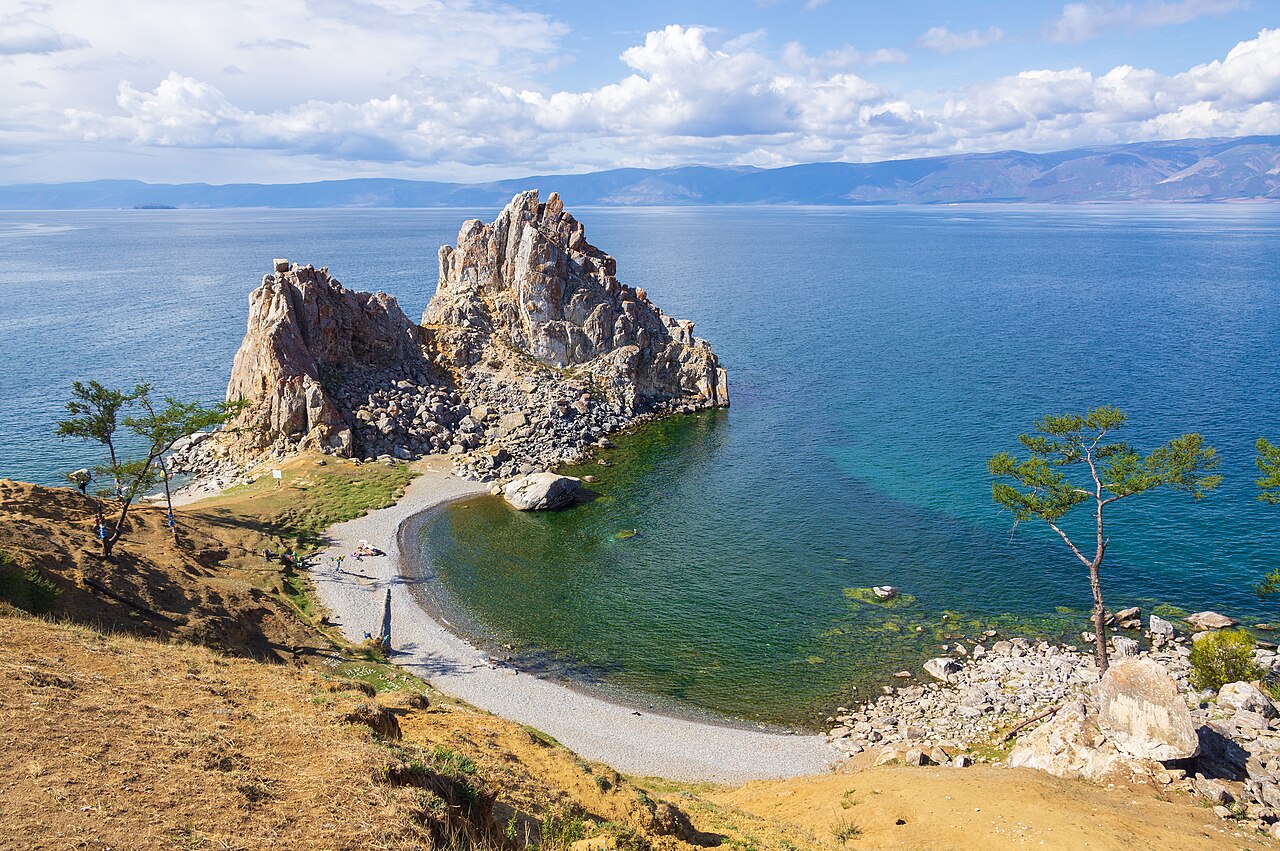
Then the scale changes entirely. Lake Baikal (UNESCO, 1996) — 1,642 m deep (the world's deepest lake), holding about a fifth of the planet's unfrozen surface fresh water, more than 25 million years old (the oldest lake) — is reached through Irkutsk and Listvyanka or across to Olkhon Island, whose Shaman Rock at Cape Burhan is Buryat sacred geography; the Circum-Baikal Railway (89 km of tunnels and galleries blasted along the south shore in 1905) is the engineering pilgrimage that pairs with it. Kamchatka (UNESCO, 1996) is the roadless finale: some 300 volcanoes (about 30 active), the Valley of Geysers (found 1941, 1 of the world's 5 great geyser fields) and Kronotsky's bears, all reached by helicopter from Petropavlovsk. And between everything runs the Trans-Siberian: 9,289 km from Moscow to Vladivostok, the longest railway on Earth, a week of birch, steppe and taiga that is less transport than the country's autobiography.
Picture the place
Olkhon Island at dusk: Shaman Rock doubled in Baikal's glass water, a Buryat prayer-pole row bright with ribbons on the cape, and the lake running to a horizon with nothing on it — because there is no far shore in sight.
The easily missed detail
Baikal has 2 seasons with equal claims and opposite faces: high summer (the Olkhon steppe, swimming in the Small Sea's warmed bays, the Circum-Baikal trains) and February–March, when the lake freezes into the clearest ice on Earth — a transparent meter over black water, walked, skated and driven on official ice roads to Olkhon. Travelers assume the lake is a summer sight; the ice season is its cult period, and Listvyanka's hotels fill for it. The twin miss is Kizhi's calendar: the island is a navigation-season visit (hydrofoils from Petrozavodsk, roughly May to October); in winter the same churches stand in a frozen lake-scape reached, if at all, by hovercraft and arrangement.
A practical rhythm
- The ring in a loop — Sergiev Posad, Vladimir and Suzdal in 3 unhurried days from Moscow
- Baikal given a week of its own — Irkutsk, Listvyanka, the Circum-Baikal and Olkhon as a single expedition, not a stop
- 1 train as destination — A 2- or 3-night Trans-Siberian leg ridden for itself, Yekaterinburg or Irkutsk as the break
What could complicate the plan
The Level 4 advisory covers every line of this answer — and, as with Ukraine, this content is a kept itinerary, not a recommendation to travel now. Within the conditional frame, Russia's logistics are their own education: Kamchatka has no road in (flights to Petropavlovsk and helicopters from there, weather-cancelled at a day's notice); Baikal's distances run on Siberian scale (Irkutsk to Olkhon is a 5- to 6-hour road-and-ferry day); Solovki is a boat-season island; Derbent and the North Caucasus sit in regions Western advisories singled out even before 2022; and visa invitations, registration with local authorities on arrival (the migration card and hotel registration system), and cash-only economics were the standing machinery of any Russia trip. The distances are the country: 11 time zones means the "beyond-highlights Russia" is 3 trips wearing 1 coat.
What to do next
File the list in order of longing (most first-timers: Baikal, Kazan, Suzdal) and let it wait, complete, for the advisory to change.
Sources
- UNESCO World Heritage Centre — the Golden Ring white monuments (1992), Trinity Sergius Lavra (1993), Kazan Kremlin (2000), Novgorod (1992), Kizhi Pogost (1990), Solovetsky Islands (1992), Derbent (2003), Lake Baikal (1996) and the Volcanoes of Kamchatka (1996, 2001)
- Russian Railways / Trans-Siberian references — the Moscow–Vladivostok line (9,289 km)
- Baikal authorities (Irkutsk region / Baikal Museum) — the lake's depth (1,642 m), age and freshwater share
- U.S. Department of State — the Level 4 advisory covering all regions