Salzburg / Austria Food and drink
Where should I eat in Salzburg, and which local food or drink is worth trying?
The short answer
A Bosna at the little Balkan Grill stand, Kaspressknödel soup and roast pork in the old Gasthäuser, beer from the stoneware mug at the Augustiner Bräu, and a Salzburger Nockerl to finish — with the hand-made Mozartkugel from Fürst as the edible souvenir.
The answer, with local context
Salzburg's signature snack hides in a passage off the Getreidegasse: the Bosna, a spiced grilled sausage (or two) in a white roll with onions, parsley and a dusting of curry spice — invented here in 1949 by the Bulgarian-born Zanko Todoroff at his Balkan Grill, and served ever since from a window so small the queue is the signage (the stand is universally called Balkan Grill Walter, after his successor). It is the city's true fast food, eaten standing in the passage in four bites. The seated canon around it is Austrian inn cooking at its most confident: Kaspressknödel — pressed cheese dumplings, here served in a clear beef soup or pan-fried with sauerkraut; Kasnocken, the little pan-tossed cheese noodles; Tafelspitz and roast pork with crackling; and the Backhendl, fried chicken, of which the Bärenwirt (an inn since 1663, up by the Mülln church) is the city's acknowledged master. The old-town Gasthäuser — Goldgockel, Zum Wilden Mann, Krimpelstätter — divide the locals' loyalty by dish, and the cafés hold the afternoon: the Tomaselli (Austria's oldest coffee house, founded 1703) on Alter Markt for the full ceremony of trays and newspaper sticks, Café Mozart for the quieter version.
The beer deserves its own paragraph because Salzburg brews with unusual depth for its size: Stiegl, founded 1492, is Austria's largest private brewery (its Stiegl-Brauwelt runs the full visitor circuit by the main station), but the city's heart beats at the Augustiner Bräu Mülln (1621), where the beer is tapped from wooden barrels into stoneware mugs you rinse yourself at the fountain, the food comes from the arcade's stalls (bring your own picnic is equally legal), and 1,400 seats of chestnut garden absorb the whole town. The fine register exists too — Ikarus at Hangar-7, Red Bull's glass hangar at the airport, where a different world-famous guest chef cooks each month, and the two-starred Senns — but Salzburg's genius is democratic: the mug and the Bosna outrank the tasting menu in local affection.
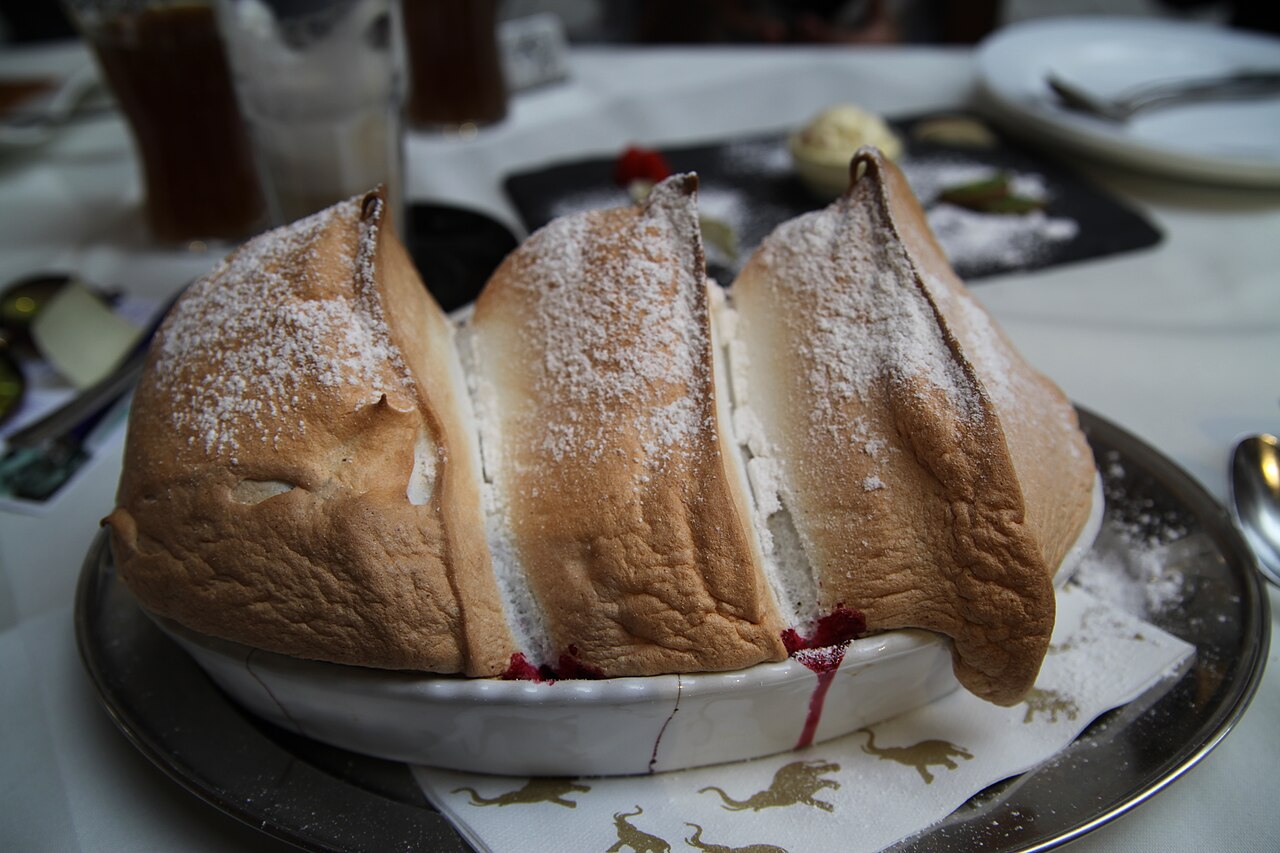
The sweet course is the city's portrait in sugar. Salzburger Nockerl is the compulsory order: a golden soufflé of egg and little else, baked to order in three billowing peaks dusted with icing sugar — said to copy the snow-capped mountains around the city (and the Fürstberg, Mönchsberg and Kapuzinerberg on a plate), served with raspberry sauce, strictly for two or more, and eaten the moment it lands, deflation being its destiny. And the souvenir is the Mozartkugel — marzipan, nougat and dark chocolate — created in 1890 by confectioner Paul Fürst, whose Konditorei Fürst still hand-makes the original (silver-and-blue foil, no two identical) while the industrial Mirabell version fills the world's gift shops: the Fürst is the pilgrimage, the comparison tasting the sport. Coffee, a Fürst Kugel, and the Nockerl at dinner: Salzburg's whole sweet argument in one day.
Picture the place
The Mülln beer garden at 7 p.m.: long tables under the chestnuts, mugs foaming at the tap barrels, a grandmother producing a whole roast chicken from a basket as legally as any stallholder.
The easily missed detail
The Balkan Grill's Bosna comes with an etiquette and a vocabulary test: order it "mit allem" (with everything — onions, parsley, the spice blend) and eat it over the paper, at the passage's standing ledges, because there are six stools and a city of devotees. The deeper cut is the Augustiner's ritual order of operations — take a mug from the shelf, rinse it at the stone fountain, pay, present it at the barrel tap, then shop the arcade for your dinner (the radish man, the sausage man, the bakery) — first-timers who queue at the bar like a pub waste twenty minutes learning what the fountain was for.
A practical rhythm
- Bosna at 11, before the queue — The Balkan Grill passage fills from noon; the snack is a morning's work
- Nockerl by reservation of appetite — Order it as you sit down (it bakes to order, 20 minutes) and skip the other desserts entirely
- Mülln on the warm evening — The garden is cash-minded and weather-honest; go when the chestnuts earn their keep
What could complicate the plan
Salzburg's edible souvenirs run into Austrian trading law: shops stay closed on Sundays and public holidays as a rule, Saturday selling stops at 18:00 under the federal baseline, weekday closing is 21:00, and a single shop may open no more than 72 hours in a week — so the hand-made confectionery and the delicatessen shopping belong to a weekday or a Saturday morning, never to the last Sunday before the flight. The famous snack counter is a window in a passage with 6 stools, no table service and no shelter from rain, and the queue starts around midday. The soufflé is the other scheduling trap, because it bakes to order in about 20 minutes and begins collapsing the moment it lands, so it has to be ordered with the main course rather than contemplated after it.
What to do next
Take the Bosna standing tomorrow morning, book the Bärenwirt for the Backhendl, and end one dinner with the Nockerl, ordered before the mains arrive.
Sources
- Balkan Grill Walter, Salzburg — the Bosna, created 1949 by Zanko Todoroff, served from the Getreidegasse passage
- Konditorei Fürst — the Mozartkugel created by Paul Fürst in 1890; the hand-made original in silver-blue foil
- Augustiner Bräu Mülln — the brewery of 1621, its wooden-barrel service and the 1,400-seat garden; Stiegl (1492)
- Café Tomaselli — Austria's oldest coffee house (1703) on the Alter Markt
- Michelin Guide — Ikarus at Hangar-7 and Senns (two stars), Salzburg
- Austrian Federal Economic Chamber (Wirtschaftskammer Österreich) — (retrieved November 5, 2026)