Samarkand / Uzbekistan Things to do
What are the most worthwhile things to do in Samarkand on a first visit?
The short answer
The Registan's three madrasas, the Shah-i-Zinda tomb street, Timur's own mausoleum at Gur-e-Amir, the giant Bibi-Khanym Mosque and Ulugbek's observatory — the whole ensemble UNESCO inscribed in 2001 as Samarkand, Crossroads of Cultures.
The answer, with local context
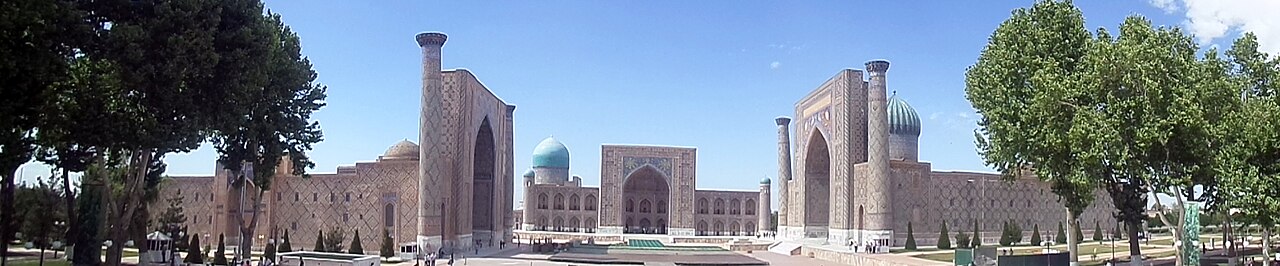
UNESCO's 2001 inscription, under criteria (i), (ii) and (iv), protects 2,775 acres (1,123 ha) of a city documented since the 5th century BCE as Sogdian Maracanda — the city Alexander the Great took in 329 BCE — and remade after 1370 as Timur's imperial capital. Its centerpiece is the Registan, a composition unique in Islamic urban planning: three madrasas squared around one plaza across two and a half centuries. The Ulugh Beg Madrasa (1417–1420) is the scholar-ruler's own college; the Sher-Dor (1619–1636) faces it with the most startling tilework in the Islamic world, lions stalking deer beneath human-faced suns, in open defiance of the ban on images; and Tilya-Kori (1646–1660) closes the square, its prayer hall gilded so heavily the name means "gold-covered."
Walk north to the city's most intimate masterpiece. Shah-i-Zinda, the "Living King," is a necropolis street climbing the Afrasiab hillside: more than twenty mausoleums and ritual buildings of the 11th to 19th centuries packed along one narrow lane, anchored by the shrine of Qusam ibn Abbas, a cousin of the Prophet Muhammad, with the finest concentration of Timurid tile mosaic anywhere — much of it raised for the women of Timur's family in the 14th century. At the city's other pole stands Gur-e-Amir, finished in 1404, where Timur lies under a dark-green jade tombstone beneath a ribbed turquoise dome, with his sons Shah Rukh and Miran Shah and his grandson Ulugh Beg around him; the dome's silhouette is the direct ancestor of the Taj Mahal's. Between the two, the Bibi-Khanym Mosque (1399–1404), built with the spoils of Timur's Indian campaign and named for his senior wife, was among the largest mosques on earth when finished, its main dome rising about 135 feet (41 m) over a courtyard built for thousands.
The last essential stop replaces faith with measurement. On Kuhak hill, the Ulugh Beg Observatory (built 1424–1429) held the Fakhri sextant, a meridian arc with a radius of 132 feet (40.4 m) — the largest instrument of its kind ever built — sunk in a trench in the bedrock. From it Ulugh Beg's team compiled the Zij-i Sultani by 1437, re-measuring 1,018 stars for the first time since Ptolemy and computing the sidereal year at 365 days, 6 hours, 10 minutes and 8 seconds, within about a minute of the modern value. The observatory was destroyed in 1449 after Ulugh Beg's murder and its trench rediscovered only in 1908; the Afrasiab Museum next door, with its 7th-century Sogdian murals, covers the city that existed before all of it.
Picture the place
In Shah-i-Zinda the lane is barely two shoulders wide, and the mausoleum portals crowd overhead in turquoise, cobalt and turquoise again — every step changes the pattern, and pilgrims touch the oldest doorframes as they pass, the wood polished by centuries of hands.
The easily missed detail
The Registan's madrasas were working colleges, not monuments, and their courtyards of student cells are still legible behind the facades. Reading the square as a university campus — lecture iwans, dormitory cells, a mosque inside Tilya-Kori serving the students — explains the layout better than treating it as a photo backdrop, and it is the reading Ulugh Beg, who lectured there himself, intended.
A practical rhythm
- Morning — The Registan first and slowly, entering all three madrasas and one courtyard, before the midday groups.
- Midday — Bibi-Khanym and Siyob Bazaar beside it, the mosque's scale taken in while the market feeds you.
- Afternoon — Shah-i-Zinda in the raking light, Gur-e-Amir at the golden hour, and the observatory paired with Afrasiab on the second day.
What could complicate the plan
The monuments are ticketed separately or on combined passes whose terms shift, and the Registan's evening light show runs on its own schedule — check both at the gate rather than from a guidebook. Restoration is permanent in a city of 600-year-old tile: one facade or dome is usually scaffolded, and Gur-e-Amir's crypt is a small, low room that bottlenecks at midday. Shah-i-Zinda is a working pilgrimage site as well as a monument, so dress and photography there carry a stricter etiquette than at the Registan.
What to do next
Stay near the Registan so the square bookends your days, and read the food answer next — Samarkand eats on a schedule set by the plov cauldrons.
Sources
- UNESCO World Heritage Centre — Samarkand, Crossroads of Cultures, inscribed 2001 under criteria (i), (ii) and (iv), an inscribed area of 1,123 ha with a buffer of 1,369 ha
- The Registan's documented building sequence — Ulugh Beg Madrasa 1417–1420, Sher-Dor 1619–1636 and Tilya-Kori 1646–1660; Bibi-Khanym Mosque built 1399–1404 with a main dome of about 41 m
- Ulugh Beg Observatory records — the Fakhri sextant radius of 40.4 m; the Zij-i Sultani catalogue of 1,018 stars completed by 1437; the sidereal year computed at 365 days 6 hours 10 minutes 8 seconds; the site destroyed in 1449 and rediscovered in 1908