Samarkand / Uzbekistan When to visit
When should I visit Samarkand, Uzbekistan, for the best experience?
The short answer
October — the city's monthly mean has dropped from a July 82°F (27.5°C) to a dry 58°F (14.4°C), the harvest fills Siyob Bazaar, and the tilework of the Registan is lit by low autumn sun for hours at a time.
The answer, with local context
Samarkand, whose weather station sits at 2,379 feet (725 m) in the Zeravshan Valley, is a continental city with four full-strength seasons and no sea to soften any of them. Its published monthly normals chart the swing in means rather than daytime peaks: July averages 82°F (27.5°C) across the whole day on 1.1 mm of rain — the monuments stand in furnace light and the sightseeing day splits in two around a long retreat. January reverses it at a mean of 37°F (2.5°C) with 38.9 mm of precipitation, snow an ordinary possibility on the domes. The rain concentrates in late winter and spring, March the wettest month at 2.7 inches (68.6 mm), and each month from June to September normally under 7 mm. Nationally the range is wider still: Uzbekistan's own climate reporting records absolute summer maxima of 118 to 122°F (48 to 50°C) in the far south and annual precipitation under 100 mm in the western deserts.
October threads the needle. The normals give it a 58°F (14.4°C) monthly mean, 0.7 inches (17.1 mm) of rain, and the year's longest run of clear, settled light — the light that makes glazed tile read as deep turquoise at nine in the morning and again in a long golden hour. The markets peak with the weather: October is harvest in the Zeravshan, so Siyob Bazaar stacks grapes, melons, pomegranates, quinces, walnuts and dried apricots at their cheapest and best, and the vineyards around the city come in. The sites, crowded hard in May and September, breathe a little easier.
Spring is the true rival and deserves its case. April climbs to a 60°F (15.3°C) mean, mulberries ripen and Navruz festivities are just past — but April also averages 2.5 inches (64.1 mm) of rain, the second-wettest month, and showers stalk the tilework. Summer's compensations are real but specialist: July's dry heat means empty sites at dawn and a city that lives at night. October wins because it asks for no strategy at all — every hour of its day is usable, which is the scarcest resource in a city with this much to look at.
Picture the place
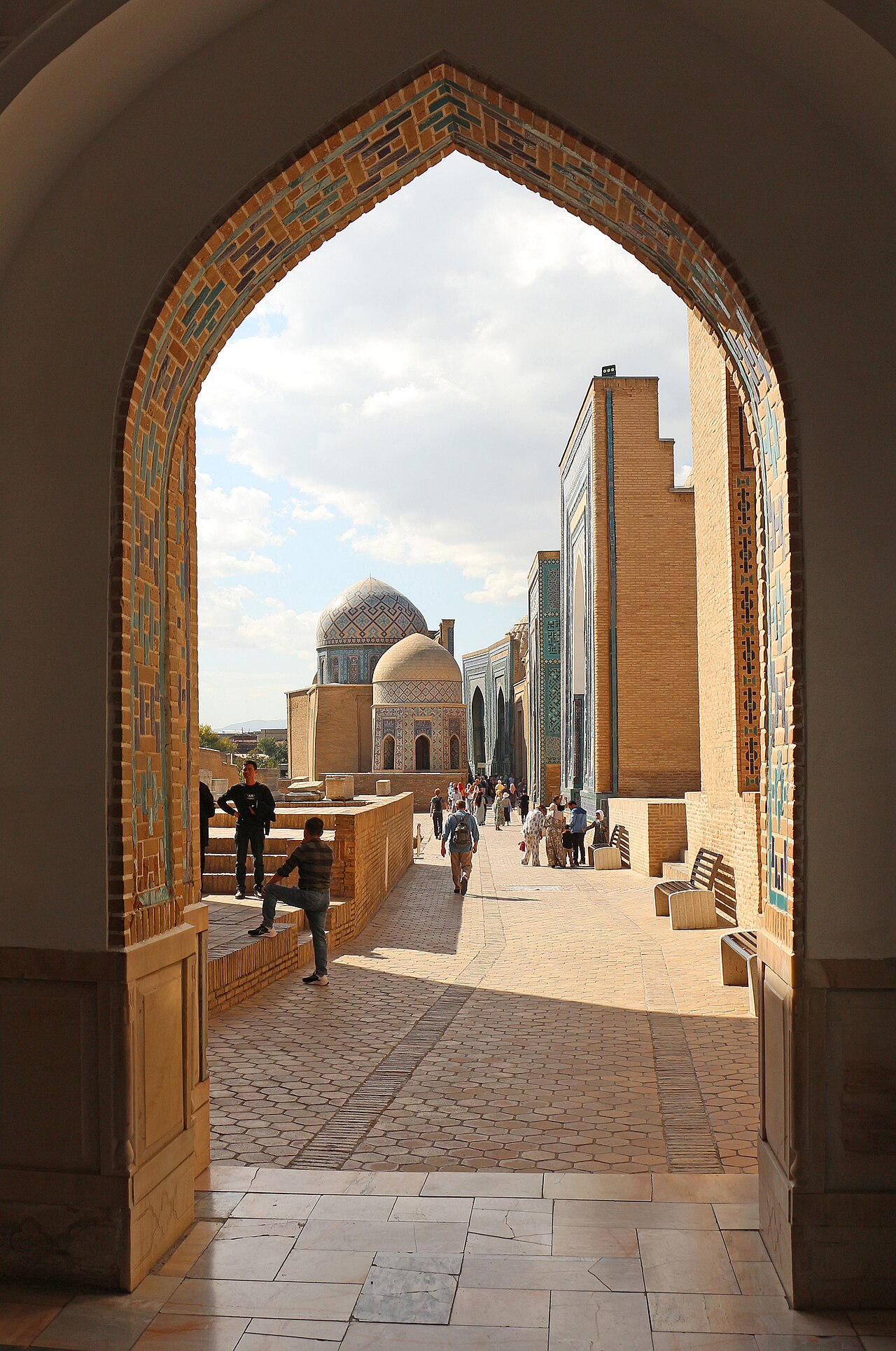
On an October afternoon the Registan's three facades stand in honey-colored light, swallows stitching the sky between the minarets, and the square's stones hold the day's warmth an hour after the tour buses have gone.
The easily missed detail
Samarkand's monuments are oriented for the sun in ways a summer visit hides. The Sher-Dor's famous sun-faces and the gilded hall of Tilya-Kori were made for low, raking light, and October's angle fires the gold leaf and the mosaic depth in a way that July's vertical glare flattens completely — the buildings are, in a real sense, autumn architecture.
The extent of what is protected is easy to under-read as well. UNESCO's Samarkand – Crossroad of Cultures property is inscribed under criteria (i), (ii) and (iv), and it is not the Registan alone: the listing takes in the historic city as a whole, the Shah-i-Zinda necropolis and the ancient site of Afrasiab among its components. Two unhurried days read better here than one long one, and October is the month that supplies enough usable daylight for them.
A practical rhythm
- Mid-morning — The Registan, when the light is on the facades and the worst school-group hour has not arrived.
- Afternoon — Shah-i-Zinda and the Afrasiab museum in the warm part of the day, the necropolis lane shaded as the sun drops.
- Evening — The Registan again after dark, floodlit, with the square given over to local families.
What could complicate the plan
The cooling is steep: the monthly mean falls from 58°F (14.4°C) in October to 46°F (7.9°C) in November, and inside a continental October the gap between afternoon and night catches travelers dressed for the daytime photograph. Early October can still borrow September's heat, a 70°F (20.9°C) monthly mean, for a day at a time. And the harvest abundance is perishable in every sense: the bazaar's grape and melon peak is a matter of weeks, and a late-October trip trades some of it away for emptier sites.
What to do next
Book the middle of October, and let the next answer order the monuments — they were built in sequence and are best read that way.
Sources
- Japan Meteorological Agency, climatological normals for the Samarkand station — monthly mean temperatures and precipitation printed with the station at 39.63°N, 66.95°E and 725 m: July 27.5 °C and 1.1 mm, September 20.9 °C, October 14.4 °C and 17.1 mm, November 7.9 °C, January 2.5 °C and 38.9 mm, March 68.6 mm and April 15.3 °C with 64.1 mm
- Centre of Hydrometeorological Service of Uzbekistan (Uzhydromet), Third National Communication under the UNFCCC — absolute summer maxima of 48–50 °C in the south of the country and annual precipitation below 100 mm in the western deserts (Tashkent, 2016)
- UNESCO World Heritage Centre, Samarkand — inscription criteria (i), (ii) and (iv) and the components of the inscribed historic city