Samarkand / Uzbekistan Food and drink
Where should I eat in Samarkand, and which local food or drink is worth trying?
The short answer
Plov at a midday osh markazi, where Samarkand's layered, pale version of the national dish is served straight from the cauldron, bread from Siyob Bazaar's tandirs, and green tea by the pot in a chaikhana — with a tasting at the 1868 Khovrenko winery if the afternoon allows.
The answer, with local context
Samarkand's eating day pivots on lunch, because plov — osh — is a midday dish cooked in cauldrons that empty by mid-afternoon. The city's style is a point of regional honor and visibly different: where Fergana's plov is dark and mixed, Samarkand's is built in layers and served unmixed, long-grain rice steamed above yellow carrots and chickpeas, the large pieces of beef or lamb carved and laid on top, the whole plate pale gold rather than brown. It is also a lighter construction — classic recipes use roughly half the fat per kilo of rice of the Fergana version, sometimes zig'ir, linseed oil, in place of tail fat. Eat it where the city does, at a plov center such as Samarqand Osh Markazi No. 1 on Ibn Sino Street, trading since 2009 in plain canteen style, and eat it correctly: with achichuk, the sharp tomato-and-onion salad that cuts the richness, and bread torn, never cut.
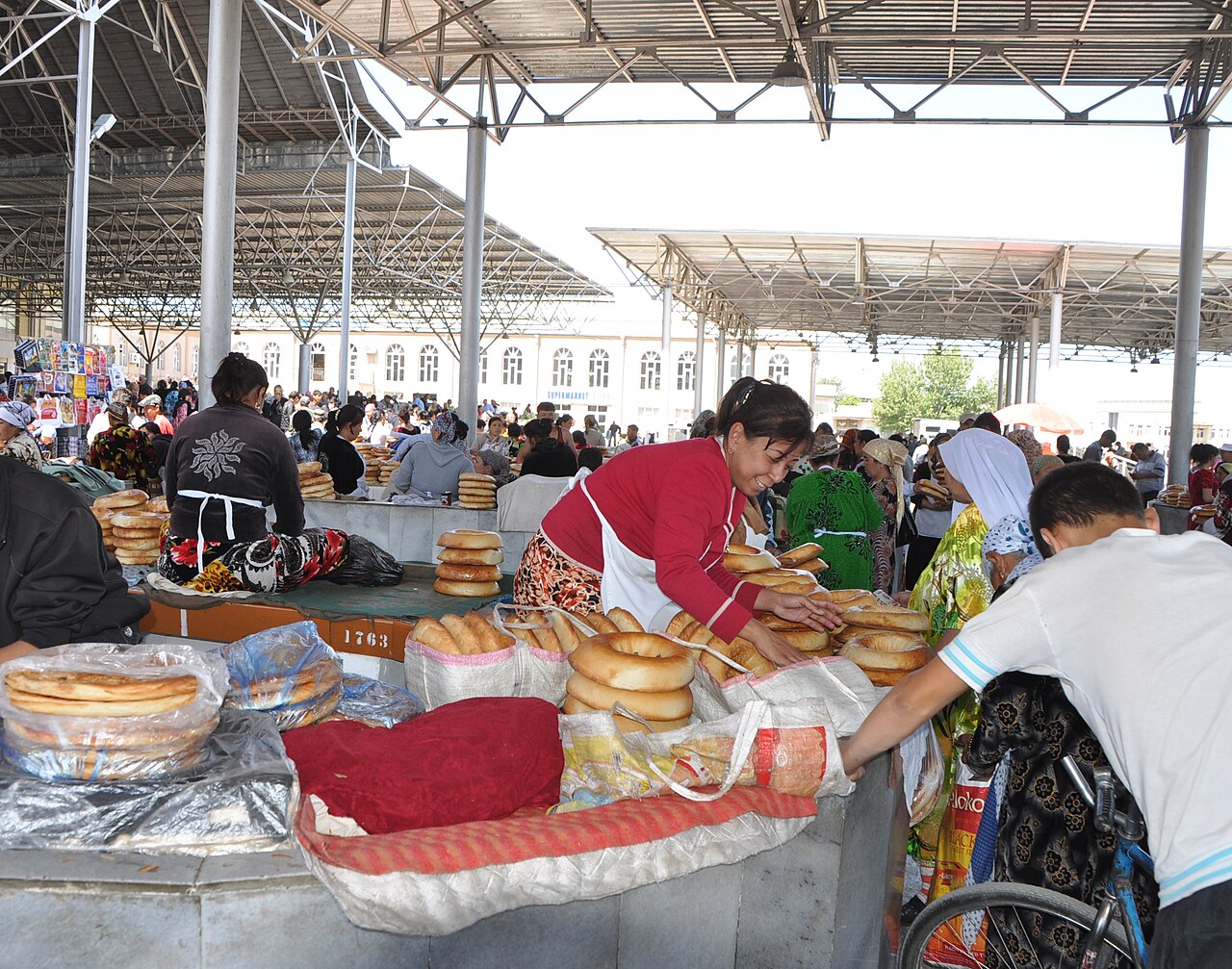
The bread is the second edible monument. Samarkand non is a dense, round, stamped loaf baked against the wall of a clay tandir, glazed and burnished, famous across Uzbekistan for a keeping quality that legend stretches to years — travelers genuinely do carry it home as luggage. Siyob Bazaar, the city's oldest and largest market, sprawling beside the Bibi-Khanym Mosque, is where to see it stacked in golden walls alongside pyramids of dried apricots, raisins, almonds and the kurut cheese balls that stock every Silk Road pantry. The bazaar is also the grazing ground for the rest of the repertoire: tandir samsa pastries blistered from the oven wall, manti dumplings, and shashlik grilled over charcoal in the evening rows.
Drink green tea — kok choy — poured into a handleless piala and returned to the pot twice before the first sip, the chaikhana ritual that slows every meal to Central Asian time. And Samarkand holds one surprise no other Uzbek city matches: wine. The Khovrenko winery traces to 1868, when the Russian merchant Filatov followed the Tsar's troops into Central Asia; its museum and tasting room, in a historic late-19th-century house, pour local wines and brandies and the dark, herbal Samarkand balsam. Just outside the center, the Meros paper mill at Konigil village makes mulberry-bark paper by the method that made Samarkand the Islamic world's first paper city in the 8th century — a craft stop rather than a meal, but the natural pairing for the city's other ancient product.
Picture the place
At the plov center at noon the oshpaz lifts the cauldron's lid and the steam rolls out in a sheet; he works down through the layers with a skimmer — rice first, then the carrots, then the meat carved at the counter — while a hundred lunchers wait with trays and nobody is in the slightest hurry to be anywhere else.
The easily missed detail
Plov has a clock. The cauldrons are timed for the lunch rush, the best centers sell out — some by 2 p.m. — and what is served in the evening at general restaurants is usually a lesser, reheated or small-batch version. A Samarkand food plan that puts plov at dinner has misunderstood the dish; dinner belongs to shashlik and the chaikhana, and plov owns the middle of the day.
A practical rhythm
- Morning — Siyob Bazaar early, for bread still warm from the tandir and the dried-fruit rows before the crowds.
- Midday — The plov center by noon, achichuk on the side, tea by the pot — the day's main meal, as the city takes it.
- Evening — Shashlik and samsa at a garden restaurant, or the Khovrenko tasting, with the Registan floodlit afterward.
What could complicate the plan
The plov centers are canteens, not restaurants: shared tables, fast turnover, menus in Uzbek or Russian, and payment in cash — the experience is the point, but travelers expecting table service should choose the evening venues for comfort and the centers for truth. Tea is not an accompaniment but a medium; refusing refills takes technique (the cup placed face down or a hand over the bowl), because a chaikhana host will pour all day. The winery's tastings run at set times and the balsam is potent; both reward an appointment rather than an ambush.
What to do next
Put one plov-center lunch on the calendar before any monument, buy the non at Siyob on the last morning, and let the rest of the eating follow the chaikhanas.
Sources
- Samarkand's plov tradition — the layered, unmixed serving of rice over yellow carrots and chickpeas with meat carved on top, linseed (zig'ir) oil in classic recipes, and Samarqand Osh Markazi No. 1 trading on Ibn Sino Street since 2009
- Siyob Bazaar — Samarkand's oldest and largest market beside the Bibi-Khanym Mosque, the city's source for tandir-baked Samarkand non and dried fruits
- Khovrenko Winery and its Museum of Winemaking — winemaking in Samarkand traced to Filatov's 1868 foundation, with tastings of local wines, brandies and the Samarkand balsam
- Meros Paper Factory, Konigil village — mulberry-bark papermaking continuing Samarkand's 8th-century craft