Santiago / Chile Food and drink
Where should I eat in Santiago, and which local food or drink is worth trying?
The short answer
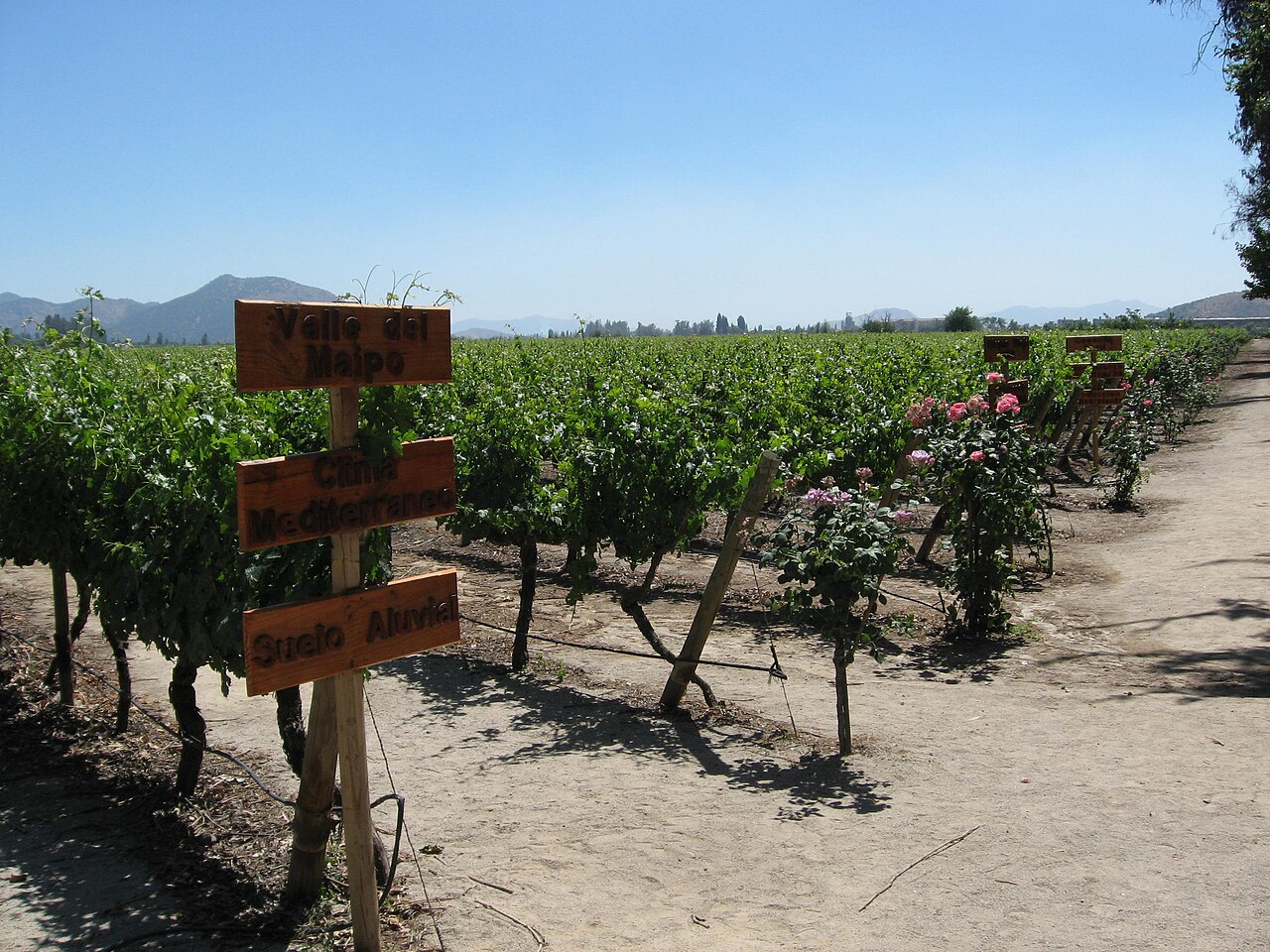
Drink the wine of the Valle del Maipo, which legally is Santiago's own appellation — Chile's wine zoning decree defines the Maipo Valley as a subregion covering all the provinces of the Región Metropolitana.
The answer, with local context
Chile's wine labels are governed by Decree No. 464, promulgated by the Ministry of Agriculture on 14 December 1994, published on 26 May 1995 and later amended by Decree No. 129 of 1998 and Decree No. 103 of 1999. It divides the country into 5 wine regions — Atacama, Coquimbo, Aconcagua, Valle Central and Sur — and places the Valle del Maipo inside the Valle Central. Because the subregion is drawn on the administrative boundary rather than on a river, every province of the capital region falls inside it. Santiago is not near a wine region. It is in one.
The decree then names 13 areas within the Maipo: Santiago, Pirque, Puente Alto, Buin, Isla de Maipo, Talagante, Melipilla, Alhué, María Pinto, Colina, Calera de Tango, Til Til and Lampa. Several of those are within an hour of the city center, which is why a Santiago wine day is a genuinely short trip rather than an expedition.
The labeling rules are strict enough to be useful to a drinker. Under article 3, at least 75 percent of a wine carrying a denomination of origin must come from the named area. Article 4 applies the same 75 percent threshold to a named grape variety, and article 5 to a stated vintage year. A blend may name up to 3 varieties, with each minor variety at 15 percent or more. The decree's article 21 also fixes a minimum of 11.5 degrees of real alcohol for wine, with a tolerance of half a degree below the labeled strength that may never take it under that minimum. Sweetness terms are defined too: seco runs up to 4 grams of residual sugar per liter, with an allowance to 9 grams depending on acidity, while dulce starts at 45 grams.
Picture the place
Chile's national tourism portal describes Santiago's climate as Mediterranean and advises sunscreen year round — which is the same growing climate the 13 Maipo areas share, since the subregion is simply every province of the capital region.
The easily missed detail
"Embotellado en Origen" on a Chilean label is not a marketing phrase. Article 6 of the decree requires that the bottling plant and the vineyards supplying the grapes both sit on land owned or held by the winery inside the denomination's area, and that vinification, bottling and storage happen as one continuous process at the winery. No percentage threshold applies — the claim is about control of the whole chain, not about a blend ratio.
A practical rhythm
- Read the area, not just the valley — A label saying Pirque or Isla de Maipo is naming one of the 13 areas the decree defines; a label saying only Valle Central is a region three levels up.
- Check the strength — Anything sold as wine in Chile must reach 11.5 degrees of real alcohol, so a lighter number on a label is telling you it is something else.
- Street food on the hill — Chile's national tourism portal names mote con huesillo, the wheat-and-dried-peach drink, as the thing to have on Cerro San Cristóbal.
What could complicate the plan
The Servicio Agrícola y Ganadero keeps the registry and enforces these rules, often through certifying companies it authorizes, so the guarantees behind a label are real — but the decree also excludes the special wines covered by article 19 of Decree No. 78 of 1986 from its scope, and a wine with no denomination of origin is a separate legal category with none of the 75 percent protections attached. Table wine is a third category again. If a bottle names no area at all, none of the above is guaranteeing anything about where the fruit grew.
What to do next
The Santiago things-to-do answer in this group covers the Bellavista end of the Parque Metropolitano, which is where the national tourism portal suggests ending a day on the hill; the when-to-visit answer sets out the months when the valley is pleasant to drive into.
Sources
- Chile, Servicio Agrícola y Ganadero (Ministerio de Agricultura), Decreto No. 464 — the Valle del Maipo subregion, its 13 named areas, and the 75 percent rules for origin, variety and vintage
- WIPO Lex, Chile, Decreto No. 464 consolidated text — promulgation and publication dates, the amending decrees, the 5 wine regions, the 3-variety blend rule, the sugar scale and the 11.5-degree minimum
- Chile Travel, Chile's official national tourism portal — mote con huesillo on Cerro San Cristóbal