São Paulo / Brazil Things to do
What are the most worthwhile things to do in São Paulo on a first visit?
The short answer
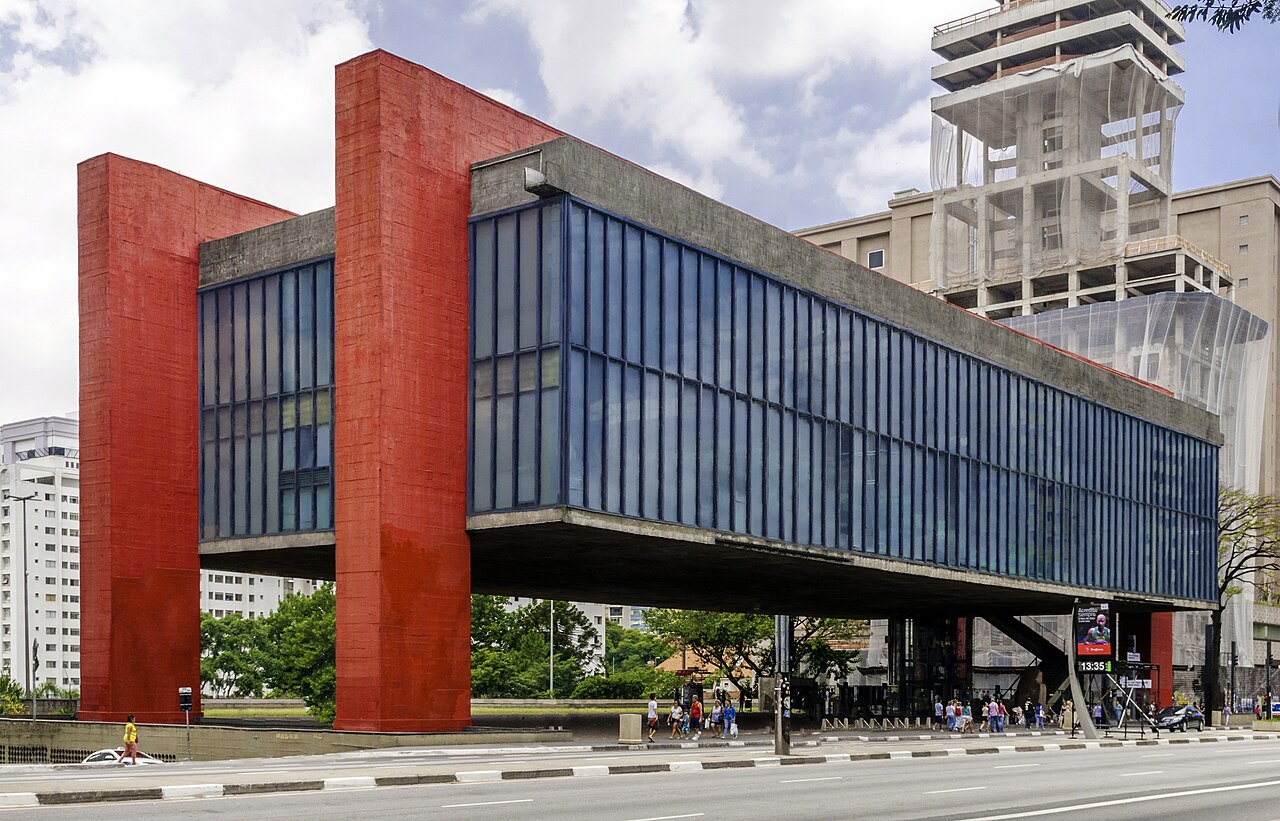
Read São Paulo as three cities in one: the museum avenue of Paulista crowned by the MASP's floating glass box, the modernist park of Ibirapuera, and the old center — Sé Cathedral, the Copan wave and the 1933 Mercado Municipal — with Liberdade's lanterns for the coda.
The answer, with local context
Begin on the ridge. Avenida Paulista, 1.7 miles (2.8 km) long, opened in 1891 as the address of the coffee barons' mansions and is now the city's cultural spine, and its emblem stands at number 1578: the MASP, the São Paulo Museum of Art. The museum was founded on October 2, 1947, by Assis Chateaubriand and Pietro Maria Bardi, and in 1968 it moved into Lina Bo Bardi's building — a glass box of some 9,200 tons suspended on four red pillars across a free span of 243 feet (74 m), the largest of its kind in the world at the time, with the void beneath deliberately left as a public plaza because the donated land came with the city's view protected. Queen Elizabeth II inaugurated the building on November 7, 1968. Inside hangs the most important collection of European art in the Southern Hemisphere, displayed on Bo Bardi's glass easels so the paintings float, and admission is free on Tuesdays. This library's Brazil answer treats the country; Paulista is where the country's money became its culture.
The green counterweight is Ibirapuera Park, inaugurated on August 21, 1954, for the city's 400th anniversary, on what had been swampy wetland: 390 acres (158 hectares) of lakes and lawns organized by Oscar Niemeyer's white pavilions and Roberto Burle Marx's landscaping, linked by the snaking covered Marquise. The Bienal Pavilion has hosted the São Paulo Bienal — the world's second-oldest art biennial, after Venice — since 1957; the park also holds the Museum of Modern Art and the Afro Brasil Museum, and Niemeyer's Auditório, completed in 2005 from his original sketches, closes the composition with its red tongue of an entrance. Then descend to the old center: the neo-Gothic Sé Cathedral, inaugurated for the same 400th anniversary in 1954; the Theatro Municipal of 1911, where the Modern Art Week of 1922 launched Brazilian modernism; Niemeyer's Edifício Copan, completed in 1966, a concrete wave holding one of the largest residential buildings in Latin America; and the Mercado Municipal of 1933, a stained-glass market hall that is also a lunch destination in its own right. The city beneath all of it runs on Latin America's pioneering metro, whose first line opened on September 14, 1974. Finish in Liberdade, the lantern-hung heart of the largest Japanese community outside Japan, or in Vila Madalena, where the Beco do Batman alley rewrites its graffiti walls continually — the two neighborhoods are São Paulo's immigration story told at street level, in a metropolis of more than 22 million people.
Picture the place
Under the MASP on a Sunday the suspended museum becomes a roof for the city: skaters and buskers in the shaded void, the antiques fair spreading its stalls, couples photographing the view down to the old center that the building was designed never to block — the plaza working exactly as its architect insisted it must.
The easily missed detail
The MASP's famous emptiness is a legal artifact before it is an aesthetic one: the Trianon terrace land was donated on the condition that the view across the Nove de Julho valley to the center be preserved forever, so Bo Bardi had two choices — bury the museum or lift it. She lifted 9,200 tons into the air and turned a planning restriction into the most recognizable building in Brazil. The antiques fair beneath it every Sunday is the clause's living dividend.
A practical rhythm
- Morning — Museums in the morning: the MASP at opening, then down Paulista's cultural row — Itaú Cultural, Japan House, the Casa das Rosas — while the avenue is still in its business-day composure.
- Midday — Midday belongs to the old center: the Mercado Municipal for the great mortadella lunch (the subject of this group's food answer), Sé Cathedral, and the Copan's wave photographed from the street it bends along.
- Evening — The evening is Ibirapuera's golden hour or Liberdade's lanterns — and on Sundays, remember, Paulista itself closes to cars and becomes the city's linear park until nightfall.
What could complicate the plan
Scale is the standing condition: São Paulo's sights are district-sized, traffic is a force of nature, and a day that tries to hold Paulista, the center and Ibirapuera becomes a tour of the metro — which is, at least, an efficient and vast system worth using deliberately. The old center rewards daylight hours and a purposeful route; its monuments are working buildings in a working downtown, not a museum quarter. And the Bienal, the city's single greatest temporary exhibition, exists only in its edition years — a first visit outside them should lean on the MASP and the Pinacoteca, the state museum founded in 1905, to carry the art argument.
What to do next
Give Paulista a full day, the center a full day and Ibirapuera a slow morning, and ride the metro between them — São Paulo is not a city to be skimmed from a car window.
Sources
- MASP (Museu de Arte de São Paulo) — founded October 2, 1947; Lina Bo Bardi's building inaugurated November 7, 1968, by Queen Elizabeth II: a 243-foot (74 m) free span on four pillars, the paintings shown on the architect's glass easels, free admission on Tuesdays
- Fundação Bienal / Parque Ibirapuera — the park inaugurated August 21, 1954, for the city's 400th anniversary; 390 acres (158 hectares) by Oscar Niemeyer and Roberto Burle Marx; the Bienal held in its pavilion since 1957
- Prefeitura de São Paulo — the Mercado Municipal, opened in 1933; Sé Cathedral inaugurated in 1954; the Theatro Municipal (1911) and the Modern Art Week of 1922; the metro's first line, September 14, 1974