São Paulo / Brazil When to visit
When should I visit São Paulo, Brazil, for the best experience?
The short answer
August — statistically the driest month of São Paulo's year, with just 1.27 inches (32.3 mm) of rain on four days, highs of 76°F (24.5°C), and the city's famous drizzle finally taking its annual holiday.
The answer, with local context
São Paulo is not tropical in the postcard sense, and its altitude is the reason: the city stands on a plateau at 2,490 feet (760 m), high enough to give it a humid subtropical climate, proper seasons and a nickname it earned honestly — Terra da Garoa, the Land of Drizzle. INMET's 1991–2020 normals for the Mirante de Santana station, at 2,575 feet (785 m), show a city of wet summers and dry winters. The year delivers 65.3 inches (1,658.3 mm) of rain, but it arrives in a rush: January alone takes 11.50 inches (292.1 mm) across 17 rainy days, the summer pattern of blazing mornings and theatrical afternoon storms, with February the warmest month at a mean high of 84.2°F (29.0°C). Then, from April, the tap turns off by stages — 3.43 inches (87.0 mm), then 2.61 (66.3 mm) — until the winter floor: July at 1.91 inches (48.4 mm) and August at 1.27 inches (32.3 mm), the driest month of the year, with only four rainy days.
August is therefore the month when São Paulo's machinery runs cleanest. The mean high of 76°F (24.5°C) and low of 56°F (13.3°C) make it the year's best walking weather in a city whose sights are spread across whole districts — Avenida Paulista's museums, the old center, Ibirapuera Park's 390 acres. Late winter also brings the veranico, the little summer: a warm, dry spell that can push August afternoons well above the average, giving the month spring's benefits before spring's rain returns — September already climbs to 3.28 inches (83.3 mm) and October to 5.01 inches (127.2 mm), on the road back to the deluge.
The honest cost of August is the festival calendar: São Paulo stages its spectacles in other seasons — Carnival in the summer, and in Bienal years the great art exhibition opens in September and runs into December, while November brings the Formula 1 Grand Prix to Interlagos. A traveler whose trip is the Bienal should come in September or October and accept the returning rain as the ticket price. For the city itself — its museums, markets, restaurants and sheer scale, unimpeded — August is the month the Paulistanos' own weather stops arguing.
Picture the place
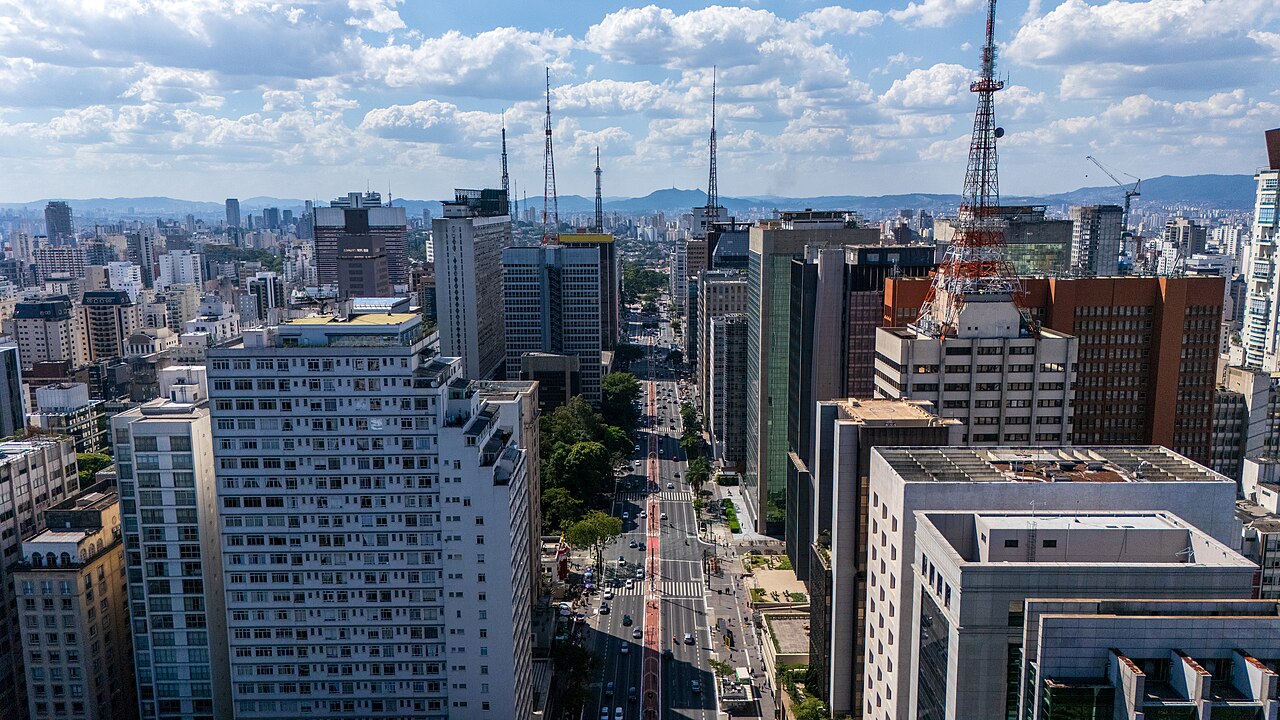
On an August morning Avenida Paulista runs under a sky scrubbed blue to the horizon, the MASP's red frame sharp against it, the winter sun warm on the pavement and the air carrying that rare São Paulo sensation — dry, thin, high-altitude light in a city that spends half the year under a gray lid.
The easily missed detail
The plateau writes plot twists into both ends of the thermometer: São Paulo's all-time record high, 101.1°F (38.4°C), was set in October, in what is nominally spring, while its record low, 28.2°F (−2.1°C) — below freezing — belongs to August, the very month recommended here. Pack for the averages and you will be right most days; the city's own history insists on one warm layer and no assumptions.
A practical rhythm
- Morning — August mornings are the museum window: cool, bright and dry — MASP and the Paulista institutions first, then the old center while the light rakes down its canyons of towers.
- Midday — Midday is park and market time: Ibirapuera's lawns at their winter-green best, and the Mercado Municipal's great hall, where lunch is the city's most democratic ceremony.
- Evening — Evenings cool fast on the plateau — down toward the mid-50s Fahrenheit (around 13°C): the restaurant districts of Jardins and Pinheiros, the bars of Vila Madalena, and a jacket that a coastal Brazilian city would never ask of you.
What could complicate the plan
The summer alternative is a genuine gamble on logistics: 17 rainy days in January means flooded avenues and gridlock as a recurring event, not an anecdote, in a metropolis of more than 11 million people. Winter has its own footnote — the same dry air that clears the sky can trap pollution haze over the plateau for days at a stretch in July and August, softening the views from the city's observation decks. And September's warmth is real but transitional: the month that tempts with the Bienal also reopens the rain account, so an exhibition trip needs indoor depth — which, in fairness, São Paulo possesses like no other city in South America. One more constraint sits above the weather in every month: the US State Department's Brazil advisory, issued on May 25, 2026, rates the country Level 2, Exercise Increased Caution, tells travelers not to enter informal housing developments — favelas, vilas, comunidades or conglomerados — at any time, and puts everywhere within 160 km (100 miles) of Brazil's land borders on its do-not-travel list, with Foz do Iguaçu and the Pantanal national parks expressly exempted, which happen to be the two excursions a São Paulo trip is likeliest to bolt on.
What to do next
Book August, base yourself near Avenida Paulista, and schedule the districts the way the weather invites: museums in the bright mornings, the park at midday, and the city's restaurants — its true evening festival — after dark.
Sources
- INMET (Instituto Nacional de Meteorologia), Mirante de Santana station, 1991–2020 normals — annual rainfall 65.3 inches (1,658.3 mm); January wettest at 11.50 inches (292.1 mm) over 17 rainy days; August driest at 1.27 inches (32.3 mm) over four rainy days, with a mean high of 76°F (24.5°C); February the warmest month at 84.2°F (29.0°C); record high 101.1°F (38.4°C) in October and record low 28.2°F (−2.1°C) in August
- Prefeitura de São Paulo / city references — the city's plateau elevation of 2,490 feet (760 m) and its nickname Terra da Garoa, "Land of Drizzle"; the veranico warm spell of late winter
- US Department of State, Brazil Travel Advisory — Level 2, Exercise Increased Caution, issued May 25, 2026; the do-not-travel guidance for informal housing developments and for areas within 160 km (100 miles) of Brazil's land borders, exempting Foz do Iguaçu and the Pantanal national parks