Scottish Highlands / United Kingdom Things to do
What are the most worthwhile things to do in Scottish Highlands on a first visit?
The short answer
Drive the Great Glen from Glen Coe to Loch Ness, ride the Jacobite steam train to Mallaig, stand on Culloden's battlefield, and finish over the Skye Bridge among the Trotternish pinnacles — the west-and-Great-Glen corridor is the first visit; the Cairngorms are the second.
The answer, with local context
Take the corridor in order, south to north, the way the geology wrote it. Glen Coe is the overture: the A82 drops into a glen of volcanic walls — the Buachaille Etive Mòr at its gate, the Three Sisters (the Bidean nam Bian massif) above the road — beautiful enough to hide its history, which the National Trust for Scotland's visitor center tells plainly: on February 13, 1692, government soldiers billeted on the MacDonalds rose before dawn and murdered 38 of their hosts, the Massacre of Glencoe, an act of state terror that still names the place. Fort William, half an hour on, is the corridor's working town under Ben Nevis: climb the mountain by the Mountain Track if fit and equipped (1,345 m; some 125,000 people a year attempt it, and its summit weather is a serious subject in every month), or take the mountain's measure from the Nevis Range gondola up Aonach Mòr across the glen.
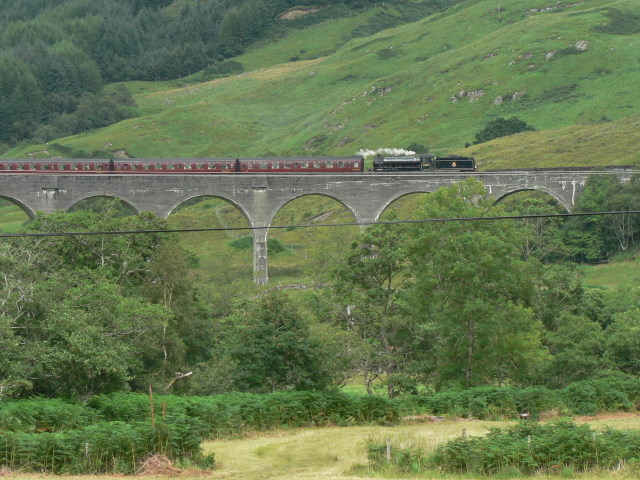
The railway is the corridor's showpiece. From Fort William the West Highland Line — regularly voted among the world's great rail journeys — runs to the fishing port of Mallaig, and from April to October the Jacobite steam train works the route: 42 miles each way across the Glenfinnan Viaduct (built 1897–1901, 21 arches of mass concrete, now carrying a fictional fame larger than its engineering: the Hogwarts Express crossings). At Glenfinnan the monument (a lone Highlander on an 18-meter column, raised 1815) marks where Charles Edward Stuart raised his standard on August 19, 1745; the National Trust visitor center tells the '45's whole arc, whose end waits at the corridor's other extremity. The Great Glen itself — the fault-line chain of Lochs Ness, Oich and Lochy, stitched by Telford's Caledonian Canal (opened 1822; its eight-lock staircase at Banavie, Neptune's Staircase, is the canal's set piece) — drives north to Loch Ness: 23 miles long and holding more fresh water than all the lakes of England and Wales together, with Urquhart Castle (Historic Environment Scotland) on its shore and the monster industry in Drumnadrochit taken at whatever seriousness you bring.
The corridor ends at Inverness, the Highland capital, and its two sombre masterpieces: Culloden Battlefield (April 16, 1746 — the last pitched battle on British soil, the Jacobite cause ended in under an hour; the National Trust's visitor center and the grave-marked moor are the Highlands' essential act of memory) and, gentler, the Clava Cairns, Bronze Age burial rings some 4,000 years old in their beech grove. Then the extension that serious first visits make: over the Skye Bridge (1995) to the Isle of Skye — the Old Man of Storr and the Quiraing's landslipped pinnacles on the Trotternish ridge, the Fairy Pools in Glen Brittle, Dunvegan Castle, seat of the MacLeod chiefs for some 800 years. The Cairngorms — Britain's largest national park (4,528 km²), Speyside's distillery row along the river — belong to the return trip; doing them justice takes the days the corridor leaves no room for.
Picture the place
The Jacobite crossing Glenfinnan at 11 a.m.: steam feathering over the viaduct's curve, the loch below black as slate, and four hundred phone cameras rising in unison from the hillside.
The easily missed detail
At Glenfinnan, stay for the other train: the scheduled ScotRail service crosses the same viaduct for a standard fare, from the same station — the Jacobite is the theater, but the line itself is the sight, and the afternoon service from Mallaig gives the crossing in the golden direction. And at Culloden, walk to the field's edge for the detail the center cannot hold: the clan graves were marked only in 1881, 135 years after the battle — the memorial cairn and stones are Victorian acts of conscience over an unmarked field, which is why the moor still feels less like a museum than a held breath.
A practical rhythm
- The corridor is one-way — Glasgow-side in at Glen Coe, out at Inverness (or reverse); backtracking burns the trip
- Jacobite or West Highland Line, booked early — Steam sells out for summer; the scheduled trains take bookings too and run all year
- Two bases, not five — Fort William (or Glencoe village) for the south, Inverness or Loch Ness for the north; Skye needs its own nights
What could complicate the plan
The Highlands run on single-track time: passing-place roads, livestock, and distances measured in hours, not miles — the itinerary that looks like a morning is a day. The Jacobite's operator and timetable have changed across recent seasons (steam services were suspended for part of 2024 over a safety-exemption dispute), so confirm the current season's running before building a day on it. Ben Nevis is the standing safety lecture: its summit can hold winter while the glen picnics, the five-finger gully navigation trap catches the underprepared in mist, and mountain rescue callouts peak with the visitor numbers — the gondola is the honourable alternative. Book Skye, the steam train and Culloden's guided walks first; they are the corridor's three hard capacities.
What to do next
Book the northbound corridor — Fort William two nights, Skye two, Inverness one — put the Jacobite on a Fort William morning, and hold Culloden for the last, quietest afternoon.
Sources
- National Trust for Scotland — Glencoe (the 1692 massacre), the Glenfinnan Monument (1815; the standard raised August 19, 1745) and Culloden (April 16, 1746)
- Historic Environment Scotland — Urquhart Castle and the state-care sites of the Great Glen; the Caledonian Canal (Telford, opened 1822)
- West Coast Railways / ScotRail — the Jacobite steam service (April–October) and the West Highland Line over the Glenfinnan Viaduct (1897–1901)
- Cairngorms National Park Authority — Britain's largest national park (4,528 km²), reserved for the second visit