Seoul / South Korea Things to do
What are the most worthwhile things to do in Seoul on a first visit?
The short answer
Changdeokgung with its rear garden, and Jongmyo Shrine — the only two UNESCO World Heritage properties inside Seoul's own boundaries, both inscribed for what they represent about Joseon-era Korea rather than for scale.
The answer, with local context
Changdeokgung Palace Complex was inscribed on the World Heritage List in 1997 under criteria (ii), (iii) and (iv), by Decision 21 COM VIII.C at the Committee's 21st session. What distinguishes it from Seoul's other palaces is that it was laid out to follow the topography rather than impose a grid on it, with halls stepped along the contours of the hillside. Behind the formal buildings lies the Huwon, the rear garden, built around the Buyongji pond with the two-story Juhamnu pavilion and the Seohyanggak library above it. The garden is the reason the property stands apart, and it is the part of the complex that changes most between seasons.
Jongmyo Shrine, inscribed in 1995 under criterion (iv) by Decision 19 COM VIII.C.1 at the 19th session, is the Confucian royal ancestral shrine of the Joseon dynasty. It is deliberately plain — long low halls, unpainted timber, a wide empty stone courtyard — and the contrast with the palace a few hundred meters away is the point. The shrine was built for ritual rather than for residence or display.
Beyond the two inscriptions, Seoul's structure gives you the rest. Bukhansan's granite ridges sit inside the city limits, which is unusual for a capital of this size. The Han River cuts the city in two, with the older core and the palaces north of it and the newer business districts south. Bukchon's hanok lanes, immediately east of Gyeongbokgung, preserve the single-story courtyard housing that the rest of central Seoul replaced.
Picture the place
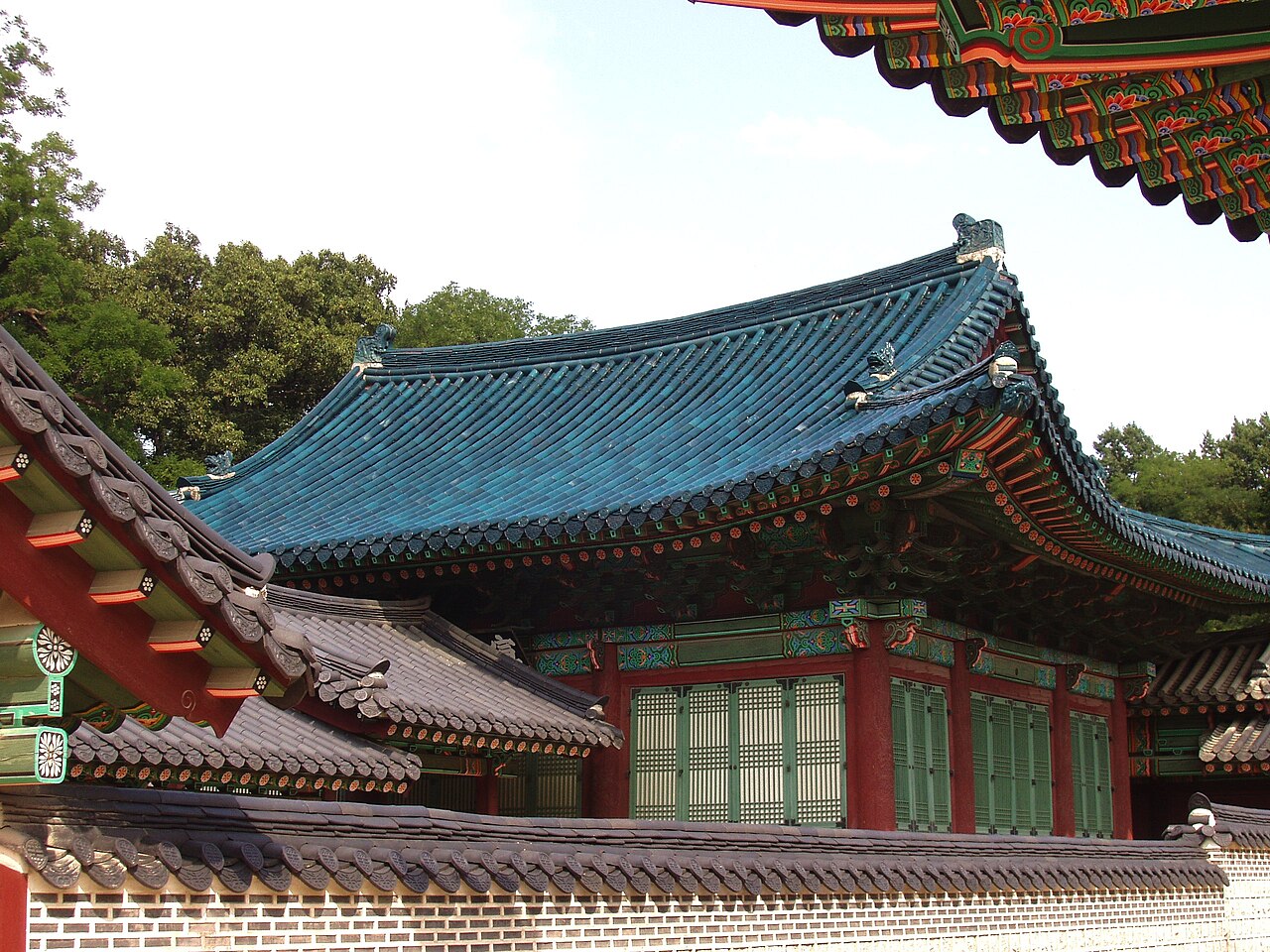
Seonjeongjeon, one of the halls at Changdeokgung, carries a blue-glazed tile roof — the only one of its kind among the palace buildings — and it reads sharply against the grey timber and the wooded slope behind it.
The easily missed detail
The rear garden at Changdeokgung is not simply part of the palace ticket in practice. Access to the Huwon has historically been managed separately from the main palace grounds, which means the Buyongji pond and Juhamnu are the part of a Seoul itinerary most likely to be missed by someone who walks in off the street and treats the complex as one open site. The garden is also where the autumn color is, which makes the late-October window doubly relevant.
A practical rhythm
- Morning — Changdeokgung's formal halls, then the Huwon; the garden is small enough that it rewards slow walking and loses nothing to a cool start.
- Midday — Jongmyo Shrine, a ten-minute walk away, where the scale and silence are the exhibit.
- Afternoon — Bukchon's hanok lanes, which are residential streets rather than a museum, and quietest before the evening crowds.
What could complicate the plan
Both properties are heritage sites with managed access and periodic conservation work, and the rear garden in particular has operated on timed access rather than free entry. US passport holders are currently covered by Korea's K-ETA exemption, extended through December 31, 2026, so entry is straightforward until that date. The US Department of State's advisory for South Korea is Level 1, issued May 28, 2025 and updated August 11, 2025. The palaces are large walking sites on sloping ground, and Changdeokgung in particular follows the hillside rather than levelling it.
What to do next
The Seoul food question in this group covers the market streets a short walk from Jongmyo.
Sources
- UNESCO World Heritage Centre, Changdeokgung Palace Complex — property name and inscription criteria
- UNESCO World Heritage Committee — Changdeokgung inscription year, decision and session
- UNESCO World Heritage Centre, Jongmyo Shrine — property name and inscription criterion
- UNESCO World Heritage Committee — Jongmyo inscription year, decision and session
- Ministry of Foreign Affairs, Republic of Korea — K-ETA exemption period
- US Department of State, South Korea travel advisory — advisory level and dates