Seoul / South Korea When to visit
When should I visit Seoul, South Korea, for the best experience?
The short answer
Late September to early November, or April into mid-May — the two stretches that sit outside both the summer monsoon and a winter that regularly runs below freezing all day.
The answer, with local context
Seoul has one of the sharpest seasonal swings of any major Asian capital. Korea Meteorological Administration normals put January's average daily high near 36°F (2°C) and its average low near 21°F (−6°C); August's average high sits near 86°F (30°C) with humidity to match. Annual precipitation runs around 55 inches (1,400 mm), and the distribution is extreme: July alone accounts for roughly 16 inches (400 mm) of it, because the summer rain front known as jangma typically sits over the peninsula from late June into late July. August and September then carry the tail of the typhoon season, when systems tracking up the East China Sea bring heavy rain to the west coast.
That leaves autumn as the strongest window. Late September through October gives dry, settled air and the clearest views out to the mountains that ring the city, and the maple and ginkgo color peaks in the palace grounds and on the Bukhansan slopes through late October into the first days of November. Spring is the other option: April brings cherry blossom along the Han River and around the palaces, with more unsettled weather than autumn but longer daylight than March.
Winter is not off the table, but it is a different trip — short days, dry cold, and a wind off the continent that makes 21°F (−6°C) feel colder than the number suggests.
Picture the place
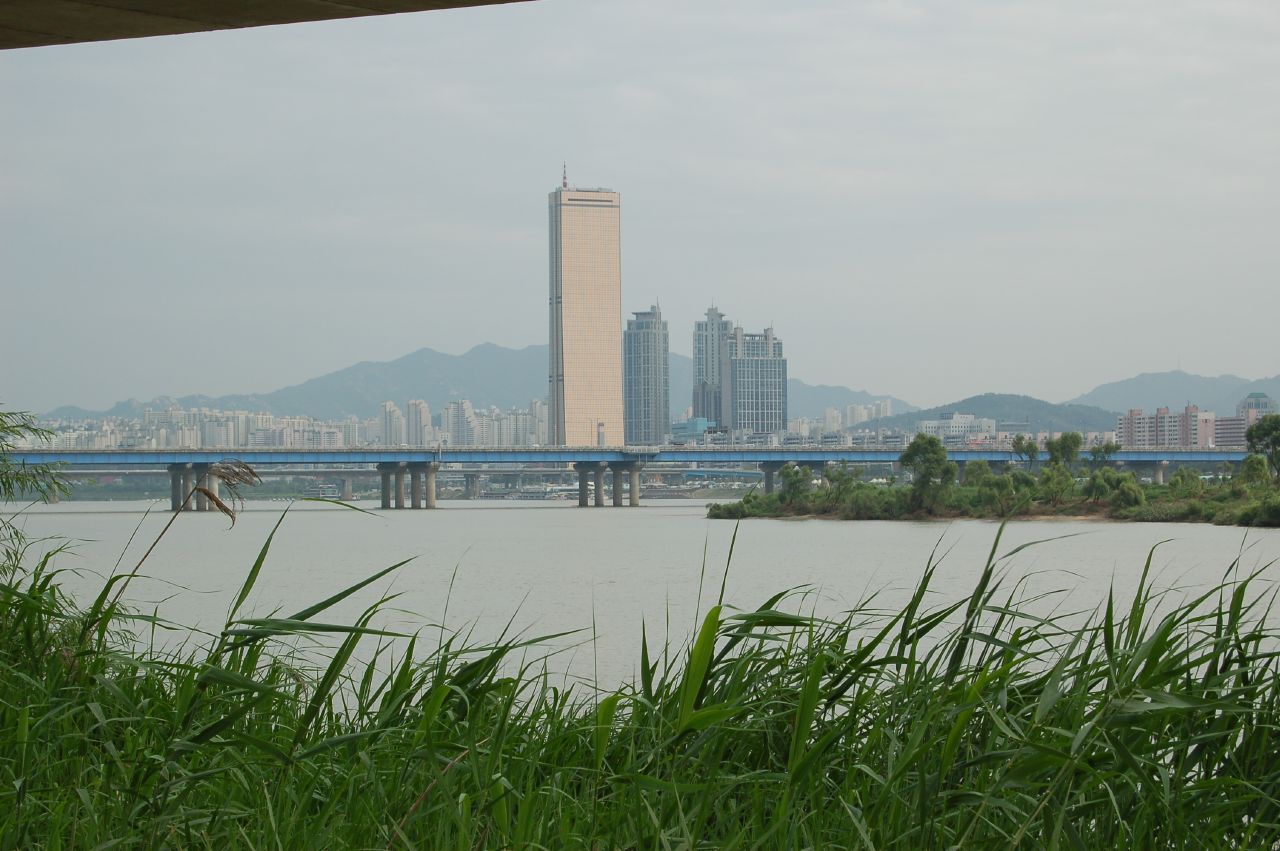
The Han River runs west through the middle of the city under a long sequence of bridges, and in late October the water carries the low afternoon light straight back up at the apartment blocks on both banks.
The easily missed detail
Entry for US passport holders currently depends on a temporary arrangement with an end date. Korea's Ministry of Foreign Affairs has extended the K-ETA exemption for countries and regions already exempt, including the USA, for one further year running from January 1, 2026 through December 31, 2026 Korea Standard Time. Travelers who do apply for K-ETA are not required to submit an arrival card, and the application carries a non-refundable fee. A trip planned across the turn of the year should be checked against whatever replaces that extension.
A practical rhythm
- Late September to early November — Driest and clearest; palace grounds and the city's mountain parks at their best.
- Late June to late July — The jangma front, with roughly 16 inches (400 mm) of rain in July alone; indoor Seoul rather than hiking Seoul.
- December to February — Daytime highs near 36°F (2°C) and nights near 21°F (−6°C), with the compensation of near-empty palaces.
What could complicate the plan
The US Department of State places South Korea at Level 1, Exercise Normal Precautions, in an advisory issued May 28, 2025 and last updated August 11, 2025. The CDC's Global Measles notice, dated May 28, 2025, lists South Korea and advises that all international travelers be fully vaccinated against measles. Typhoon remnants in late August and September can disrupt domestic travel and outdoor events on short notice, and the K-ETA exemption's December 31, 2026 expiry is a hard date rather than a guideline.
What to do next
The Seoul things-to-do question in this group covers the two World Heritage properties inside the city and why autumn suits one of them in particular.
Sources
- Korea Meteorological Administration — Seoul monthly temperature normals, annual and July precipitation, jangma timing
- Ministry of Foreign Affairs, Republic of Korea — K-ETA exemption extension dates, inclusion of the USA, arrival card and fee
- US Department of State, South Korea travel advisory — advisory level, issue and update dates
- US Centers for Disease Control and Prevention, travel health notices — Global Measles notice level, date and vaccination advice