Shanghai / China Things to do
What are the most worthwhile things to do in Shanghai on a first visit?
The short answer
The Bund and the tower trio across the river, Yu Garden in the old town, the Shanghai Museum's bronzes, the shikumen lanes of the French Concession, and one ride on the 268 mph (431 km/h) maglev — the arc of a city that has rebuilt itself four times in 180 years.
The answer, with local context
Shanghai's essential view is a dialogue across the Huangpu. On the west bank, the Bund runs a mile (1.5 km) of more than 50 treaty-port buildings — Gothic, Romanesque, neoclassical and Art Deco facades raised after the 1842 Treaty of Nanjing opened Shanghai as a treaty port — headquarters of the banks and trading houses that made the city the "Paris of the East." Facing them across 1,300 feet of river stands what replaced all that: Lujiazui, paddy fields until the 1990s, now holding the 1,535-foot (468 m) Oriental Pearl Tower (completed 1994), the 1,614-foot (492 m) World Financial Center, and the 2,073-foot (632 m) Shanghai Tower — China's tallest building and the world's third tallest, its 118th-floor sightseeing hall at 1,791 feet (546 m), reached by elevators running at 59 feet (18 m) per second, among the fastest on earth. See the pair at dusk from the Bund promenade, then cross and see it back from the tower the next clear morning.
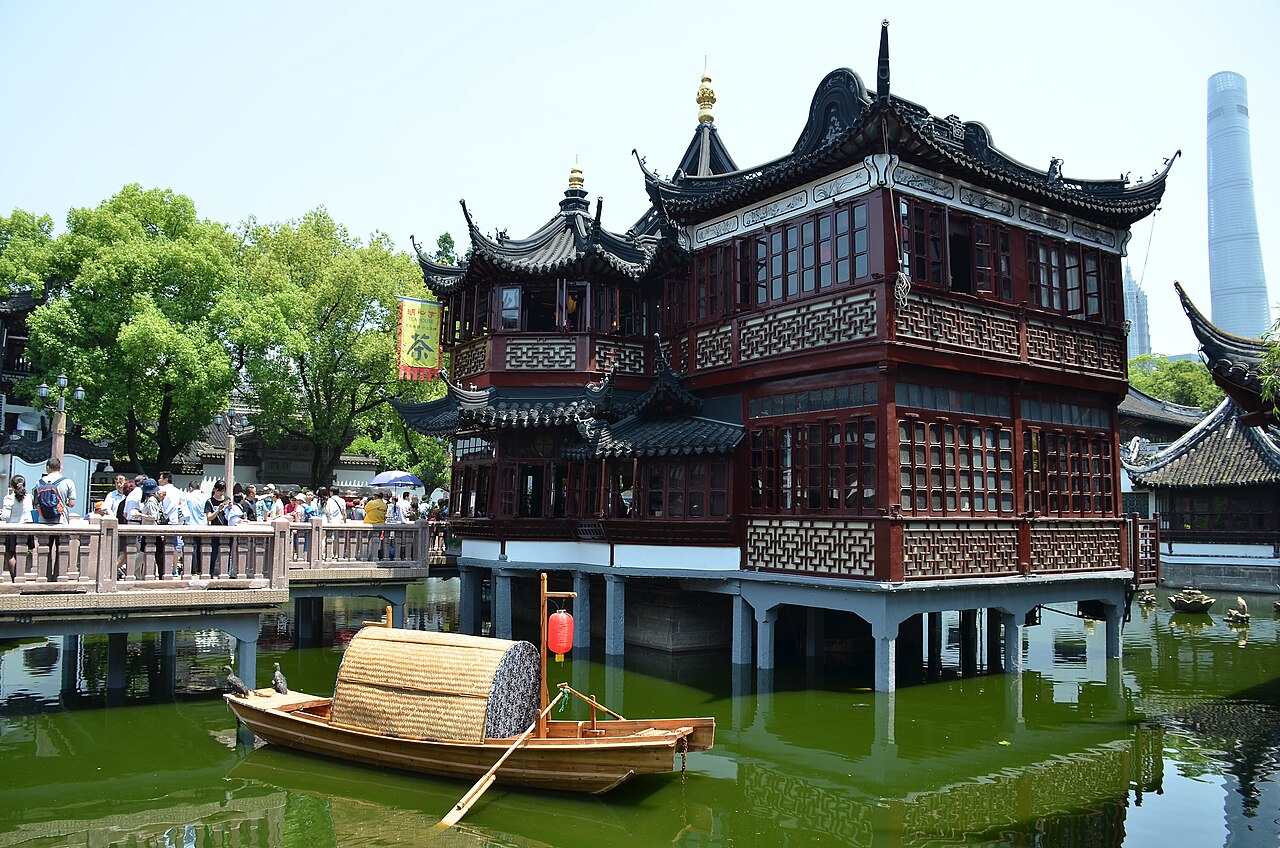
The older Shanghai survives inland. In the old town, Yu Garden is a Ming-dynasty private garden created from 1559 by the official Pan Yunduan for his father — five acres of rockeries, dragon walls, halls and ponds, its Exquisite Jade Rock a porous 16-foot (5 m) scholar's stone, and the Nine-Turn Bridge outside leading over the lotus pond to the Huxinting Teahouse of 1855. At People's Square, the Shanghai Museum holds some 140,000 artifacts, its ancient bronze gallery the finest of its kind in China, admission free, inside a building shaped like a bronze ding vessel. Both reward early starts; the garden's surrounding bazaar, whatever its souvenir density, is also where the xiaolongbao queues of the food answer form.
The lived-in layer is the former French Concession: plane trees planted a century ago over streets of shikumen, the stone-gate lane houses that were Shanghai's vernacular. Walk Xintiandi, where two blocks of shikumen were rebuilt into the city's smartest restaurant quarter beside the preserved house where the Chinese Communist Party held its First Congress in July 1921; then Tianzifang, where the same lanes stayed scruffy and filled with workshops instead; then up to Jing'an Temple, a working Buddhist temple under a golden roof squeezed between malls. Finish with the maglev: the world's first commercial magnetic-levitation line, in service since 2004, runs its 19 miles (30 km) from Longyang Road to Pudong Airport in about eight minutes at up to 268 mph (431 km/h) on scheduled peak services — transport as theme-park ride, and the correct way to leave.
Picture the place
At the Yu Garden bazaar the Nine-Turn Bridge zigzags over green water because straight bridges, the belief runs, let evil spirits cross — so the teahouse sits safely behind nine bends, and the queue for the dumpling shop below shuffles the whole length of it.
The easily missed detail
The Bund's buildings are a working museum of why Shanghai exists. Read the names: the former HSBC Building of 1923, once called the most luxurious building between the Suez Canal and the Bering Strait, now houses a bank again; the Customs House beside it still chimes its 1927 clock, whose mechanism copies Big Ben's. The skyline tourists photograph is the second draft — the facades behind them are the first, and the city is legible only with both.
A practical rhythm
- First morning — Yu Garden at opening and the old-town lanes, dumplings for an early lunch, Shanghai Museum through the afternoon.
- Golden hour — The Bund promenade as the floodlights arm, dinner in the Concession afterward.
- Second day — Lujiazui's tower deck on the clearest morning, Xintiandi and Tianzifang on foot, and the maglev worked into the airport run.
What could complicate the plan
Both the museum and Yu Garden run on reservations and weekly closures — the garden closes on Mondays, and museum entry, though free, is booked in timed slots that vanish on weekends. The tower decks are weather wagers: Shanghai's haze can reduce the 118th floor to an expensive fog exhibit, so hold the ticket until a clear morning shows itself. River cruises sell the same skyline the free promenade shows better; spend the money on dinner instead.
What to do next
Base in the Concession or near People's Square where the metro fans out, and use the world's longest metro network — some 500 miles (800 km) of it — rather than taxis for every leg but the last one at night.
Sources
- The Bund — a 1.5 km promenade of over 50 early-20th-century heritage buildings on the Huangpu's west bank, opened to trade after the 1842 Treaty of Nanjing
- Shanghai Tower — 632 m (2,073 ft), China's tallest and the world's third tallest; its 118th-floor observation deck at 546 m; elevators at 18 m per second; Oriental Pearl Tower 468 m (1994) and World Financial Center 492 m
- Yu Garden — created from 1559 by Pan Yunduan; the Huxinting Teahouse of 1855 above the Nine-Turn Bridge; Shanghai Museum's 140,000 artifacts and free admission
- Shanghai Maglev — the first commercial maglev line, opened 2004, 30 km to Pudong Airport in about 8 minutes at up to 431 km/h