Sigiriya / Sri Lanka Things to do
What are the most worthwhile things to do in Sigiriya on a first visit?
The short answer
Climb the rock through its water gardens, fresco gallery and Lion's Paws to Kashyapa's summit palace; take in the museum the ticket includes; and finish the day across the valley on Pidurangala, the rock that shows you Sigiriya itself.
The answer, with local context
UNESCO inscribed the Ancient City of Sigiriya in 1982 under criteria (ii), (iii) and (iv), and the climb is best read as one designed ascent. King Kashyapa I, who seized the throne in 477 CE and ruled until 495, moved his capital onto this 590-foot (180 m) column of hardened magma and built the approach as a sequence of pleasures. It begins in the water gardens, among the oldest landscaped gardens in the world: symmetric pools, islands and fountains fed by underground conduits whose pressure still lifts water in the rainy season, laid out across a royal precinct roughly 1.7 miles (2.75 km) east to west. Beyond them the boulder gardens thread natural rock arches and monastic caves — Sigiriya was a monastery before the palace and became one again after it — and then the staircases begin.
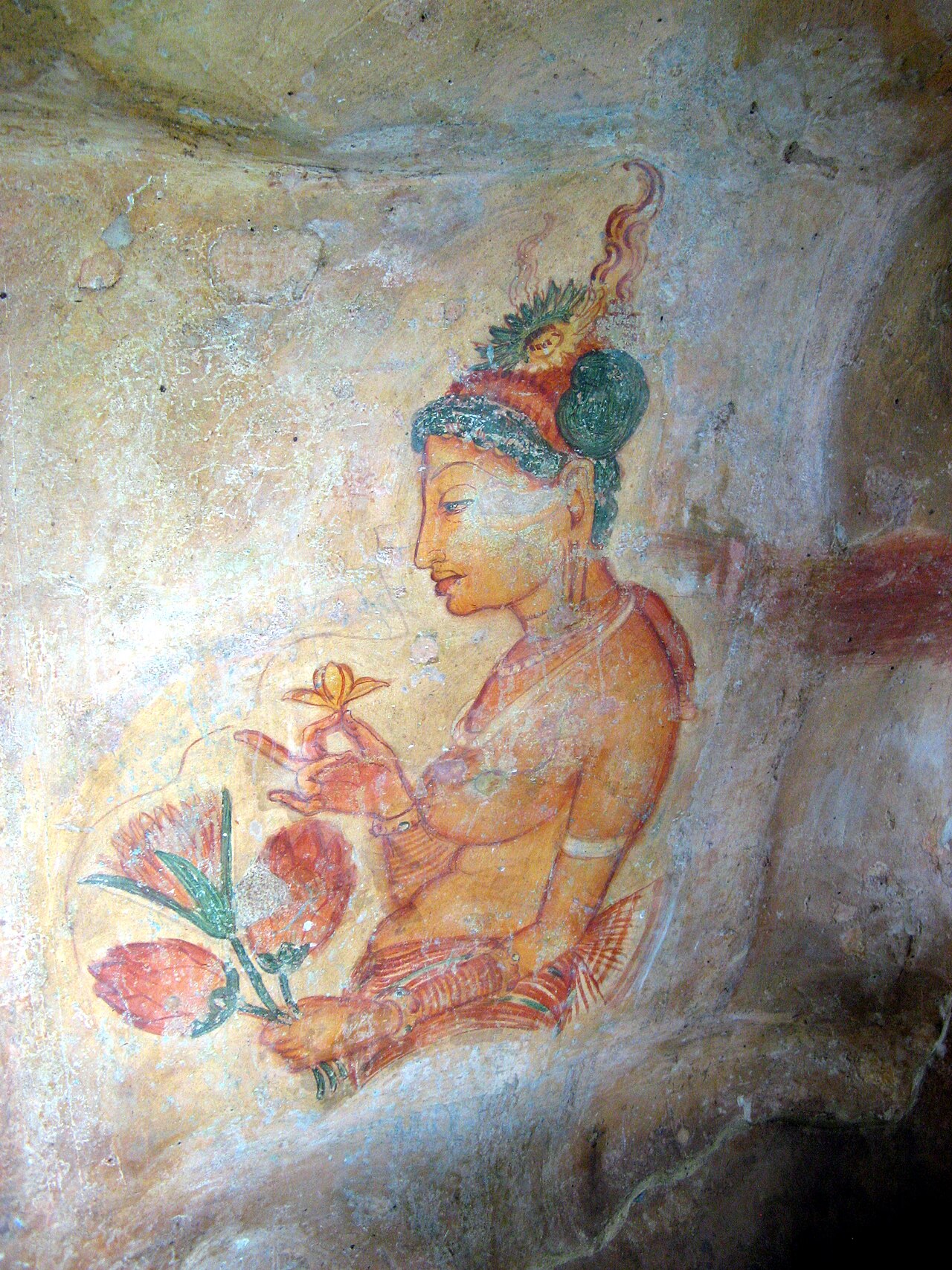
Halfway up the western face, a spiral stair reaches the fresco gallery: paintings of women in gold and blue-gray tones, waist-up in cloud, that are among the masterpieces of ancient South Asian art. Of the original painted band — perhaps 500 figures across 460 feet (140 m) of rock — 21 survive in their sheltered pocket. The path then runs along the Mirror Wall, a plaster surface once polished until the king could see his reflection in it, now covered in more than 1,800 pieces of graffiti left by visitors between roughly the 6th and 14th centuries — poems to the maidens, and the world's oldest fan mail. At the Lion Staircase the route passes between two colossal brick-and-plaster paws, all that remains of a gateway lion whose head travelers once entered through; the Sinhala name Sinhagiri, Lion Rock, comes from here.
The summit is the revelation: a broad flat plateau of palace foundations, pools and a great tank, an entire royal city at 1,150 feet (350 m) above the sea with the jungle unrolling to the Knuckles range. Allow two and a half to three and a half hours for the round trip, and spend the ticket's included museum first or last: its models decode the hydraulics and the palace layout that the foundations alone won't explain. Then cross the valley. Pidurangala, 1 mile (1.5 km) north, is the older monastic rock — entry about LKR 1,000 (roughly US$3) at its temple, cash — and its flat summit at sunset is where the postcard view lives: Sigiriya standing out of the green, lit orange, exactly as Kashyapa's enemies saw it.
Picture the place
The fresco maidens emerge from painted cloud at eye level, gold-skinned, lotus buds in their hands — and the 21st-century spiral staircase hangs in the air beside them, so you meet 1,500-year-old faces at the distance of a conversation.
The easily missed detail
The graffiti on the Mirror Wall is not vandalism but evidence: over 685 distinct visitors have been identified in the inscriptions, including twelve women, some traveling from the island's far corners between the 6th and 14th centuries. Sigiriya has been a tourist attraction, with reviews, for more than a thousand years — and the reviews are carved into the attraction.
A practical rhythm
- Morning — The full climb at opening: gardens, frescoes, Mirror Wall, Lion's Paws and a slow circuit of the summit before the descent.
- Midday — The site museum in the cool, then back to the village for rice and curry and the pool.
- Sunset — Pidurangala across the valley, up by about 4:30 p.m., for the fortress in evening light and the monkeys on the descent.
What could complicate the plan
The climb is about 1,200 steps with steep, open-sided metal sections — a genuine obstacle for vertigo or bad knees, and slick after rain. Fresco photography is prohibited in the gallery, strictly and for conservation reasons. The site ticket is single-entry and single-day, so the museum must be fitted inside the same day; and official guides are optional despite what the entrance touts insist — tickets are only legitimate from the Central Cultural Fund counter or its e-ticket portal.
What to do next
Sleep in Sigiriya village within walking distance of the gate, and keep the Dambulla Cave Temple — UNESCO's other Triangle site 10 miles (16 km) away — for the following morning rather than squeezing both climbs into one heat.
Sources
- UNESCO World Heritage Centre — Ancient City of Sigiriya, inscribed 1982 under criteria (ii), (iii) and (iv); the palace of King Kashyapa I (477–495 CE) on a rock rising about 180 m
- Sigiriya's documented features — 21 surviving fresco figures from an original band of perhaps 500; more than 1,800 graffiti inscriptions on the Mirror Wall dating from the 6th to 14th centuries; about 1,200 steps on the ascent
- Central Cultural Fund — the site ticket includes the Sigiriya Museum, is single-entry and valid for the day of issue
- Pidurangala Royal Cave Temple — entry about LKR 1,000 in cash at the temple, the rock standing 1.5 km north of Sigiriya