Solomon Islands country guide Places and experiences
What should a first-time traveler see in Solomon Islands beyond the obvious highlights?
The short answer
Marovo Lagoon, the world's largest saltwater lagoon; Tetepare's conservation island; Malaita's artificial islands and shell-money workshops; East Rennell, the planet's largest raised coral atoll; and the Toa Maru at Gizo: the Solomons beyond Guadalcanal are the Pacific's least-visited great archipelago.
The answer, with local context
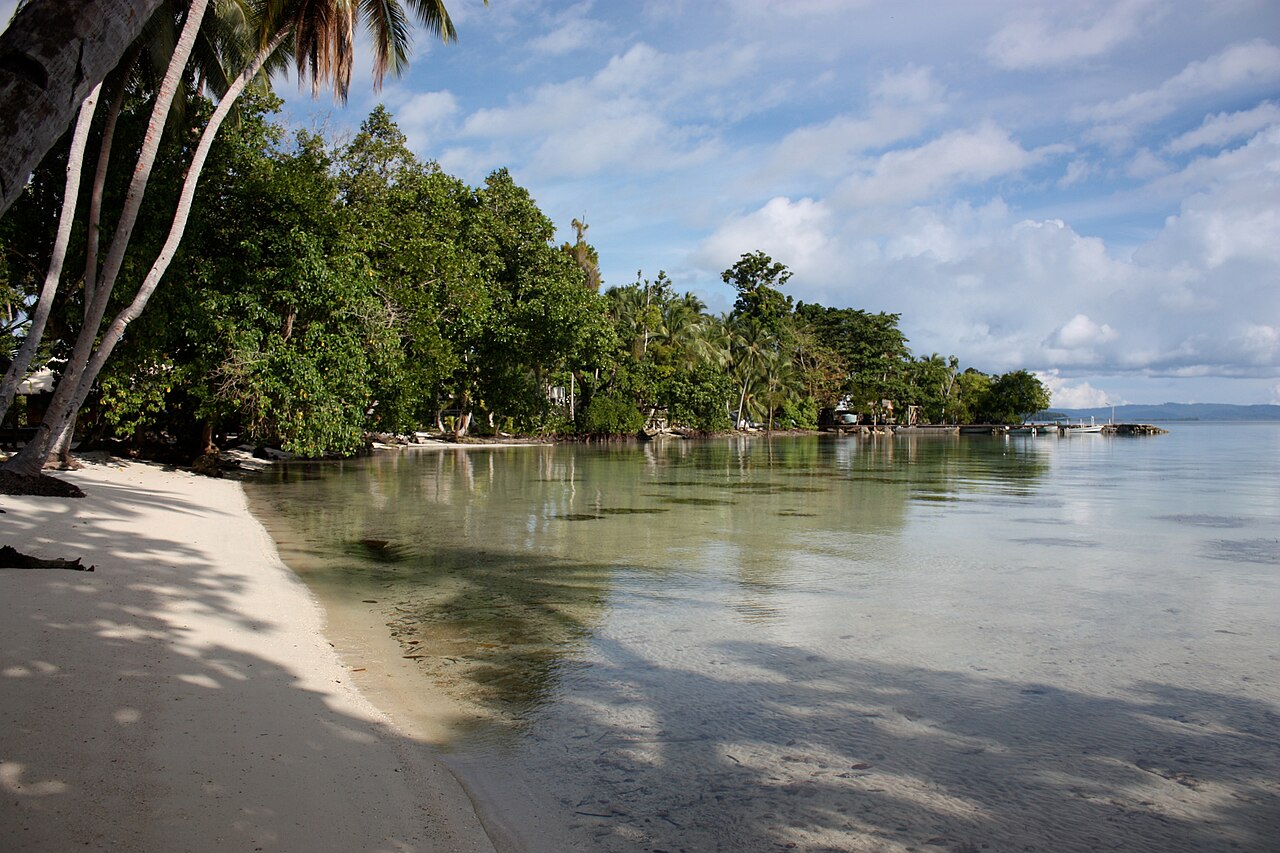
Measure the country first: roughly 900 islands strung 1,500 km from the Shortlands to the Santa Cruz group, 28,400 km² of land, a provisional 721,455 people counted on census night in November 2019, 70+ languages, and provincial worlds so distinct that "the Solomons" is a plural noun in practice. The western register is the watery masterpiece: Marovo Lagoon on New Georgia's northeast — the world's largest saltwater lagoon, roughly 700 km² of double-barrier reef enclosing island-dotted water of improbable calm — holds the dive-snorkel-kayak heartland (Uepi Island Resort at the lagoon's mouth is the classic base) and some of the Pacific's finest woodcarving villages. Just south, Tetepare Island — the largest uninhabited tropical island in the South Pacific (about 25.5 km²) — is run by the Tetepare Descendants' Association as a conservation island with an ecolodge: leatherback turtles nest on its black beaches, dugongs graze its seagrass, and the mystery of why its people left in the 19th century (headhunting fear is the usual telling) hangs over empty village sites in the forest. Roviana Lagoon at Munda adds Skull Island (the shrine of ancestral chiefs' skulls, visited with local custodians' permission) and the Kennedy story at nearby Kasolo Island — the reef where the wrecked PT-109's crew swam in August 1943, now signed as Kennedy Island, a short boat ride from Gizo town, the west's easy-going capital of dive shops and market mornings.
Eastward the register changes to ceremony and craft. Malaita's Langa Langa Lagoon is built — literally: its people constructed artificial islands on the reef flats over centuries (some still growing), living on stone platforms above the water, and the lagoon villages remain the heartland of shell-money manufacture, drilling and stringing the discs that still settle bride-price and compensation across the country. Auki, Malaita's capital, is fly-in simple; the lagoon is a boat-and-guide day beyond it. Then the far south: Rennell Island, the world's largest raised coral atoll (86 km long), whose southern third is East Rennell, UNESCO-listed in 1998 as a natural property (37,000 ha, criterion ix) and the first World Heritage site held under fully customary ownership — Lake Tegano, its brackish heart, is the largest lake in the insular Pacific (15,500 ha), full of endemic species. It is also a site in honest difficulty: on the Danger List since 2013 (logging pressure, invasive rats), damaged by the 2019 Solomon Trader oil spill at Kangava Bay, reachable only by small plane to Tigoa and village arrangement. Go informed, go gently, or admire it as a reason the country's conservation story matters. Between the poles sit the dive capitals' catalogues — the Toa Maru (a 6,700-ton transport, among the world's great wreck dives, off Gizo), the Florida Islands' Twin Tunnels and Cathedral Caverns off Tulagi (the old capital), Leru Cut's light-shaft swim in the Russells, and Mborokua (Mary Island) for pelagic walls — and Honiara's own second look: the National Museum, the Art Gallery's carvings, and the central market's Saturday abundance.
Picture the place
Marovo at dawn from Uepi's jetty: the lagoon flat as poured glass to a horizon of barrier islands, a dugout sliding out with 1 fisherman standing to paddle, and no other wake anywhere.
The easily missed detail
Kastom governs access in the Solomons as completely as fa'a Samoa does in Samoa, with its own grammar: beaches, reefs, skull shrines and even some dive sites sit under customary ownership, fees are paid to landowners and custodians (small, in SBD cash), and photography of shrines and ceremonies follows the custodian's word — the ecolodges and dive operators function as cultural brokers as much as hoteliers, which is why booking through them is the etiquette, not just the logistics. The second detail is the Solomons' signature sound: panpipe bands and the carved slit-drums belong to village celebrations that visitors encounter by arrangement, and the string-band and panpipe music of the islands (a living tradition, not a performance genre) is what a village evening actually sounds like.
A practical rhythm
- West for a week — Seghe (for Marovo/Uepi) or Munda/Gizo as 1 base, Tetepare or Skull Island as day trips
- Malaita as the cultural day — Auki in, Langa Langa by boat with a guide, out the next morning
- Rennell only with time — A dedicated expedition of 4+ days, community-arranged, weather willing
What could complicate the plan
Everything here is boat-and-plane country with thin schedules: Seghe, Munda and Gizo take a handful of flights a week, Tetepare is a boat from Rendova's villages or Munda in fair weather only, and East Rennell's Tigoa airstrip service is the country's most weather-vulnerable — build the west as 1 base with radial days, never as a chain of 1-night stands. Malaria runs through every province in this answer (the west's lagoon resorts spray and net, but prophylaxis remains the traveler's own job) and health care outside Honiara is clinic-level — evacuation insurance underwrites the whole archipelago. Customary access can close without appeal (a death in a landowning family can shut a site or a beach for days; the operator absorbs the reshuffle, the independent traveler absorbs the loss). Cash is the country's true currency outside Honiara's hotels (SBD, small notes; ATMs are Honiara, Auki, Gizo and Munda on a good day), and December's homecoming crush fills domestic flights with Solomon Islanders — a lovely month to be in the country and a hard one to move around it.
What to do next
Base the west at Seghe or Munda for 6–7 nights, let the lodge broker every customary visit, and leave Rennell for a second trip done properly.
Sources
- UNESCO World Heritage Centre — East Rennell (inscribed 1998, criterion ix; 37,000 ha; Lake Tegano 15,500 ha, the insular Pacific's largest lake; first customary-owned natural property; Danger List since 2013)
- Tourism Solomons — Marovo Lagoon (the world's largest saltwater lagoon); Tetepare Descendants' Association conservation island; Skull Island; Kennedy Island; the Toa Maru wreck
- Solomon Islands National Statistics Office — a provisional count of approximately 721,455 people, against a census reference night of 24 November 2019 (release dated 16 November 2020)