Split / Croatia Things to do
What are the most worthwhile things to do in Split on a first visit?
The short answer
Live inside Diocletian's Palace for a day — Peristyle, cathedral-mausoleum, basement halls, Gregory of Nin — then take the city outward: Marjan hill, Bačvice beach, the ferries to Brač and Hvar, and the Roman ruins of Salona and fortress of Klis.
The answer, with local context
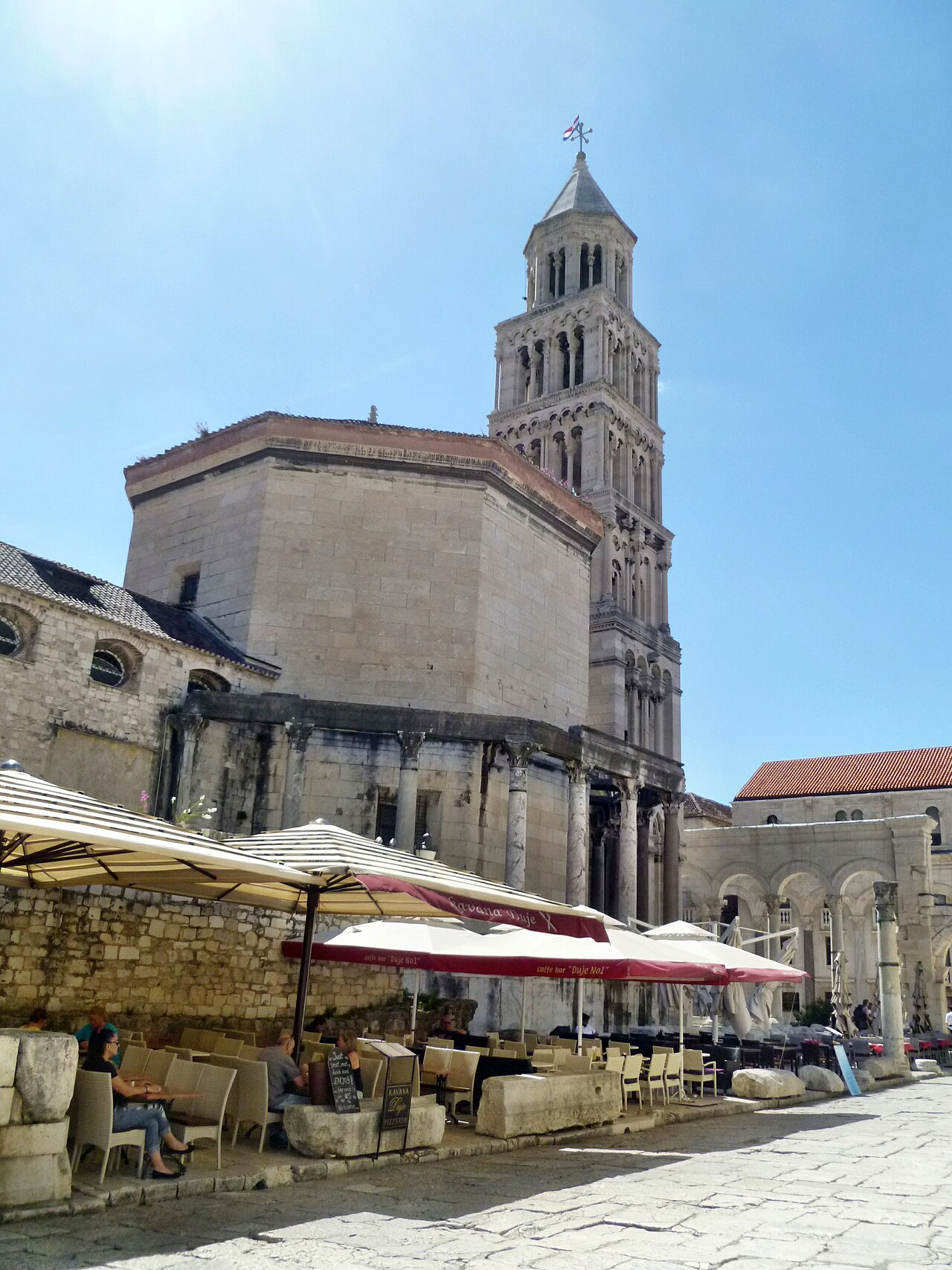
Everything begins with the palace, because Split is not a city with a Roman ruin — it is a Roman retirement palace with a city inside it. Diocletian, the emperor who abdicated in AD 305, built his fortified villa on this bay (roughly 705 by 590 feet — 215 by 180 m — walled), and when he died the palace became the town: some 3,000 people still live within its walls, washing lines across imperial arcades, cafés in the barracks. The UNESCO-listed circuit (inscribed 1979) runs vertically through time. At its center, the Peristyle — the palace's ceremonial court, red granite columns, an Egyptian sphinx Diocletian imported (one of a set now some 3,500 years old) still on guard — faces the building's great joke of history: Diocletian's own mausoleum, converted in the seventh century into the Cathedral of St Domnius, among the world's oldest cathedrals in continuous use inside its original Roman fabric (the saint it honours was a bishop Diocletian executed). Climb the bell tower (57 m, raised in stages from the 1100s) for the palace's whole geometry.
Below, the basement halls (the Podrumi) mirror the vanished imperial apartments above them — vaulted, cool, half-buried for centuries, which is why they survived (television's dragon-keeping cellars in Game of Thrones, but the archaeology is better than the fiction). At the Golden Gate, the palace's ceremonial entrance, stands Meštrović's Gregory of Nin (1929): rub the bronze toe, as everyone does, for luck. Then the living city: the Riva's café theater, the Pazar green market east of the walls, the Peškarija fish market in its secessionist hall, and the Veli Varoš fishermen's quarter climbing west. The Meštrović Gallery — the sculptor's own villa and atelier on the Marjan shore, holding his life's work — is the old town's essential second museum.
The second act is the city's green and blue margin. Marjan, the forested hill (protected since 1964, peak Telegrin at 178 m) west of the harbor, is Split's lung: pine paths, hermit chapels cut into the cliff, the Jewish cemetery of 1573, and the swimming coves (Kašjuni, Bene) along its shore. Bačvice, the sandy bay east of the port, is the social beach — picigin in the shallows, beach bars, the New Year swim for the brave. And Split is Dalmatia's ferry port: Brač (50 minutes to Supetar, then Zlatni Rat beach at Bol) and Hvar (an hour by catamaran) are day trips in season; Klis fortress (the Ottoman-era stronghold in the pass above the city, another Game of Thrones Meereen) and Salona (the Roman provincial capital's amphitheatre and necropolis at Solin, 3 miles inland) are the half-day excursions. Trogir, a UNESCO island-town 30 minutes west, completes the circuit for those with a third day.
Picture the place
The Peristyle at 8 a.m.: the sphinx in first sun, a café waiter chalking the day's board among Diocletian's columns, and two grandmothers crossing the emperor's courtyard with market bags.
The easily missed detail
The palace has a voice: at noon on the Peristyle, costumed "Diocletian's guards" stage the changing ceremony, but the quiet marvel is the Vestibule — the domed, open-to-the-sky rotunda between the Peristyle and the imperial apartments — where klapa singers (Dalmatia's a cappella tradition, UNESCO-listed intangible heritage) test its acoustics through the day; wait for a group and listen from the center, where the dome throws a single voice into a choir. The companion detail is under the cathedral: Diocletian's mausoleum kept its pagan emperor's porphyry solemnity — the Christians who converted it changed the dedication, not the architecture — making the cathedral the palace's most intact room and its sharpest irony.
A practical rhythm
- Palace basement first — The Podrumi entry orients everything above it; the halls also stay cool at noon
- Marjan by morning, coves by afternoon — The hill's paths are shadeless at the top; swim at Kašjuni on the way down
- Ferries booked the day before — Catamarans to Hvar sell out on summer weekends; the car ferry to Brač is the forgiving alternative
What could complicate the plan
The palace is a living town, which means its monuments keep residents' hours and temperaments: the cathedral closes to sightseers for Mass and weddings, the Peristyle hosts concerts that fence the court, and the famous lanes are also someone's commute — August midday compresses all of it into a slow river of people. The bell tower's stairs are steep, narrow and honest about vertigo. Island day trips hinge on the last catamaran home (miss it and Hvar's hotel prices become your problem), and Klis/Salona need a car or bus planning. Give the palace two passes — a guided morning for the structure, a wandering evening for the life — rather than one dutiful march.
What to do next
Start tomorrow in the basement halls, climb the bell tower before the heat, and put a Brač ferry on the trip's sunniest forecast.
Sources
- UNESCO World Heritage List — Historical Complex of Split with the Palace of Diocletian (inscribed 1979)
- Split City Museum / Diocletian's Palace basement halls — the palace built for Diocletian's retirement (abdicated AD 305), its dimensions and the substructures
- Cathedral of St Domnius, Split — the converted mausoleum, among the oldest cathedrals in an original Roman structure; the 57-metre bell tower
- Jadrolinija — ferry and catamaran times to Brač (Supetar) and Hvar; Marjan Forest Park (protected 1964)