Split / Croatia Food and drink
Where should I eat in Split, and which local food or drink is worth trying?
The short answer
Soparnik, the protected pastry of the Poljica region just east of the city — registered across the EU as a Protected Geographical Indication by Commission Implementing Regulation (EU) 2016/526 of 30 March 2016.
The answer, with local context
The registration covers 3 names for the same thing: Poljički soparnik, Poljički zeljanik and Poljički uljenjak. The European Commission classified it in Class 2.3 — bread, pastry, cakes, confectionery, biscuits and other baker's wares — on an application submitted by Croatia. All 3 registered forms carry the adjective Poljički, which ties the name to the Poljica rather than to Split, and it is the one baked dish in the city's own hinterland whose name is legally protected rather than simply traditional.
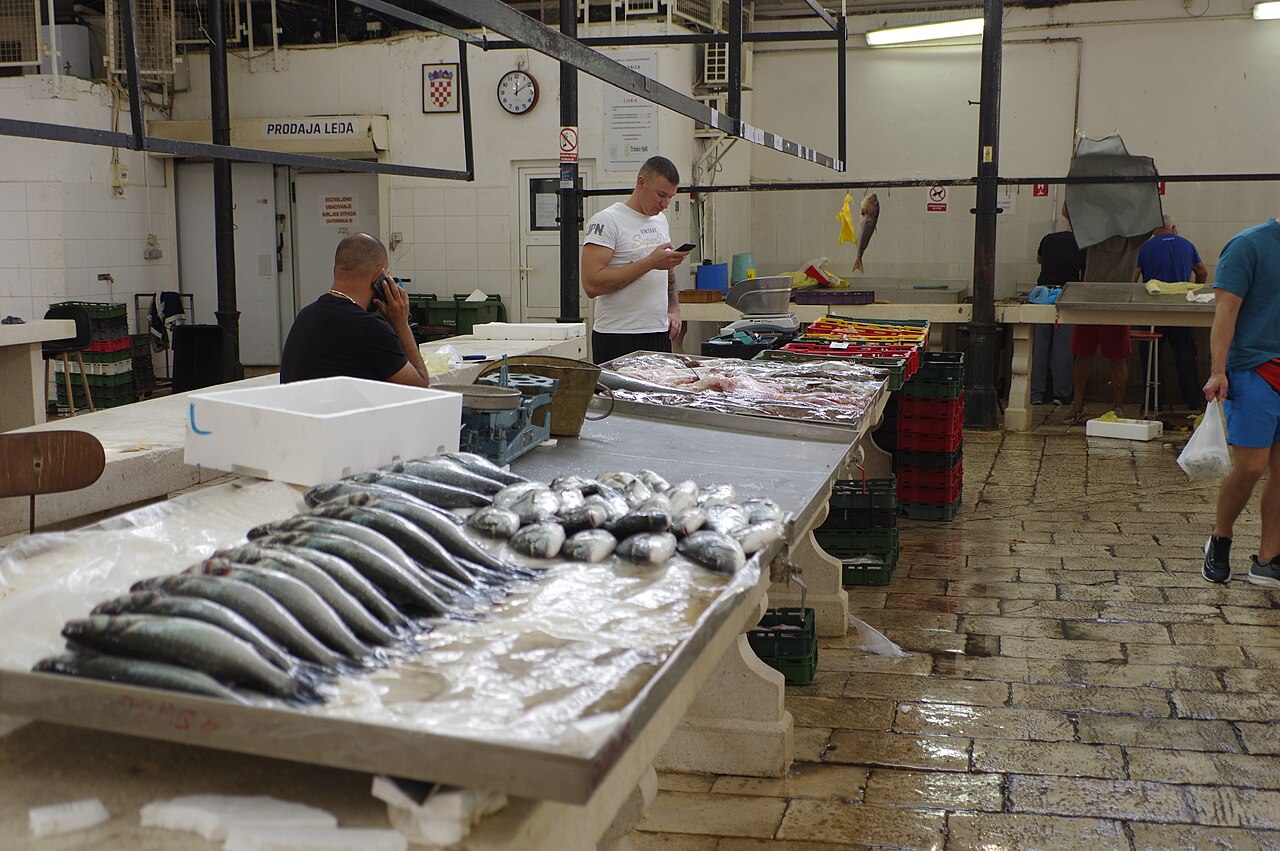
The other half of eating in Split happens at the Fish Market. The city's tourist board lists what comes in: sprats, picarels, sardines and mackerel at the everyday end, and red scorpionfish, dentex, red porgy, sea bass and lobster at the expensive end. The hall itself was built over 120 years ago in Secession style. That split between the cheap small pelagic fish and the costly reef and bottom species is the real structure of a Dalmatian menu, and a restaurant price that looks startling usually reflects which half of the list it came from.
Vegetables arrive separately. The Pazar, the open-air market pressed against the east wall of Diocletian's Palace around the Church of St Dominic, is where the produce side of a Split kitchen is bought.
Picture the place
The Fish Market is a Secession-style hall that the city's tourist board treats as an architectural monument in its own right — a building more than 120 years old, still doing the single job it was put up for, with the morning's catch running from sprats at one end of the slab to lobster at the other.
The easily missed detail
The protected name is geographical in the strictest sense: it belongs to the Poljica, not to Split. A soparnik eaten in the city is therefore a Poljica product on sale away from home, and the registration — made under the EU quality scheme and published as Implementing Regulation 2016/526 on 30 March 2016 — attaches to that territory rather than to the city selling it.
A practical rhythm
- Buy at the Pazar — The open-air market against the palace's east wall is the produce end of the city's food.
- Choose at the Fish Market — Sprats, picarels, sardines and mackerel on one side; red scorpionfish, dentex, red porgy, sea bass and lobster on the other.
- Ask for the protected name — Poljički soparnik, Poljički zeljanik or Poljički uljenjak are the 3 registered forms of the same PGI.
What could complicate the plan
The registering regulation describes the product only by name and class; it publishes no composition, no geographical boundary description and no production method in its own text, so there is no official source that will tell you what a correct soparnik should weigh or contain. The second constraint is volume. The Croatian Bureau of Statistics recorded 3,860,446 arrivals and 18,436,939 nights in Split-Dalmatia County during 2025, published on 26 February 2026, and the city's restaurants sit inside a historic quarter whose inscribed core is 20.8 hectares (51.4 acres). In July and August, evening tables in that area are effectively a rationed resource.
What to do next
The Split things-to-do answer in this group covers the palace quarter the Pazar leans against; the when-to-visit answer gives the early-May civic festival when the markets are busiest with locals rather than visitors.
Sources
- European Commission, Commission Implementing Regulation (EU) 2016/526 of 30 March 2016 — the Poljički soparnik PGI, its 3 registered names, product class and applicant country
- Tourist Board of the City of Split, Markets — the Fish Market's age and style, the species sold, and the Pazar's location
- Croatian Bureau of Statistics, Tourist arrivals and nights in commercial accommodation, 2025 — county arrivals and nights and the publication date
- UNESCO World Heritage Centre, Historical Complex of Split with the Palace of Diocletian — the inscribed core-zone area