Tbilisi / Georgia When to visit
When should I visit Tbilisi, Georgia, for the best experience?
The short answer
September — 80°F (27°C) average highs with under 5 rain days on the 1991–2020 normals, the summer heat broken, the rtveli grape harvest beginning in Kakheti, and Tbilisoba, the city's own festival, waiting on the first weekend of October.
The answer, with local context
Tbilisi's climate has an unhappy spring and a glorious autumn, and the 1991–2020 normals draw the contrast precisely. The rain comes early in the year: May carries the most rain days of any month (10.4), June the most rain by volume (3.3 inches, 84 mm), and the wet stretch runs April through June, exactly when the temperatures turn inviting. Summer then dries out but overshoots — July and August each average 22 days at 86°F (30°C) or above, with August's mean high at 90°F (31.9°C) and warm nights that barely relieve the stone city. Winter is genuinely cold and gray, January's high just 45°F (7.1°C).
September is the month the curves cross. The mean high falls to 80°F (26.7°C), the low to a pleasant 61°F (15.9°C), and rainfall drops to 1.4 inches (34.8 mm) on fewer than five rain days — the driest warm month of the year. The Mtkvari gorge turns its first autumn colors, the outdoor tables that define Tbilisi's evenings are still all open, and the crowds of August have gone. October is the close second: 68°F (20.2°C) highs, a little more rain (1.8 inches, 46 mm), and the harvest in full swing.
The calendar argues for arriving late in the month. Rtveli, the grape harvest, rolls through Kakheti — an hour and a half east — from mid-September into October, when the qvevri wines of the new vintage begin and every cellar door is open. It is a state-coordinated season as well as a social one: the agriculture ministry runs a Harvest Coordination Headquarters that about 300 registered wine companies join in stages as reception begins, with Dedoplistskaro and Sighnaghi the busiest municipalities — which is also a map of where to drive for it. And on the first weekend of October, Tbilisoba takes over Rike Park, Orbeliani Square and the old town: the city festival held since 1979, with regional food stalls, folk dance, concerts and the honorary-citizen ceremony, all free. A trip spanning the last days of September into that weekend gets the best weather of the year and the best party of the year in one booking.
Picture the place
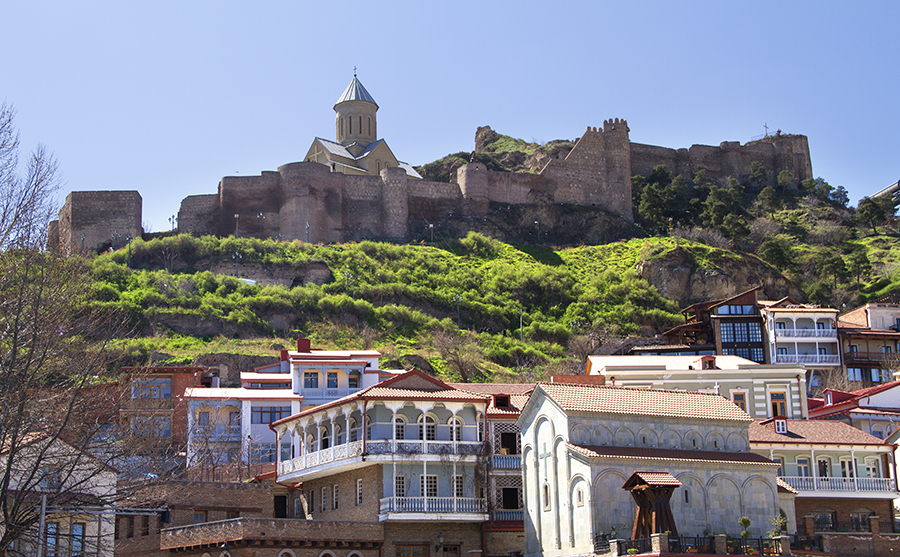
A late-September evening in the old town: the carved balconies glow amber, the Narikala floodlights come on above the bathhouse domes, and every café table on Shardeni Street is full — the city dining outside in shirtsleeves, in no hurry at all.
The easily missed detail
Tbilisi's name is a weather report. The city was founded, in the legend, where King Vakhtang Gorgasali's falcon fell into a hot spring in the 5th century — tbili means "warm" in Georgian, after the sulfur springs that still feed Abanotubani's baths. The springs run all year (the baths are a winter pleasure too), but the autumn visitor gets the warm city at its warmest-hearted season.
A practical rhythm
- Morning — The old town and the cable car in the clear early light, before the day warms.
- Afternoon — The National Museum's gold rooms and a long lunch in the shade of Sololaki's courtyards.
- Evening — The baths at Abanotubani, then dinner outside — September is supra season at full stretch.
What could complicate the plan
September is the connoisseur's choice and no longer a secret: the best old-town hotels book out around Tbilisoba weekend, and Kakheti's harvest lodgings go earlier still. Georgia's politics have periodically filled Rustaveli Avenue with demonstrations in recent years; they are typically peaceful and localized, but check the current UK FCDO advisory before travel and give any march its street. And the first cold rain of autumn usually arrives sometime in October — the festival weekend is the gamble's edge, not its center.
What to do next
Book the last week of September into the Tbilisoba weekend, stay in the old town or Sololaki, and put one day aside for a Kakheti harvest run to Telavi and the Alazani valley.
Sources
- World Meteorological Organization — the 1991–2020 climate normals for Tbilisi: September mean high 26.7°C (80.1°F), low 15.9°C (60.6°F), rainfall 34.8 mm on 4.9 rain days; May the most rain days (10.4), June the wettest by volume (84.0 mm); August mean high 31.9°C (89.4°F) with about 22 days at 30°C or above in July and August; January mean high 7.1°C (44.8°F); 511.5 mm of rain a year
- Tbilisi City Hall / Tbilisoba — the city festival held since 1979, fixed since 2018 on the first weekend of October (October 3–4 in 2026), across Rike Park, Orbeliani Square and the old town, and free to attend
- Georgian National Tourism Administration — rtveli, the Kakheti grape harvest, running mid-September into October
- Ministry of Environmental Protection and Agriculture of Georgia — the Kakheti harvest coordinated through a state Harvest Coordination Headquarters with about 300 registered wine companies joining grape reception in stages, the Dedoplistskaro and Sighnaghi municipalities most active (the notice gives a September 6 cutoff but prints no year, so its tonnages are not quoted here)