United Arab Emirates country guide When to visit
When is the best time to visit United Arab Emirates for Dubai?
The short answer
November through March, when Dubai's average highs sit near 76°F (24°C) in January rather than the 105°F (41°C) of August — and when Ras Al Khor Wildlife Sanctuary, the Ramsar-listed wetland inside the city, holds more than 20,000 waterbirds.
The answer, with local context
The Emirates run on one long seasonal switch. Rain is scarce and concentrated between December and March, with the annual total staying under four inches across most of the country, and the summer months bring both extreme heat and heavy humidity off the Gulf. The practical consequence is that almost everything worth doing outdoors in the UAE — the dunes of Liwa, the Hajar mountain roads of Ras Al Khaimah, the Gulf of Oman beaches on the Fujairah side — is comfortable in the same five-month window.
For Dubai specifically, the winter window is also the wildlife window. Ras Al Khor Wildlife Sanctuary sits at the inland end of the 14-kilometer Dubai Creek and was designated Ramsar Site no. 1715 on 29 August 2007, covering 620 hectares. In winter it regularly supports more than 20,000 waterbirds across 67 species, and counts of more than 3,000 greater flamingos have been recorded there. That is a rare thing: a wetland of international importance a short drive from a central business district, and it is only at its fullest in the cooler half of the year.
Inland, the same months open up the older of the country's two World Heritage properties. The Cultural Sites of Al Ain are a serial listing of 17 components covering the Hafit, Hili and Bidaa Bint Saud areas and the oases, inscribed under criteria (iii), (iv) and (v) for continuous settled occupation of a desert region since the Neolithic. Circular stone tombs there date to around 2500 BC, and Hili holds one of the oldest known examples of the aflaj irrigation system, traced to the Iron Age. Walking an oasis at 105°F is a different proposition from walking one at 76°F.
One moving target sits inside the winter window. Ramadan follows the lunar calendar and shifts roughly eleven days earlier each year, which changes restaurant hours and the rhythm of the day rather than the weather.
Picture the place
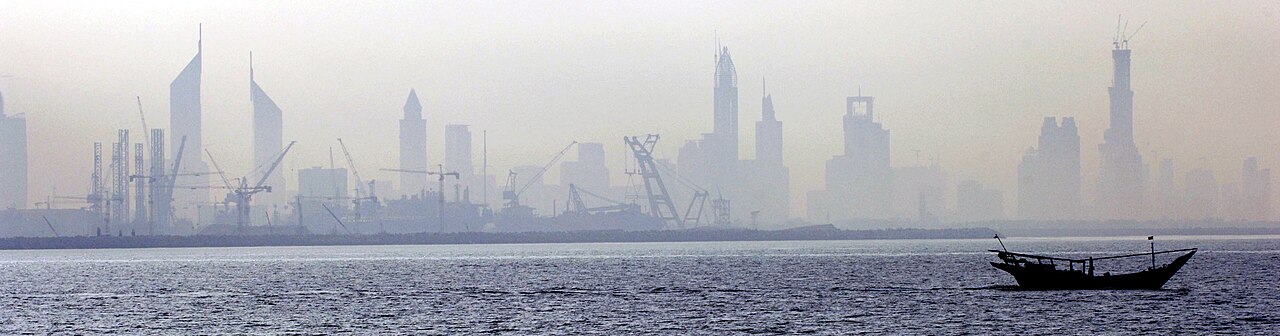
In January the Creek water is cool enough that the flamingos stand in it for hours, and the mudflats at Ras Al Khor dry pale and crack between tides while the towers behind them stay in haze. Out at Al Ain the oasis channels run shaded under date palms, and the temperature difference between the palm cover and the open gravel outside it is immediate.
The easily missed detail
Ras Al Khor is a staging ground on the East African–West Asian Flyway, and some of its most interesting traffic is not the winter residents but the passage birds. Broad-billed sandpipers move through in autumn and spring, and more than one percent of the regional population uses the site during those migrations. If your interest is birds rather than warmth, late autumn and early spring beat midwinter.
A practical rhythm
- Early morning — The flamingo hides at Ras Al Khor face the water, and the light is behind you rather than in your eyes before the heat builds.
- Midday in winter — This is the only season when midday outdoors is comfortable in the UAE; spend it in the Al Ain oases or on the east coast rather than indoors.
- Evening — Sunset comes early in December and January, which shortens the useful day considerably compared with June.
What could complicate the plan
This is the decisive point for anyone booking now. The US Department of State has the United Arab Emirates at Level 3, Reconsider Travel, issued 3 March 2026. On 2 March 2026 the Department ordered non-emergency US government employees and US government family members to leave the UAE because of the threat of armed conflict. The advisory records that hostilities between the United States and Iran began on 28 February 2026, cites an ongoing threat of drone and missile attacks from Iran, and notes that Iran has publicly stated it intends to target UAE locations associated with the United States. It also reports significant disruptions to commercial flights, and the Federal Aviation Administration has issued a NOTAM recommending caution for US air carriers and commercial operators across the Middle East, including the UAE. Separately, the CDC's Global Measles notice, a Level 1 practice-usual-precautions notice dated 28 May 2025, names the UAE among affected destinations.
What to do next
Read the Emirates trip-planning question in this chapter for entry rules, passport conditions and the exit-ban trap, and the places question for what the country holds outside its best-known city.
Sources
- US Department of State, United Arab Emirates Travel Advisory — advisory level, issue date, ordered departure, flight disruption and FAA NOTAM
- Ramsar Sites Information Service, Ras Al Khor Wildlife Sanctuary — site number, designation date, area, waterbird and flamingo counts, flyway and passage species
- UNESCO World Heritage Centre, Cultural Sites of Al Ain — serial components, criteria, tomb dating, aflaj
- US Centers for Disease Control and Prevention, travel health notices — Global Measles notice level and date
- UAE National Center of Meteorology climate normals — monthly temperature averages and annual rainfall distribution