United States country guide Trip planning
How can I plan a memorable first trip to United States without rushing?
The short answer
Choose two or three regions, not ten states: the country is 3.8 million square miles with a 46,876-mile Interstate system, so the unrushed first trip gives each base three or four nights and lets one region — not the whole republic — be the trip.
The answer, with local context
The scale is the whole problem, so put numbers on it first. The Census Bureau measures the United States at about 3.80 million square miles; the Federal Highway Administration puts the Interstate system alone at 46,876 miles; New York to Los Angeles is roughly 2,790 miles by air-route distance on the map and more than 40 hours of pure driving on the road. A first trip that tries to "do" New York, the Grand Canyon, Yellowstone and California in ten days spends its middle in airports and its evenings apologising to the places it reached. The fix is geographic discipline: pick one anchor region done deeply (the Northeast corridor, the Southwest's parks, the Pacific Northwest, the Deep South with New Orleans) or two regions joined by a single flight, and treat the rest as the reason for the second trip — which travelers who pace the first one almost always take.
Pacing has mechanics. Three to four nights per base turns arrival days into something other than losses and gives every place a second morning — the morning you know where the coffee is. Long transfers belong in the middle of the day-count, never stacked at the end, and the itinerary should alternate intensities: a museum city day after a driving day, a park's big hike before its scenic-drive day. The park layer needs its own forward planning: the Park Service's America the Beautiful annual pass (since January 1, 2026 priced at $80 for US residents and $250 for nonresidents, covering entrance fees at federal recreation sites for a year) pays for itself across a multi-park route, while the busiest parks layer timed-entry reservations and activity lotteries, booked on Recreation.gov, on top of entry — the reservation calendar, set months out, is the true skeleton of a western parks trip. Amtrak is the slow alternative with real coverage (its network reaches 46 states), and on corridors like the Northeast it is also simply the fastest city-center-to-city-center option.
Leave the plan porous on purpose. Book the spine — flights, first and last hotels, park passes, the one restaurant that needs a month — and leave one unplanned half-day per base, because the memorable material of American trips (a small-town diner detour, a ranger talk, a thunderstorm clearing over a canyon) is disproportionately unbookable. Administrivia rewards the same calm: foreign visitors should confirm their visa or ESTA status with the State Department well ahead, US domestic flyers have needed REAL ID-compliant identification since May 7, 2025 (the Department of Homeland Security's deadline), and everyone should price the trip in total — car hire, park fees, city hotel taxes — rather than by the flight that looked cheap.
Picture the place
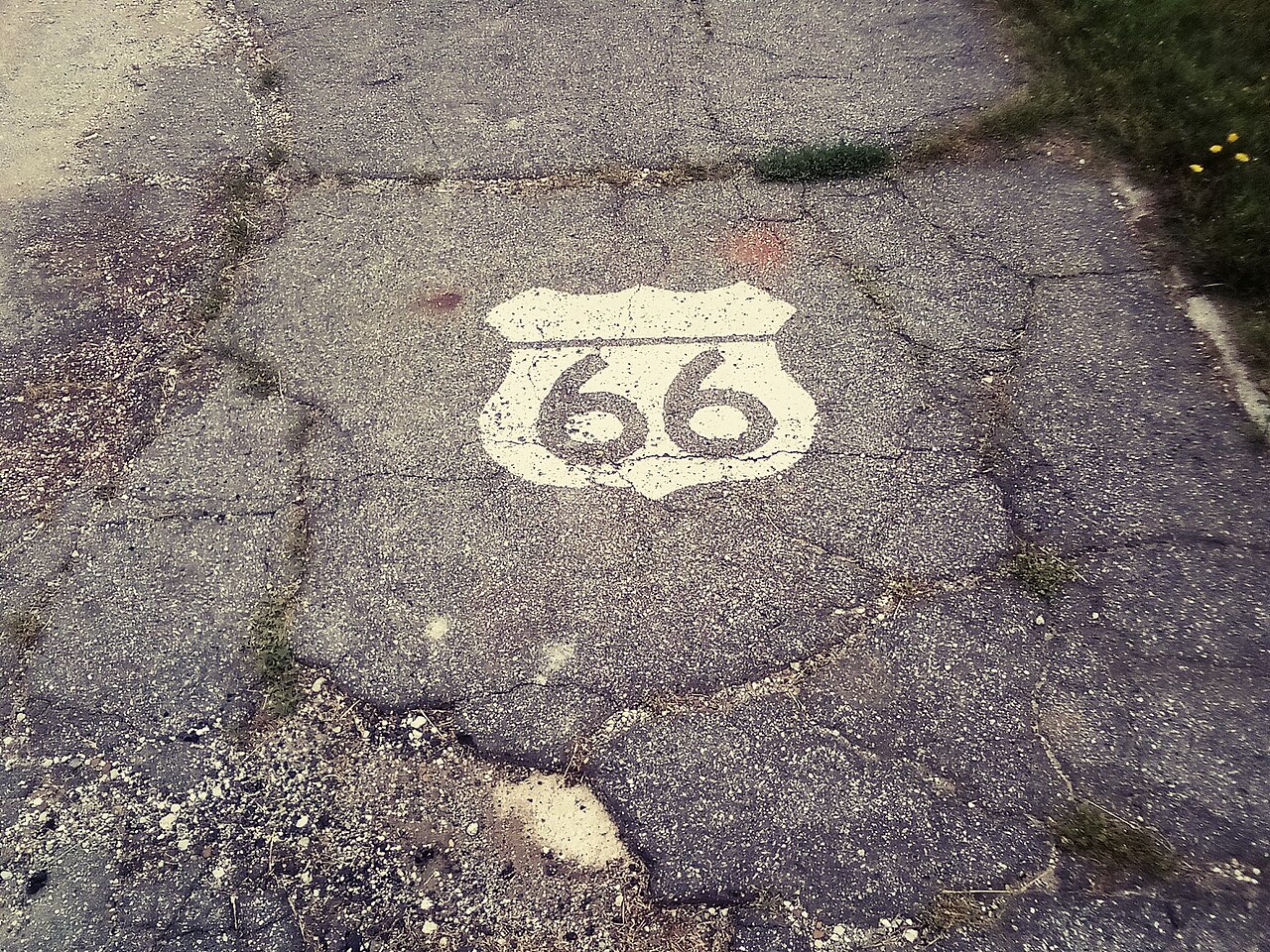
Late light on a two-lane section of old Route 66 in Oklahoma: the narrow Ribbon Road running straight between fields, nobody behind you, and the day's only remaining appointment a diner pie in the next town.
The easily missed detail
The most common pacing error is not distance but time zones and check-out arithmetic: a "short" two-hour flight from Chicago to Denver lands across a zone line, eats a connection, a car-hire queue and a two-hour ground transfer to the mountains, and consumes the day the itinerary had labelled "afternoon in Aspen". Build every inter-region move as a full travel day in the plan, then enjoy it when it comes in under budget. The second quiet trap is Sunday and holiday America: small-town museums close early or entirely on Mondays, national-park fee-free days (residents only since 2026) spike the famous parks, and Thanksgiving week is a domestic travel summit best simply avoided.
A practical rhythm
- Two regions, maximum — One done deeply, or two joined by one flight; everything else formally postponed
- Three nights minimum per base — Arrival, a full day, a second morning: the smallest unit that feels like being somewhere
- Spine booked, days porous — Passes, timed entries and the hard reservations fixed; one half-day per base deliberately empty
What could complicate the plan
Park access rules now move faster than guidebooks: from January 1, 2026 nonresidents pay a $100 per-person fee on top of standard entry at 11 of the most visited national parks unless covered by the $250 nonresident annual pass, and resident fee-free days no longer extend to them — a multi-park budget must be built from the Park Service's current fee pages, not from a previous trip's memory. Weather is the other planner: hurricane season (June–November) in the Southeast, winter road closures at the northern parks from October, and desert heat above 110°F (43°C) in summer can each delete a leg, so every long route deserves a named alternative day, not a shrug.
What to do next
Draw your first trip as two shaded regions on the map, count the travel days as spent days, and book the park passes and timed entries before the hotels.
Sources
- US Census Bureau — the Interstate System's 46,876 miles
- US National Park Service / Department of the Interior — the America the Beautiful pass structure from January 1, 2026 ($80 residents, $250 nonresidents) and the nonresident fee at 11 major parks
- US Department of Homeland Security — its 46-state network
- US Department of State — visa and Visa Waiver Program (ESTA) entry requirements