United States country guide When to visit
When is the best time to visit United States for New York?
The short answer
Mid-September to late October — the country's summer crowds and heat fall away, the national parks and eastern forests color up, and in New York itself the NOAA normals deliver the year's most walkable weeks: Central Park averages highs of 76°F (24°C) in September easing to 65°F (18°C) in October.
The answer, with local context
A country with six state time zones, an Arctic territory in Alaska and coral cays in Florida has no single perfect month, but autumn comes closest to a national consensus. After Labor Day (the first Monday of September, the informal end of the American summer) the big-ticket machinery relaxes everywhere at once: national-park traffic drops from its July–August summit, the desert Southwest cools toward hiking temperatures, New England and the Appalachians run their foliage season from late September in the northern forests to late October further south, and the Gulf and South become pleasant rather than punishing. September and October are also the hinge of the festival calendar — harvest in wine country from Napa to the Finger Lakes, the Albuquerque International Balloon Fiesta in early October (first flown in 1972), state fairs across the farm belt. Travel in this window and the nation is simultaneously at its most scenic and its least queued.
Now anchor it in New York, because the city runs its own version of the same season, slightly delayed. NOAA's 1991–2020 climate normals for the Central Park station put July's average high at 85°F (29°C) with heavy humidity, and January's at 40°F (4°C); by contrast September (76°F / 24°C) and October (65°F / 18°C) are the two months built for a walking city of five boroughs. Central Park — 843 acres laid out to Frederick Law Olmsted and Calvert Vaux's Greensward Plan, which won the design competition in 1858 — is the season's theater, and Manhattan's urban heat means the city's own foliage typically peaks later than upstate New York's, often from late October into early November, tracked tree by tree on the Central Park Conservancy's fall foliage map. The calendar stacks around it: the US Open finishes at Flushing Meadows in early September (the tournament has played there since 1978), the New York Film Festival runs from late September into October at Lincoln Center (founded 1963), Broadway's autumn season opens its new productions, and the city's museums mount their flagship exhibitions after the summer lull.
The practical arithmetic favours the window too. Flights and hotels sit between the summer premium and the December ceiling, the timed-entry attractions that sell out in July breathe again, and the same weeks let a traveler bolt a foliage drive up the Hudson Valley or a flight to a western park onto the New York stay without fighting peak season at either end. If the trip must be one season only, this is the one where both the anchor city and the country behind it are showing their best side at the same time.
Picture the place
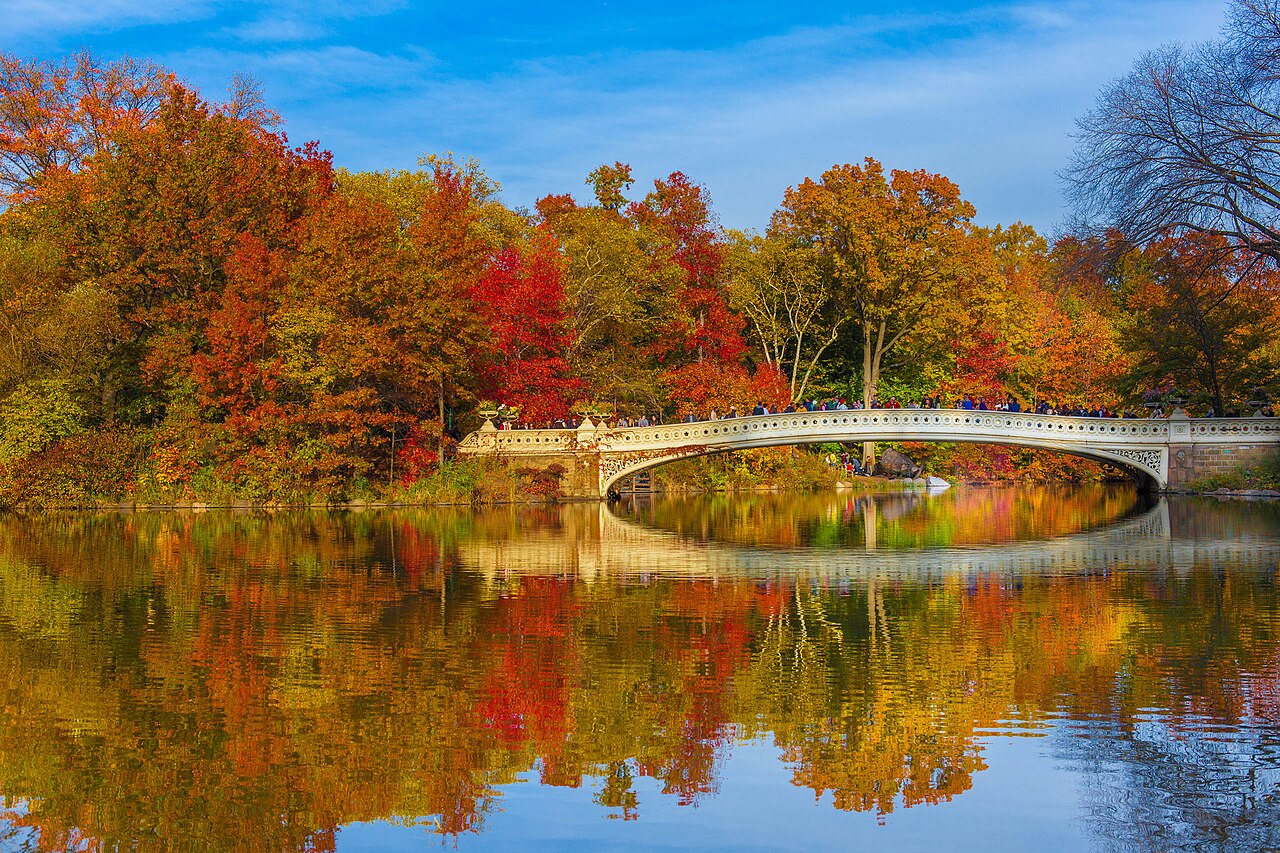
Bow Bridge in late October: the lake glassy, the elms and oaks along the Ramble turned copper and gold, rowboats still out, and the Midtown towers standing in clear, low light beyond the trees.
The easily missed detail
The season's late starter is the city itself: visitors who time a mid-October trip for peak color in Central Park often arrive a week or two early, because Manhattan's heat island delays its foliage behind the Hudson Valley's — the Conservancy's foliage map, not a national foliage calendar, is the document to watch. The second timing trap is the first Sunday of November: the New York City Marathon (run since 1970, with more than 50,000 finishers in recent editions) delivers one of the year's great street parties and some of its highest hotel rates on the same weekend.
A practical rhythm
- City first, foliage second — New York in mid-to-late September warmth, then the Hudson Valley or New England as color builds
- Weekdays in Manhattan — Museums and observation decks from Tuesday to Thursday; the parks own the weekend
- One bolt-on region — A single add-on (a western park, the foliage north) rather than a coast-to-coast sweep in the same weeks
What could complicate the plan
The Atlantic hurricane season runs officially from June 1 to November 30 (NOAA), peaking around September 10 — early-autumn itineraries touching Florida, the Gulf Coast or the Carolinas carry a real, if shrinking, storm risk that New York mostly escapes. Foliage is a forecast, not a date: a warm September can push color a fortnight later, and the state tourism office I LOVE NY publishes weekly foliage reports through the season precisely because the peak moves. Finally, October's holiday weekend (Columbus Day / Indigenous Peoples' Day, the second Monday) is a domestic travel surge hiding inside the quiet season.
What to do next
Fix New York for the second half of September into October, check the I LOVE NY foliage report in the week before you travel, and book the timed-entry headliners once the dates are set.
Sources
- NOAA / National Weather Service — the 1991–2020 Central Park climate normals (September 76°F, October 65°F average highs) and the Atlantic hurricane season dates (June 1–November 30)
- Central Park Conservancy — the park's 843 acres, the 1858 Greensward Plan, and its fall foliage map
- USTA — the New York Film Festival (founded 1963)
- New York Road Runners — the New York City Marathon, first run 1970, held on the first Sunday of November