Varanasi / India When to visit
When should I visit Varanasi, India, for the best experience?
The short answer
Mid-to-late November — the monsoon is months gone from the ghats, the summer heat has broken, and the calendar crests on November 24, 2026, when Dev Deepawali lights the riverfront with millions of earthen lamps between Assi Ghat and Raj Ghat.
The answer, with local context
Varanasi's year has three weathers, and the groundwater survey of the district puts the first one plainly: about 90 percent of the year's rain falls in the southwest monsoon, June to September, which floods the lower ghats until the steps themselves go underwater and the boat city shuts down. The summer that precedes it is among the harshest urban heats in India — May is the district's hottest month, and the loo winds make the old city's lanes a furnace by ten in the morning. Winter is the city's true season, and November is its hinge: the rain has stopped, the river falls back to reveal the full staircase of ghats, and the morning mist that December and January thicken into fog is still mostly atmosphere rather than obstacle.
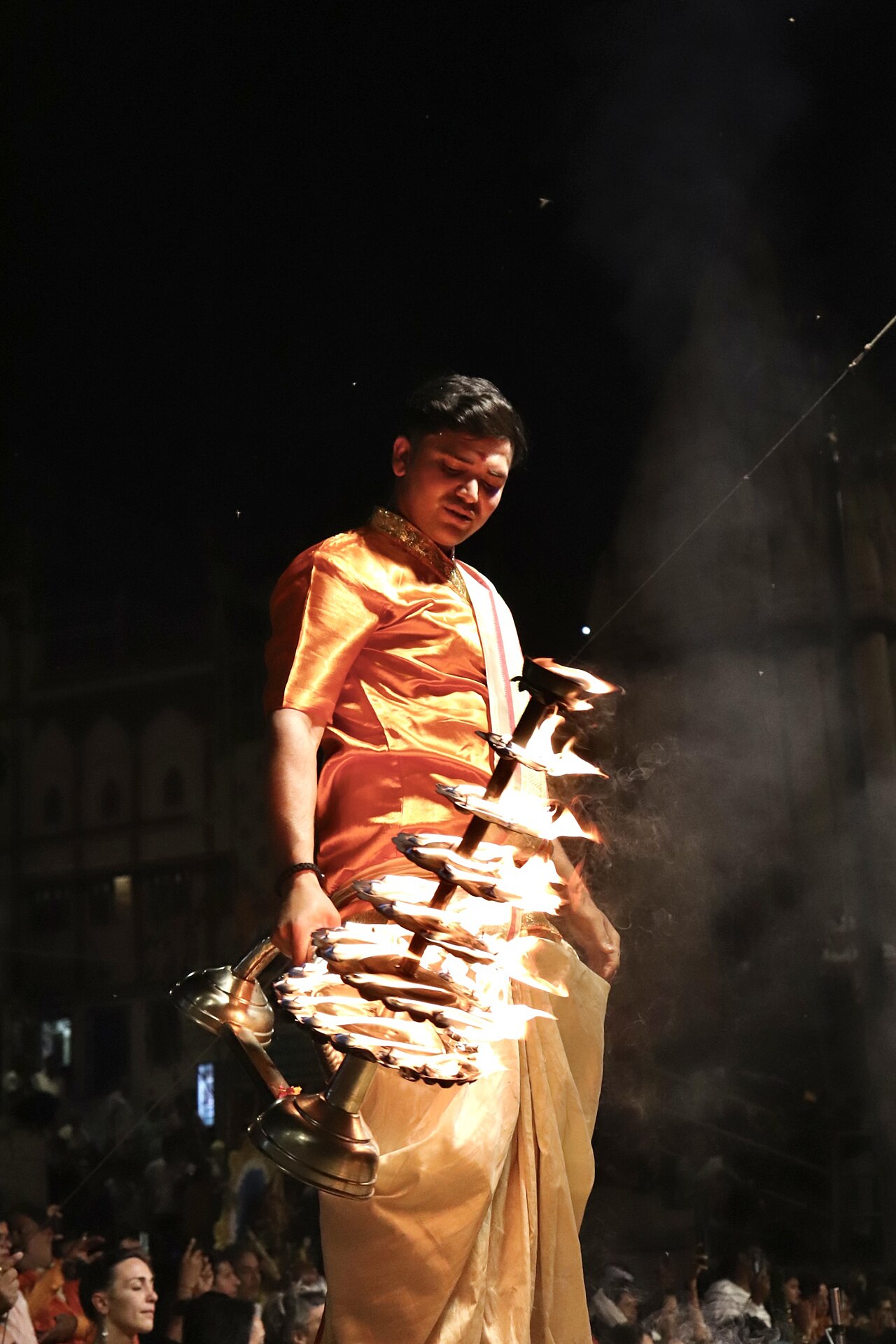
The festival calendar stacks the month deliberately. The holy month of Kartik fills the pre-dawn river with bathers and the ghats with sky-lamps on bamboo poles, and it closes on Kartik Purnima, the Kartik full moon, which in 2026 falls on November 24 — 15 days after Diwali. That night is Dev Deepawali, the Diwali of the gods, when millions of earthen diyas are lit along the ghats in commemoration of Shiva's victory over the demon Tripurasura; the stretch officially given for watching them runs from Assi Ghat to Raj Ghat, priests perform the Ganga Aarti in lamp-light, and most visitors take the whole crescent in from a boat. It is the single most spectacular night of the Indian year to be standing on this riverfront, and it falls in the year's best weather almost by design.
November brings two food seasons with it. Malaiyyo — the saffron milk foam that exists only in the cold months, roughly November to February, set overnight in the dew and gone by nine in the morning — starts its season. So does chooda matar, the winter breakfast of flattened rice and green peas. A November arrival eats the city at its richest, in its kindest weather, at its greatest festival, all at once.
Picture the place
Dev Deepawali at dusk: every step of every ghat carrying its row of flames, the lamplight running unbroken around the river's crescent for miles, boats standing off in the dark water, and the whole old city behind you smelling of mustard oil and marigold.
The easily missed detail
Book the fortnight before the festival, not the night itself, if crowds worry you — Kartik's daily rituals (the pre-dawn baths, the akash deep sky-lamps at Tulsi Ghat, the evening aartis growing larger night by night) deliver most of the atmosphere with a fraction of the crush, and Dev Deepawali can be watched from a boat booked days ahead as the finale rather than fought for on the steps.
A practical rhythm
- Morning — On the river at dawn every day; November's light is the city's second festival.
- Afternoon — The old city's lanes and Sarnath in the soft post-lunch hours, when the ghats rest.
- Evening — The aarti at Dashashwamedh nightly; on November 24, a pre-booked boat for the lamps.
What could complicate the plan
North India's winter air is the month's asterisk, and the published scale is worth carrying: an Air Quality Index of 101 to 150 is rated unhealthy for sensitive groups, 151 to 200 unhealthy and 201 to 300 very unhealthy, the federal health guidance is that anyone with asthma, COPD or heart disease should limit strenuous or prolonged outdoor activity when the index is poor, and a dust mask or bandana gives only limited protection where an N95 or P100 respirator does the work. The same guidance counts incense and candle smoke as exposure — a note worth reading twice in a city of censers and oil lamps — and haze on some sunrises is simply part of the season. Dev Deepawali week fills every hotel and jacks every boat price — the festival is the reason to come and the reason to book months early. And December–January's fog, when it arrives, cancels trains and delays flights across the Gangetic plain, one more argument for November over the deeper winter.
What to do next
Arrive through Lal Bahadur Shastri International Airport or 1 of the city's 5 railway stations, target November 20–26, 2026 — Kartik's full moon and Dev Deepawali inside one stay — stay in the old city near Assi or the southern ghats, and reserve the festival-night boat before the hotel.
Sources
- Central Ground Water Board, Ground Water Brochure of Varanasi District, Uttar Pradesh — about 90 percent of the district's rainfall arriving in the southwest monsoon from June to September, and May as the hottest month (the brochure gives two different annual rainfall totals and three humidity figures, so none is quoted here)
- Ministry of Tourism, Government of India (Incredible India), Dev Deepawali in Kashi — Dev Deepawali on 24 November 2026, celebrated on Kartik Purnima 15 days after Diwali, millions of earthen diyas seen along the span from Assi Ghat to Raj Ghat, the Ganga Aarti, boat viewing, and the commemoration of Shiva's victory over Tripurasura (source credited to Uttar Pradesh Tourism)
- US Centers for Disease Control and Prevention, CDC Yellow Book 2026, Air Quality and Ionizing Radiation During Travel — the Air Quality Index bands (151–200 unhealthy, 201–300 very unhealthy), the advice that travelers with asthma, COPD or heart disease limit strenuous outdoor activity when the index is poor, the limited protection of dust masks against N95 or P100 respirators, and incense and candle smoke counted as exposure