Wadi Rum / Jordan Things to do
What are the most worthwhile things to do in Wadi Rum on a first visit?
The short answer
A full-day Bedouin jeep circuit — Khazali Canyon's petroglyphs, the Red Sand Dune, Lawrence's Spring and the rock bridges — one scramble (Um Fruth or Burdah), a camel ride at dawn, and a night in a Bedouin camp under the stars: the complete grammar of the place in 24 hours.
The answer, with local context
Everything begins at the Visitor Centre, because the Protected Area is a managed landscape: JD 5 entry (or the Jordan Pass), registration, and transfer to a Bedouin-operated 4WD — the tours are run by the local Zalabieh Bedouin, and your driver is also your guide, cook and translator of the desert. The center's first sight stands opposite: the Seven Pillars of Wisdom, the massif named for T. E. Lawrence's memoir. The classic circuit then strings the valley's archive. Lawrence's Spring (Ain Abu Ainah), where Lawrence washed during the Arab Revolt of 1917–18, feeds a fig tree in a cliff cleft; the Nabataean Temple nearby carries the valley's older civilization. Khazali Canyon is the treasury: a narrow siq whose shaded walls hold thousands of years of carving — UNESCO's inscription of the Protected Area in 2011 (as a mixed cultural and natural property of 183,970 acres, 74,200 ha) cites some 25,000 petroglyphs and 20,000 inscriptions across the wider site, in Thamudic, Safaitic, Nabataean and Arabic scripts, and Khazali's gallery of human figures, ibex and hunting scenes is where a first-timer reads them best. Anfishiyeh's inscriptions and the Red Sand Dune — a dune banked against a cliff, made for the barefoot climb and the sandboard descent — complete the standard loop.
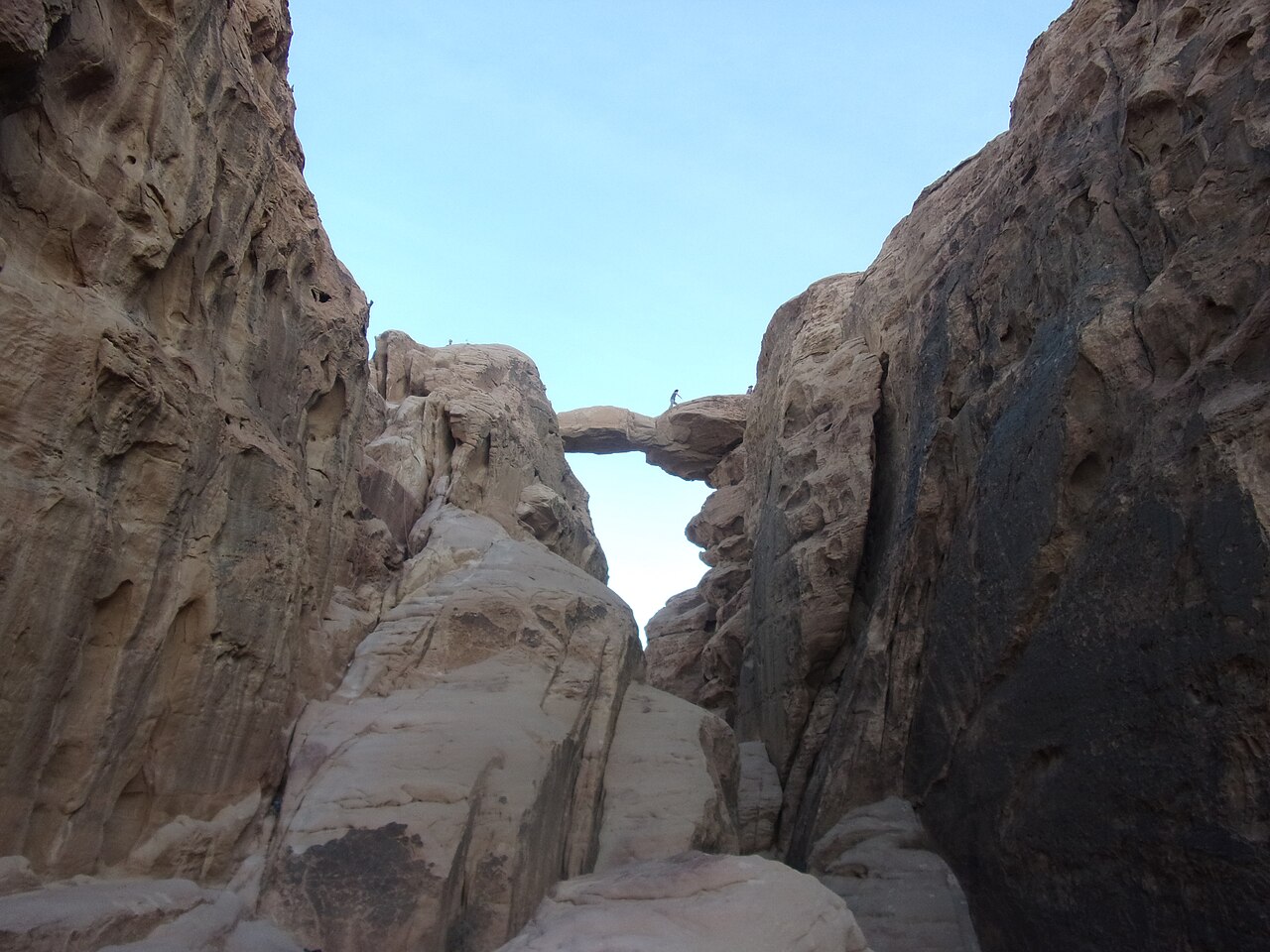
The second tier separates the visits. Um Fruth Rock Bridge, a 50-foot (15 m) arch you can scramble onto for the photograph, is the easy conquest; Burdah Rock Bridge, among the highest natural rock arches on earth at about 115 feet (35 m), is a half-day's guided scramble-and-climb up Jebel Burdah that returns the valley's grandest view. Barrah Canyon, 3 miles (5 km) of shaded corridor, is the walker's canyon — go by jeep to its mouth and walk it with your driver. Climbers come for the other Rum: the sandstone big walls, pioneered in the 1980s, on Jebel Rum (5,754 feet, 1,754 m — Jordan's second-highest summit) and its neighbors; and the country's true highest point, Jebel Umm ad Dami (6,083 feet, 1,854 m), is a drive-and-scramble day on the Saudi border for a second trip. Film fans will keep recognizing the valley: it played Mars for The Martian (2015), Jedha for Star Wars, and itself for David Lean's Lawrence of Arabia in 1962 — the desert that cinema reaches for when a landscape must look unearthly.
Then stay the night; a day trip is a Rum with its soul removed. The camps — permanent Bedouin camps of goat-hair or canvas tents in side canyons, plus the famous geodesic "Martian" domes of the luxury camps — serve zarb at sundown (see the food answer), and after dinner the valley performs its oldest show: no light pollution, the Milky Way structural overhead, and silence of a completeness most visitors have never heard. Wake for the dawn camel ride back toward the village, an hour of the desert at walking pace and first light, and the circuit is closed.
Picture the place
Inside Khazali at midday the canyon is a cool slot of shade; your driver points without ceremony at a wall you have already walked past, and the rock resolves — a hunter, a bow, an ibex, a line of Thamudic letters — twenty centuries of travelers signing the same guest book.
The easily missed detail
The inscriptions are the itinerary's quiet thesis: UNESCO listed Wadi Rum as much for its writing as its scenery — the petroglyphs record 12,000 years of human presence, from Neolithic hunters to the caravans of the incense road. Ask your driver to stop at one unmarked wall; the guides know dozens, and the un-touristed stops are where the valley's time depth lands.
A practical rhythm
- Arrival — Visitor Centre formalities by mid-morning; the classic jeep circuit through the afternoon, ending on the dune at sunset.
- Night — The camp: zarb, music, the sky. Sleep out of the tent if the camp offers bedrolls — October allows it.
- Morning — Dawn camel ride or the Um Fruth scramble, breakfast at camp, and out by the second morning's light.
What could complicate the plan
Only licensed local operators may run tours inside, and the Visitor Centre tariff exists for a reason — book through the center or a camp with a name and reviews, and be wary of operators who intercept cars on the highway before the center (a known route into the wrong desert entirely, outside the Protected Area). Scrambles like Burdah need a guide, a head for heights and morning timing; they are not jeep stops. TwoWD vehicles go no farther than the village. And the desert keeps its hazards plain: no phone signal in much of the reserve, real cold after dark in season, and distances that turn a "walk back" into an emergency — stay with your driver.
What to do next
Book a small Bedouin-run camp for two nights with a full-day jeep tour between them, carry cash in dinars (there is no reliable ATM beyond the Visitor Centre), and let the camp arrange everything from the gate.
Sources
- UNESCO World Heritage List (2011) — Wadi Rum Protected Area inscribed as a mixed property of 74,200 ha (183,970 acres), citing about 25,000 petroglyphs and 20,000 inscriptions recording some 12,000 years of human presence
- ASEZA / Wadi Rum Visitor Centre — entry JD 5 per person (Jordan Pass included), registration required, tours operated by local Bedouin in 4WD vehicles; private cars park at the Visitor Centre or Rum Village
- Wadi Rum landmarks — Khazali Canyon's petroglyph walls; the Red Sand Dune; Um Fruth bridge about 15 m; the Burdah Rock Bridge about 35 m, among the world's highest natural arches; Jebel Rum 1,754 m (5,754 ft); Jebel Umm ad Dami 1,854 m (6,083 ft), Jordan's highest point; film locations for Lawrence of Arabia (1962) and The Martian (2015)